


Donald Trump announced Friday that he’s barring three news organizations, CNN, MSNOW, and Politico, from the White House, accusing them of “purposely” writing “negative news” to “diminish the Republicans and a Republican administration.” He didn’t name a story. He didn’t need to. The point was never a specific grievance.
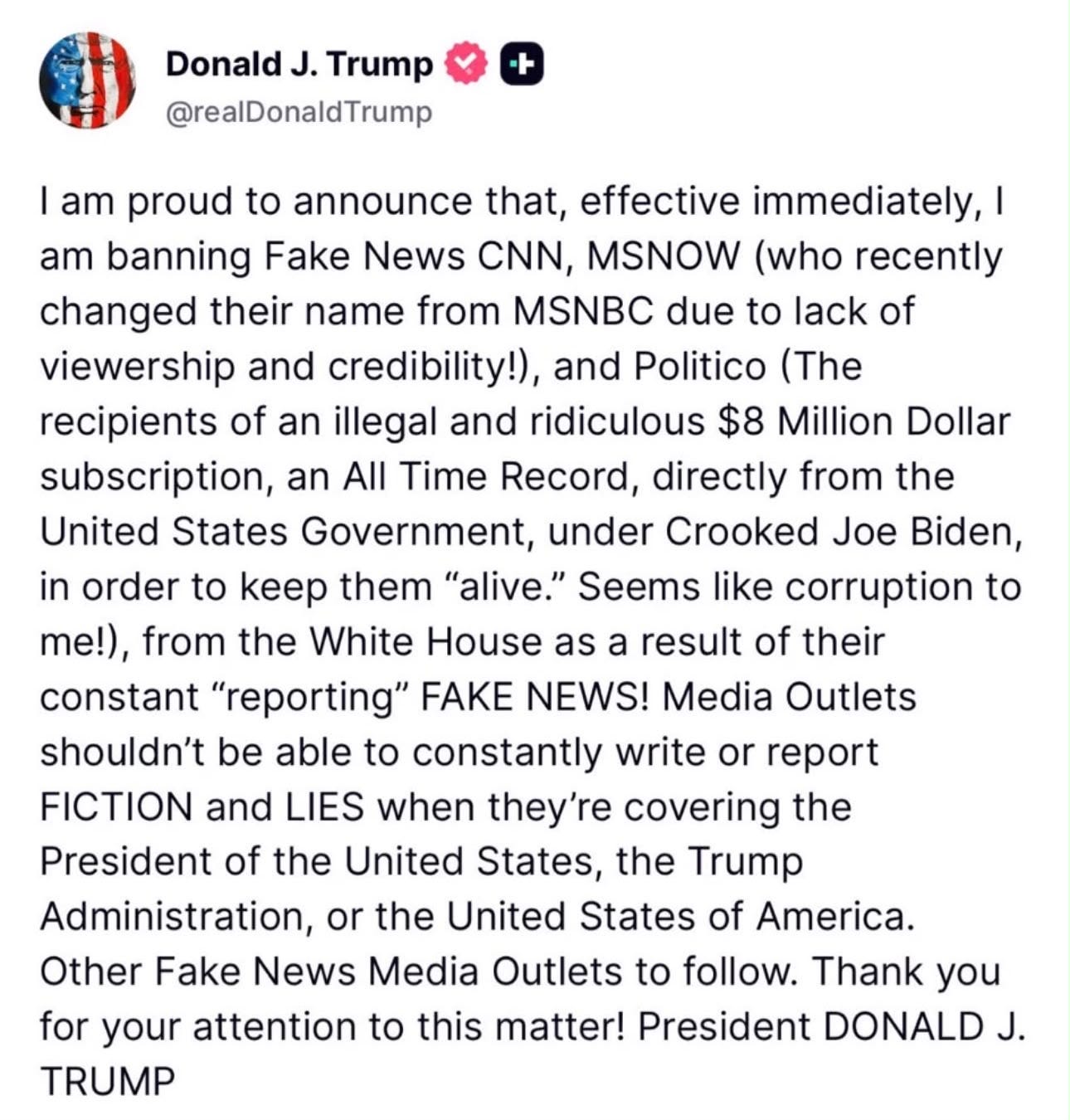
What Trump is trying to do is make the price of a White House press pass taking a de facto loyalty pledge. And that’s why his attacks on the First Amendment are far more serious than the typical complaints you hear from politicians across the political spectrum.
CNN called Trump’s move “an illegal assault on their constitutionally protected right to free speech.” The Freedom of the Press Foundation decried it as a blatant First Amendment violation. Even Ari Fleischer, who spent years as George W. Bush’s press secretary (and has his own checkered record), told Trump to knock it off and try winning the argument instead. When a Republican flack who famously told Americans to “watch what they say” after the 9/11 attacks thinks you’ve gone too far … well, you’ve probably gone too far.
Even the White House Correspondents’ Association (which just hosted a thoroughly embarrassing dinner where Trump repeatedly trashed our profession from a podium they gave him) wouldn’t let this one slide.
WHCA President Jacqui Heinrich, a senior White House correspondent for Fox News (not exactly a bastion of anti-Trump sentiment), called the ban a constitutional breach outright. She noted that Trump himself had described his own planned action, in the Oval Office, as a “ban on the free press.”
“The Constitution protects the freedom of the press from government interference,” Heinrich said. “That protection does not depend on whether the president likes a news organization’s coverage, agrees with its reporting, or approves of the questions its journalists ask.” She added that the WHCA “stands in defense of our colleagues at CNN, MSNOW and Politico who are being singled out for doing their jobs” — a defense that, notably, crossed every ideological line in that briefing room.
On Monday, there was an even more significant show of solidarity, because it hits Trump where it hurts. CBS, NBC, ABC, and even Fox News suspended their TV coverage of him — something the former reality TV star truly cares about. “No administration should restrict a news organization because it objects to its reporting,” they said in a joint statement.
But something has been getting lost in the news cycle. Trump’s ban came on the same day ABC was in federal court fighting another Trump administration onslaught against the free press.
ABC and Disney sued the Federal Communications Commission back in August, arguing that Chairman Brendan Carr’s decision to order early license renewal reviews of eight ABC-owned stations wasn’t oversight. They claimed it was retaliation for content the administration didn’t like, from Jimmy Kimmel’s monologues to The View to the network’s news coverage. On Friday, ABC’s lawyers went further, telling the court there is “substantial evidence” of a Trump “retaliatory motive” behind the FCC’s order.
This abuse of power is a pattern and it’s one of the hallmarks of the second Trump administration. With ABC, the mechanism is bureaucratic with an agency chairman leaning on a broadcast license nobody can actually revoke over network content. The administration made the bet that a publicly-traded company with billions in FCC-regulated assets would decide it’s cheaper to bend than to find out. After all, that’s exactly what ABC did in 2024 by settling a defamation suit with Trump for $15 million.
With Trump banning three outlets on Friday, the mechanism is cruder. The president simply announces that reporters he doesn’t like can’t come to work anymore. It’s the same goal — controlling who gets to cover this administration and how.
This is also, notably, an escalation from Trump’s first term, when he targeted individual reporters. He still does plenty of that now, regularly bashing journalists, especially women, including CNN’s Kaitlan Collins, the New York Times’ Maggie Haberman, and NBC’s Kristen Welker.
But this time, Trump’s also banning entire newsrooms. And his administration is subpoenaing a New York Times reporter’s mother, prodding the FCC to dangle license renewals over Iran coverage, and watching CBS gut 60 Minutes rather than risk Paramount’s merger approval.
After the WHCA dinner, I wrote that Trump’s war on the press is different this time because the rhetoric now comes with government machinery attached. Friday is what that machinery looks like when it stops hiding behind a merger review and just says the quiet part on Truth Social.
Why Trump’s War on the Press Is Different This Time

Donald Trump spent Friday night at a party in his own honor, in a ballroom he built, thrown by the very press corps he’s spent over a decade trying to destroy.
None of this happens in a vacuum, and it doesn’t happen by accident. Carr’s FCC cleared the Nexstar-Tegna merger. Paramount got its Skydance approval within days of paying Trump $16 million to settle a bogus lawsuit. The Pentagon press corps turned in its badges rather than pre-clear its reporting with Pete Hegseth’s office, and got replaced with a lineup of right-wing hacks.
Every one of those episodes taught the same lesson: capitulation gets rewarded, and resistance gets a subpoena, an investigation, or a press ban.
ABC’s lawsuit is worth watching precisely because the network is refusing to capitulate (this time). A company that settled with Trump once, that has every commercial incentive to just make the FCC problem go away, is instead standing in federal court arguing on the record that this White House is retaliating against it for journalism.
That’s not nothing. It’s also significant that the FCC has asked the court to throw the case out — because the alternative is a judge putting Brendan Carr’s actual motives on the record, under oath.
CNN, MSNOW, and Politico made the same bet Monday, filing an emergency lawsuit in federal court in D.C. — not against some faceless agency, but against Trump personally, along with Chief of Staff Susie Wiles, Communications Director Steven Cheung, and Secret Service Director Sean Curran.
The outlets argue the ban violated their First Amendment rights as retaliation for the content of their reporting. They also allege a violation of their Fifth Amendment due process rights, since credentials that CNN’s Betsy Klein, MSNOW’s Akayla Gardner, and Politico‘s Cheyenne Haslett had held for years were confiscated over the weekend “without notice or process.”
Asked in the Oval Office what specific reporting had prompted the ban, Trump couldn’t point to a single story. “It’s really just cumulative stories over the last few years,” he declared. “You get sick of it.” That’s not a legal standard. (That’s also an admission from the president that there isn’t one).
The suit leans on Sherrill v. Knight, the nearly half-century-old precedent barring the White House from denying access based on a reporter’s coverage — the same precedent that got Jim Acosta’s pass restored in 2018 and freelancer Brian Karem’s in 2019.
But last year’s fight over the Associated Press, which was banned after it wouldn’t use Trump’s rebranded “Gulf of America” as the official name, shows how shaky that precedent has become. A D.C. Circuit panel ruled the Oval Office and Air Force One aren’t First Amendment forums at all, meaning Trump can bar whoever he likes from the rooms where the actual news happens. That case is still unresolved more than a year later. So the three outlets are asking a court to enforce a rule the same appeals court has already started carving exceptions into.
I’ve written before that the Founders put the free press first in the Bill of Rights because they’d just fought a war against a king who decided what could be printed. Every president since has hated the media, both fairly and unfairly (because it’s not our job to be loved; it’s about holding the powerful accountable. And yes, sometimes we make mistakes and need to be better about owning up to them).
What’s different about Trump is he’s installed FCC chairman willing to weaponize broadcast licenses and a Department of Justice willing to subpoena a reporter’s family. And now he’s disposing of any pretense that access to the White House is a right. Under Trump II, press access is a favor to the king, which he can revoke by tweet.
The press doesn’t get to decide whether this White House likes us. We only get to decide whether we’re going to do our job for the American people. I can promise you that as long as I’m in charge of Lincoln Square, that’s exactly what we’re going to do.
Keep the ban permanent. Every time he speaks a little bit more in America breaks.
I am so enjoying the mass television media boycott!