


Edwin Eisendrath is the former CEO of the Chicago Sun-Times and Chicago Alderman who hosts It's The Democracy Stupid on Lincoln Square and a weekly radio show on WCPT820AM/ Heartland Signal. Subscribe to his Substack.
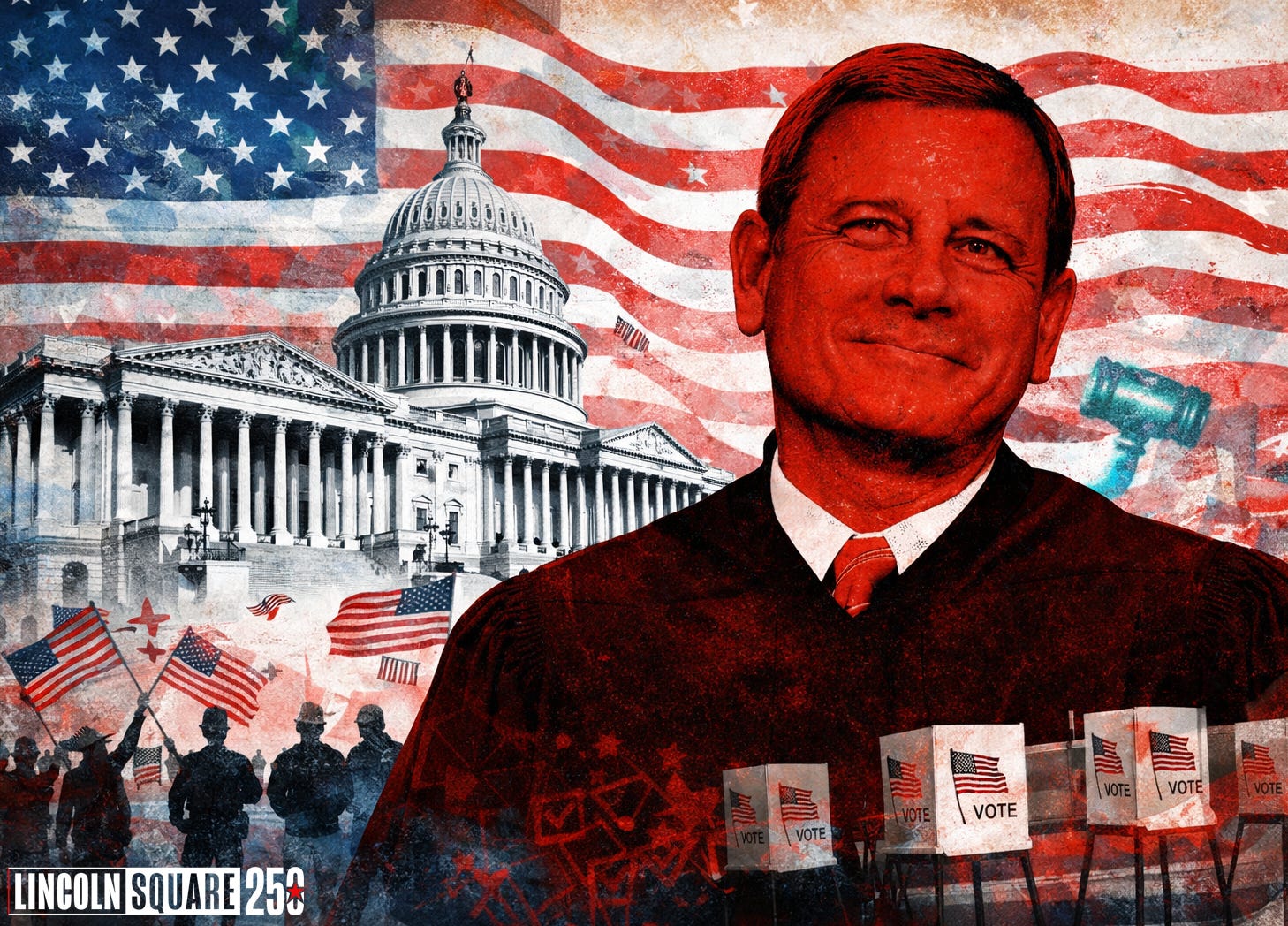
Restraint and tolerance are bedrock principles governing the application of power in a democratic society. For too long, the Roberts Court has jettisoned these principles in favor of a radical revision of our Constitution, and it has done so in league with the Republican Party.
The effects have been on full display these past two years:
Vast unchecked corruption.
The use of appalling militarized force against Americans in our own cities.
The shocking detention of tens of thousands, many of whom have been deported to places where they face indefinite imprisonment or death.
The reckless, unexplained and unauthorized wars launched by a president alone.
A Justice Department that lies in court. A Congress that has surrendered the power of the purse.
The obscene and corrupt abuse of the pardon power. I could go on.
The father of this misery is John Roberts. More than anyone, he helped create this Republican Congress by gutting bipartisan campaign finance rules and undermining nearly unanimous legislative commitment to voting rights. And that Congress, elected with the help of mountains of dark money and radically gerrymandered districts, was ready to follow a president Roberts exempted from our laws.
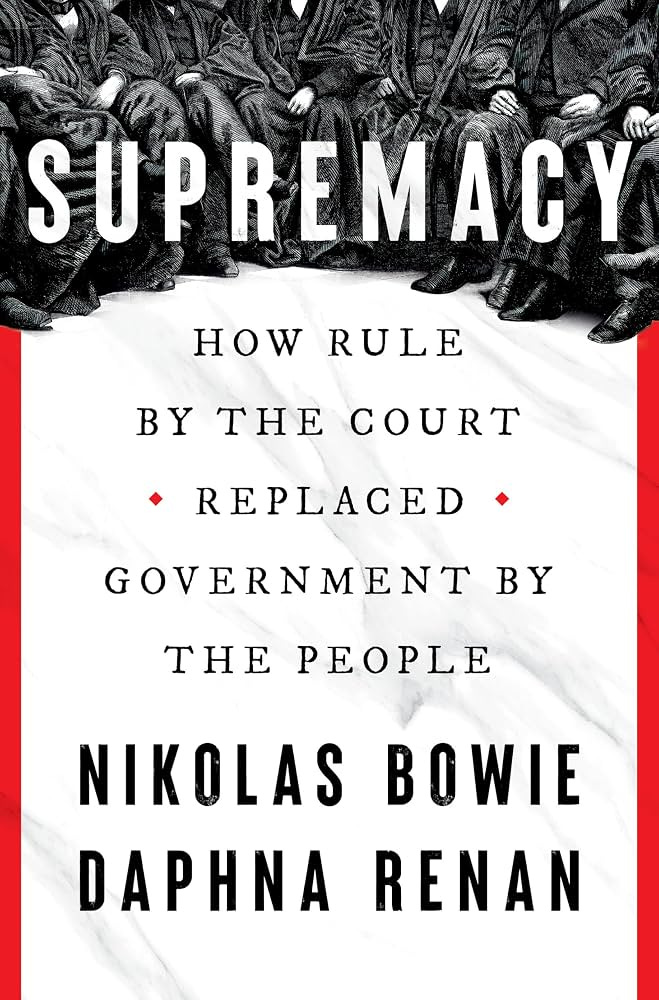
Roberts could do this because of a of the long-held view that the Supreme Court alone decides what the Constitution says. But, as Harvard Law School professors Daphna Renan and Nikolas Bowie argue in their essential new book, Supremacy, How Rule by the Court Replaced Government by the People, our conception of judicial supremacy is an power that the founders did not write into the Constitution.
Abraham Lincoln helped launch the Republican Party in opposition to the idea that the Supreme Court could settle questions that were rightly the people’s to decide. In 1958, the great jurist Learned Hand warned that when a nation turns constitutional questions over to a court alone, it risks weakening the very civic virtues that make constitutional liberty possible. One 20th century scholar put it this way: the Supreme Court is constitutional convention sitting in perpetual session with no readily available check left to the people.
Today, some of the most talented lawyers in America, lawyers arguing cases that determine questions as profound as who is a citizen, spend all their time trying to understand what Judge Kavanaugh thinks. On that slim thread such decisions should never be made.
It is worth revisiting with Abraham Lincoln the decision in Dred Scott. Scott was an enslaved man who had been taken by his owners to live in Illinois — a free state. Illinois was a free state because Congress had passed the Missouri Compromise. But the Court found that Scott remained enslaved because freeing him would violate his owners fifth amendment right not to be deprived of property without due process of law. With that, the court invalidated the Missouri Compromise and effectively legalized slavery everywhere.
In his first inaugural address, Lincoln responded:
If the policy of the government upon vital questions affecting the whole people is to be irrevocably fixed by decisions of the Supreme Court... the people will have ceased to be their own rulers, having to that extent practically resigned their government into the hands of that eminent tribunal.
This is where we are today. Dred Scott was egregiously wrong. So, too, is Trump v. United States. So, too, is Citizens United. So, too, is Shelby County v. Holder. One distorts our balance of power by putting presidents above the law. Another elevates wealth over people in our politics. The weakens Congress’ ability to protect voting rights. But their consequences are not the only reason they are wrong. They are wrong because these are not the Court’s decisions to make.
The Supreme Court Is Getting High on its Own Supply

Kristoffer Ealy is a political scientist, political analyst, and professor in Southern California. He teaches American Government and political behavior, with a focus on political psychology, voting behavior, and political socialization. Subscribe to his Substack,
Roberts himself understands the difference between legal questions and political ones. In Rucho, he ruled that partisan gerrymandering claims presented political questions beyond the reach of federal courts.
But that ruling served Republican interests. On other questions with profound political consequences, the Court seemed eager to reach. When does money corrupt our politics? How can we control it? Should presidents be exempt from our laws? Did George Bush or Al Gore win the 2000 presidential election? Across all these cases, the Court’s decisions favored Republican interests.
Roberts does not just know the difference between political and legal questions. He also invokes the “major questions” doctrine to insist that executive agencies need clear congressional authorization for decisions of vast economic and political significance. But his deference to the people’s representatives stops when his own Court claims the final word on the Constitution. His Court regularly takes up our most consequential questions and seeks to remove them from politics by claiming the right to settle them in perpetuity by a one-vote margin.
If the Roberts Court has proven anything, it is that freedom and judicial supremacy are incompatible. Democrats must take up this challenge. We must do so with vigor. The Republican Party is the SCOTUS party because Republicans do not trust democracy.
If that big midterm vote is to have real meaning, Democrats must use it to restore government by the people.
Judicial Arson: How the Supreme Court’s Feral Supermajority Broke the Law

The Supreme Court of the United States apparently has amnesia. Not the kind where you forget where you put your keys. The kind where you forget an entire constitutional ruling you wrote three years ago — a ruling with your name on it, your reasoning in it, your signature under it. The highest court in the land just looked at its own precedent, shrugged like a toddler who knocked a vase off the counter, and said never mind.
Roberts has always been concerned about his legacy. Well, sorry to say Johnny, your legacy is secure - the worst CJ in American History. Destroyer of civil rights protections, granter of presidential immunity, enabler of autocracy, presider over overt corruption, user of secret shadow docket to promote right wing policy. I could go on.
You and Professors Bowie and Renan nail the structural diagnosis: when nine unelected jurists hold the final, unappealable monopoly over constitutional meaning, "government by the people" has been replaced by an apex tribunal. Lincoln saw this exact danger in Dred Scott.
Where we have to be careful is the remedy. If the solution to a captured Court is simply mobilizing a partisan majority to recapture institutional supremacy and wield the same coercive powers in the opposite direction, we don't escape the trap—we accelerate what I call the Tyranny-vs-Tyranny Ratchet.
When every branch of government is treated as an unbounded weapon to impose one coalition's mandates on the rest of the country, every election becomes an existential fight for survival. Whether supremacy sits with five justices on the bench or a temporary 51% majority in Congress, the underlying defect is the same: an institutional architecture that permits unilateral, non-consensual coercion.
Breaking that ratchet requires more than changing who holds the gavel or the majority—it requires hard constitutional locks that strip every branch of the authority to rule without the consent of the governed. (For anyone interested in the mechanics of how this ratchet works and how we break it, I explore it in detail in my pinned post on my profile.)