The New Guard of Grievance: Inside the Toxic Culture of MAGA Influencers
How Kick streamers and "Looksmaxxers" are shaping the next generation on the right.
Evan Fields is a veteran who writes the Fourth and Democracy and Lincoln Logue newsletters for Lincoln Square. Subscribe to his News from Underground Substack.
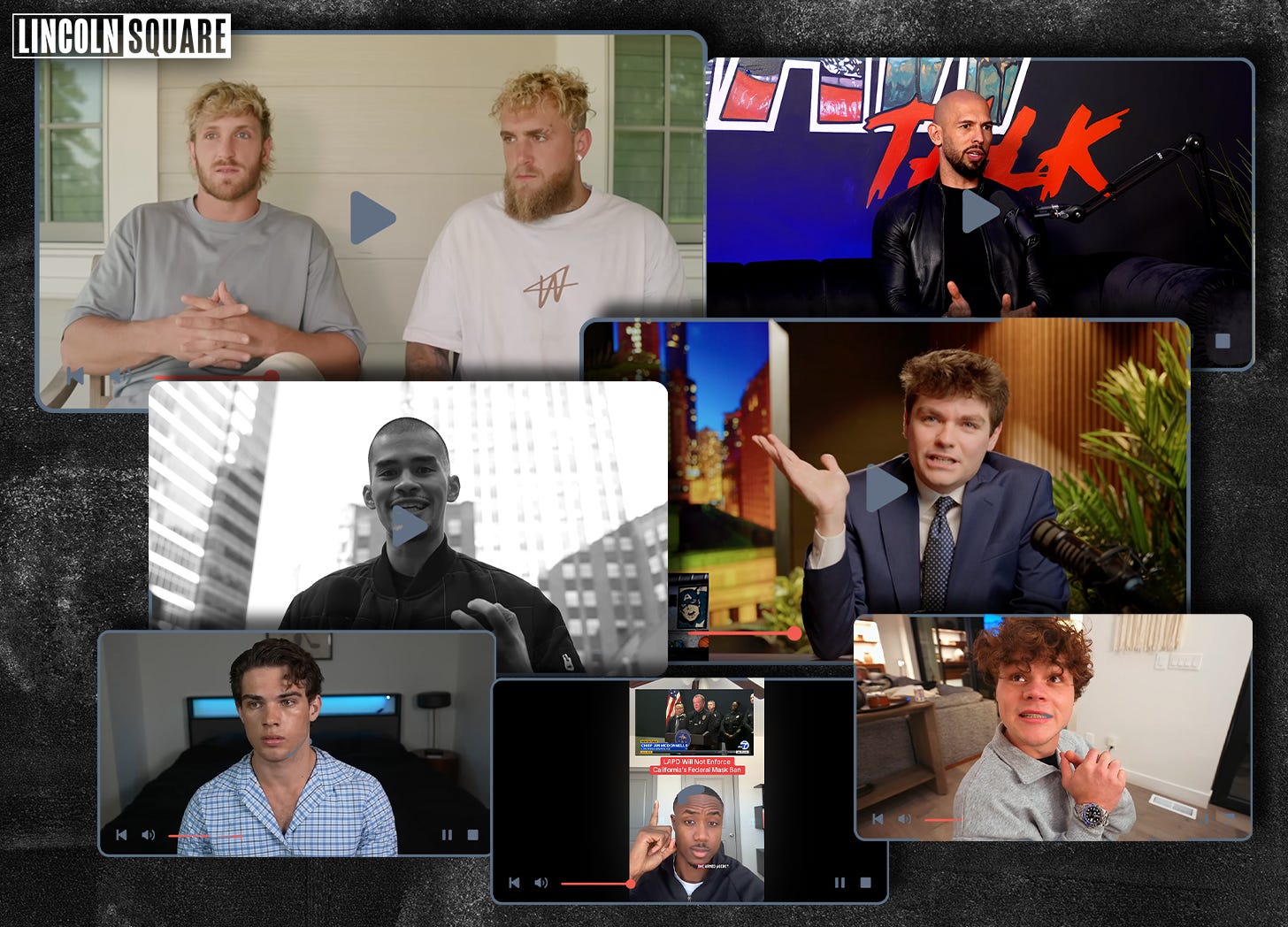
When Charlie Kirk was shot and killed, the attack was shocking — not just because the prominent figure in conservative politics was murdered, but because it exposed what was already festering beneath the surface: a movement untethered from ideas, institutions, and intellectual coherence now seethed with chaos and spectacle. And what came next wasn’t a sober reflection of the MAGA movement — it was a dive deeper into the gutter.
Because while the rest of America watched Kirk bleed out, large swaths of the right turned not to philosophers or policymakers, but to the streamers and influencers whose currency of cruelty, resentment, and chaos were about to cash in.
It wasn’t an evolution of the movement as much as degradation from an already questionable belief set.
The Vacuum
There was a time when political movements had thinkers, strategists, or at least rhetorical bullshit artists. Even if you disagreed with them, you could point to something resembling an argument — a book, a speech, a policy paper.
That era is dead.
Into the vacuum left in Charlie Kirk’s void, stepped figures whose contempt for coherent thought is mirrored only by their contempt for anything resembling empathy.
We’re talking about:
Nick Fuentes, whose brand of normalized antisemitism and racially charged grievances have become a defining vector for young adherents to the right.
Andrew Tate, whose misogynistic lectures about dominance and male entitlement have been embraced by the very demographics most in need of direction — young men floating in a fractured culture.
Sneako, whose clipped rage sessions and performance of contrarian aggression are thinly veiled emotional breakdowns pretending to be enlightenment.
Clavicular, real name Braden Peters, an American Kick and social media streamer known for “looksmaxxing” content — a controversial niche focused on extreme self-modification and criticized as feeding into unhealthy body image obsessions and performative masculinity.
Jeffery Mead, a former University of Oklahoma football player turned online political influencer. Though not a streamer in the same vein, his brand of commentary fits right into the ecosystem by trading outrage signals for analytical depth.
Jack Doherty, a Kick streamer and attention whore whose brand revolves around provocation, reckless stunts, and antagonizing strangers. Most recently getting himself kicked out of the WM Phoenix open for disruptive behavior for “content.”
And the twin spectacles of Jake Paul and Logan Paul, whose ascent from YouTube prank wars to mainstream pay-per-view boxing illustrates the laundering of toxic performance into the cultural bloodstream.
None of these figures build anything. They tear things down. They don’t persuade, they inflame tensions. Their platforms are not forums for debate as much as arenas for spectacle where the goal isn’t understanding, but domination.
Hate Is their Product
Look at how they speak to the people they attract, especially young men:
Women aren’t partners; they are punchlines or things to be conquered.
Empathy is weakness, and weakness is mocked without restraint.
Power is measured in humiliation, often performed for the camera.
It’s not accidental. It’s optimized for an algorithm.
Tate built a business on telling young men that success is about control — control of women, of image, of fear. Fuentes has built an audience by wrapping bigotry in the language of “truth telling.” Sneako traffics in outrage because outrage sells.
The teaching is consistent: to be powerful is to despise and reject softness; to be worthy is to look down on everyone else.
That’s not a healthy ideology.
It’s a toxic byproduct of a culture that no longer has an ethical center.
The Nightclub Moment: When Irony Ends and Nihilism Begins
There was a moment — viral and emblematic — when a crowd of right-wing internet figures (Fuentes, Sneako, Andrew Tate, Clavicular, and others) were caught in a nightclub blasting Kanye West’s notorious “HH” track, notorious for its praise of the Nazi leader and antisemitic tropes.
It wasn’t just tasteless; it was telling.
This wasn’t irony. It wasn’t a protest. It was identity through offense.
The message was:
We don’t care what you think. We don’t even care if we shock you. We only care that we can get your attention.
That’s how these incel “edgelords” turn hate into content, and content into money.
The Culture They Cultivate
When influencers teach young men that:
Cruelty is cool
Women are targets
Empathy is weakness
Outrage is authenticity
…You don’t end up with citizens. You end up with angry, incel spectators who take their grievances out on women online. They are as animated as possible, enraged, and hollow. They seek to emulate their online heroes by entering the DM’s of left-leaning female influencers with threats of rape, murder, and more.
We are seeing this play out in real time:
Spoken hatred of women normalized in mainstream commentary
Misogyny reframed as “confidence”
Bigotry stripped of public outrage
Antisemitism treated as edgy humor
Violence pressed into the service of attention.
And they aren’t a fringe phenomena. They are cultural vectors that spread because they are effective at capturing eyeballs — not because they have anything to offer to society.
The Mirage of Masculinity
Toxic masculinity didn’t start on a livestream — but it has been validated in these forums. What once might have been whispered in bars or locker rooms is now declared in monologues watched by tens of thousands of young men.
It’s no accident that the adherents to these personas a disproportionately younger men who feel displaced, unseen, or have no power. In the absence of community, purpose, or mentorship, the only alternative on offer is performance identity — carving out a place in the world by dominating others online.
Instead of encouraging young men to build, to protect, to love, to contribute, these influencers teach them to hate.
Instead of empathy, they idolize aggression.
Instead of dialogue, they incite dismissal.
Instead of responsibility, they worship spectacle.
These aren’t examples of strength. They are insecurity in a costume.
After the Spectacle
The most disturbing thing about this movement isn’t that it exists — plenty of subcultures can be messy — but that it is profitable. Where traditional media used to curate, contextualize, and challenge — algorithms now amplify without concern. Where institutions once vetted voices, now there are only virality metrics.
Society isn’t watching these figures because they have answers, they’re watching them because they offer unfiltered anger and grievance in a world drowning in complexity. Feelings have become a stand-in for understanding.
But feeling without context is a vacuum, and vacuums get filled with whatever will fit — even if it’s hate dressed as self-help.
The Cost
This is where the damage stops being an idea.
Because when hate becomes entertainment and grievance becomes identity, someone always pays the price — and more often than not, it’s women.
The culture these influencers cultivate doesn’t stay contained to livestreams or comment sections. It spills outward. It shows up in inboxes flooded with threats. It shows up in coordinated harassment campaigns against women who dare to speak publicly. It shows up in rape threats sent as jokes, in murder fantasies framed as political expression, in the casual normalization as engagement.
It even plays out in the way women are treated in local communities. In bars where men who think women are less than from the content they’re taking in, deciding it’s okay to slip something in her drink. That ‘no’ really does mean ‘yes’.
This isn’t free speech culture. It’s intimidation culture.
Young men trained on this content aren’t being taught how to live in a pluralistic society. They’re being taught that women are obstacles, that disagreement is betrayal, and that violence — or the suggestion of it — is a legitimate way to reassert control. When you tell an entire generation that empathy is weakness and domination is virtue, you don’t just warp politics. You endanger people.
And the harm doesn’t just stop with women. A society that treats cruelty as entertainment and hatred as personality eventually loses the ability to recognize dignity at all. Trust erodes. Community fractures. Politics becomes pure spectacle, stripped of accountability and meaning. What fills the void isn’t strength or clarity — it’s paranoia, resentment, and rage.
This is the end result of a movement that abandoned ideas for influencers, persuasion for humiliation, and responsibility for clicks.
It’s not rebellion. It isn’t counterculture. It’s decay.
And a society that keeps mistaking decay for authenticity will keep producing the same result: more anger, more fear, more people put in harms way — all so a few can go viral.


"A society that treats cruelty as entertainment and hatred as personality eventually loses the ability to recognize dignity at all. Trust erodes. Community fractures. Politics becomes pure spectacle, stripped of accountability and meaning. What fills the void isn’t strength or clarity — it’s paranoia, resentment, and rage."
All true and eloquently stated. But never forget to follow the money. It's a short-sighted billionaire class that's now driving this, mounting the tiger that will eventually consume them. It is to be hoped that the tiger doesn't destroy us all first.
You continue to point the issue out very well. Lifting up a less Toxic roll model seems almost impossible. Thanks Evan. You keep raising the issue and looking to help. Big task leading anyone out of a toxic maze to fresh air.