


Kristoffer Ealy is a political scientist, political analyst, and professor in Southern California. He teaches American Government and political behavior, with a focus on political psychology, voting behavior, and political socialization. Subscribe to his Substack, The Thinking Class with Professor Ealy.
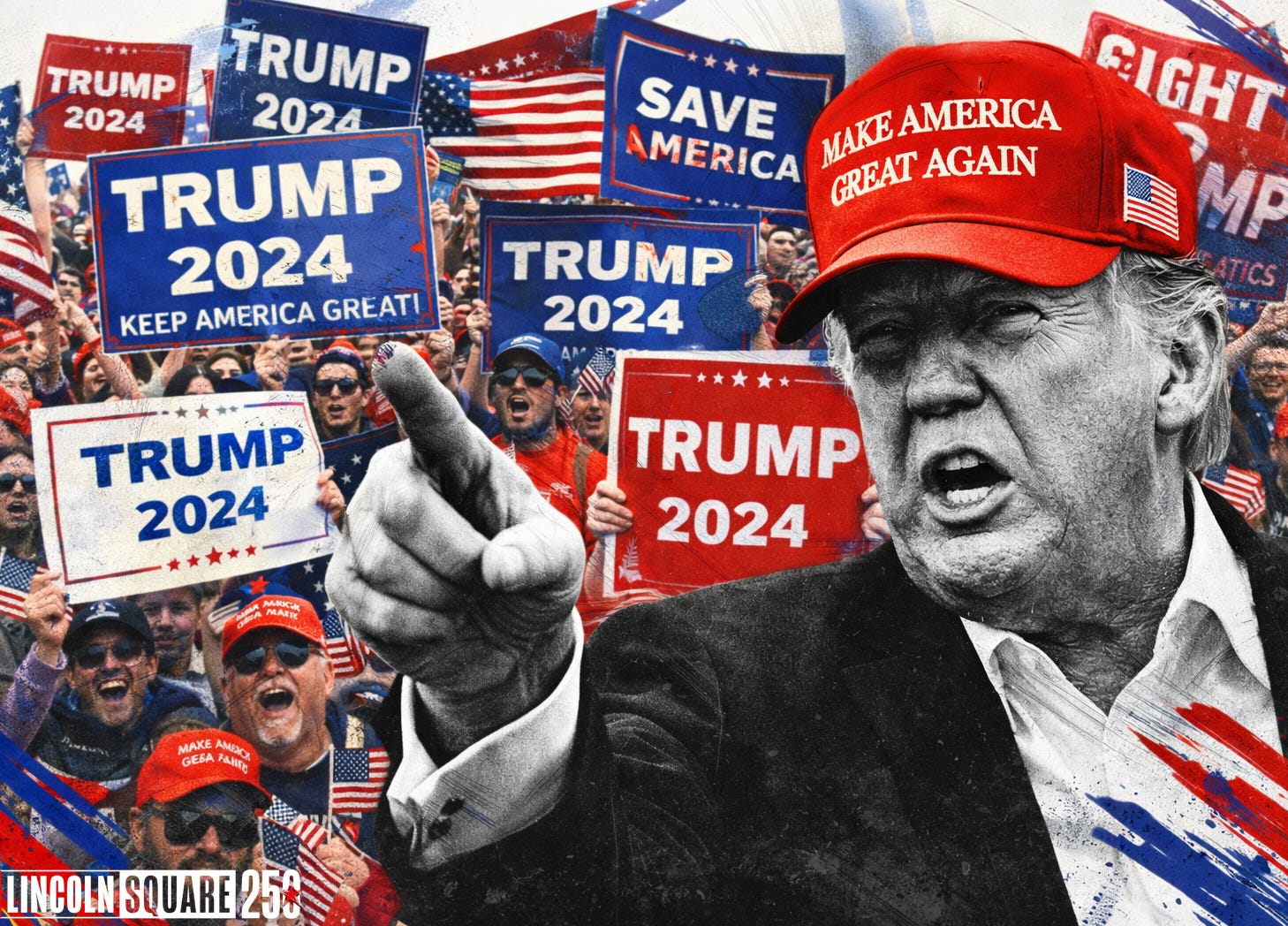
Since Donald Trump began doing dirty business alongside his father in the late 1970s, most Americans had the luxury of treating him the way you treat a jackass yelling into a Bluetooth headset at the airport: irritating if he happened to be near you, but otherwise somebody else’s problem. His deals could be shady, his ethics could bend like warm plastic, and none of it necessarily had to occupy much real estate in our heads. He was rich, loud, geographically distant, and—most importantly—politically irrelevant.
By the 1980s, though, Trump was becoming a national character. This was the era of Wall Street excess, conspicuous consumption, hostile takeovers, cocaine optimism, and enough shoulder pads to interfere with commercial aviation. Trump fit the moment almost too perfectly. He appeared on television, gave interviews, and popped up in films like Ghosts Can’t Do It, playing the role he had already spent years perfecting: Donald Trump.
But an eight-year-old kid like me growing up in South Central Los Angeles had no particular reason to give a damn about him. Trump could be as crooked, vain, tacky, or morally repellent as he wanted somewhere across the country, behind a velvet rope guarded by somebody named Chip. He was New York’s problem. I had cartoons to watch.
What makes that period even more grotesque in retrospect is the contrast between the mythology Trump was building around himself and the experiences of people who had actually sacrificed something for the country. Plenty of Vietnam veterans were back home living ordinary lives while carrying trauma that America was still remarkably uncomfortable discussing. Trump, meanwhile, had avoided military service and would later go on Howard Stern and joke that navigating his sex life without contracting a sexually transmitted disease had been his own “personal Vietnam.” He described himself, remarkably, as something like a brave soldier for surviving the dating scene without catching anything.
Imagine having the historical Vietnam War available as a reference point and deciding the Tet Offensive was basically comparable to whether you remembered to use protection at Studio 54.
That tells you quite a bit about the man even before politics enters the picture. Men who had actually been shot at were carrying memories they sometimes could not talk about. Trump was on the radio comparing gonorrhea avoidance to jungle warfare and handing himself a Purple Heart for remaining asymptomatic. Yet even then, most of us still had the luxury of ignoring him. He showed up on Oprah, periodically teased a presidential run, and generally behaved like a man auditioning for a political future nobody had yet been reckless enough to give him.
By the 1990s, the mythology was fully operational. Trump was not merely wealthy; he was performing wealth. His public persona had become a commercial product—part businessman, part tabloid fixture, part self-authored legend, part guy who could lose money in a casino and somehow still convince people he had unlocked capitalism.
None of that made him harmless. In 1989, he took out full-page newspaper advertisements demanding the return of the death penalty as New York convulsed over the Central Park Five case, targeting five Black and Latino teenagers who were later exonerated. Trump has never meaningfully apologized for his role in inflaming that hysteria. It was ugly. It was cruel. It was evil. But for most of the country, it was still possible to process it as Donald Trump doing Donald Trump shit: a rich asshole saying something monstrous in New York while everybody else went about their day.
The Reality TV Administration

Reality TV has always produced far more rejects than stars. For every winner, there are thousands of fame-hungry people who never made it to air. Then there’s the rest of the cast who got a few weeks of screen time, maybe said something memorable in a confessional booth, and then watched the cameras move on without them.
Then came The Apprentice in the 2000s, and the mythology acquired a weekly time slot.
NBC did not merely give Trump another television vehicle. It helped launder a deeply uneven business record into the image of an omniscient executive. Every week, millions of Americans watched contestants stand before a man presented as the final authority on competence, success, leadership, negotiation, and apparently whether somebody had arranged a cupcake display correctly.
The problem, of course, was that reality television was doing what reality television does: manufacturing reality.
