

Mark Zuckerberg’s Chickens Have Come Home to Roost
Facebook once gave us a front-row seat to the lives of those we love. But after choosing revenue over people's safety for years, the company is finally facing a legal reckoning.

Facebook changed my life in ways I am genuinely grateful for. I have family members spread across countries and time zones — people I love, people I grew up hearing about, people whose voices I would have known only through photographs and secondhand stories. Facebook gave me a front-row seat to their lives. Birthdays, graduations, funerals, the mundane Tuesday afternoon that reminds you someone is still here and still thinking of you.
I have made friends through Meta platforms that I would never have made otherwise — real friendships, substantive ones, built across the kind of distances that used to make connection nearly impossible. Small businesses I know were built on Facebook and Instagram from the ground up, with no advertising budget and no corporate backing, just a page and an algorithm that, for a while, actually worked for the little guy. For a certain window of time, Mark Zuckerberg’s platforms did something genuinely democratic. They compressed the world.
I am telling you this because what comes next is not the rant of someone who never logged on. This is the reckoning of someone who did — and watched the man behind the curtain slowly reveal that none of it was ever about us.
On March 25, 2026, a Los Angeles jury found Meta and Google liable for designing social media platforms that deliberately addicted a young woman and caused her serious psychological harm — anxiety, body dysmorphia, and suicidal ideation that she traced directly to her years on Instagram and YouTube. The jury ordered Meta to pay $4.2 million and Google $1.8 million in compensatory damages, then came back with an additional $2.1 million in punitive damages against Meta and $900,000 against Google. Six million dollars total. That sounds like a parking ticket for two companies whose combined market capitalization could buy several small nations, and you would be right — but the money is not the point. The point is what this verdict represents.
This was not a random lawsuit. It was a bellwether — a carefully selected test case designed to set the legal precedent for approximately 2,000 other pending lawsuits consolidated in California state courts alone, with a separate federal trial involving school districts and parents nationwide set for this summer. The day before the Los Angeles verdict, a New Mexico jury ordered Meta to pay $375 million for failing to protect young users from child predators on Instagram and Facebook. Two juries. Two days. $381 million. The tobacco lawyers of the 1990s are somewhere nodding slowly, because they have seen this movie before, and they know how it ends.
Meta, predictably, said it “respectfully disagrees with the verdict” and will appeal. Google said the case “misunderstands YouTube, which is a responsibly built streaming platform, not a social media site.” That second statement deserves a moment of appreciation for the audacity required to make it with a straight face after a jury just found you liable. But we will get to Google.
Here is what made this case different from every congressional hearing, every stern op-ed, every open letter from alarmed pediatric psychologists that Zuckerberg has managed to survive over the past decade: the documents. The internal documents are what get you every time, because corporations are extraordinarily good at lying out loud and extraordinarily bad at lying on paper.
Jurors saw internal Meta communications in which Zuckerberg and other executives laid out the company’s strategy for attracting young users. One document read: “If we wanna win big with teens, we must bring them in as tweens.” Another internal memo revealed that 11-year-olds were four times as likely to return to Instagram compared with competing apps — despite the platform’s own terms of service requiring users to be at least 13 years old. Meta knew. They built for it. They optimized for it. When the question of beauty filters came up — filters that employees and eighteen separate experts had flagged as potentially harmful to teenage girls’ body image — Zuckerberg overrode the concerns. “I felt like the evidence wasn’t clear enough to support limiting people’s expression,” he told the jury. Eighteen experts. He needed more data.
James Steyer, founder and CEO of Common Sense Media, put it plainly after the verdict: the companies “buried their own research showing children were being harmed, and used kids and society as guinea pigs in massive, uncontrolled, and wildly profitable experiments.” That is not an activist’s hyperbole. That is a summary of what the documents showed.
This is the pattern that connects the addiction case to everything else Zuckerberg has done. It is not negligence. Negligence implies you did not know. What the trial documents describe is something more deliberate: a company that knew, weighed the cost of knowing against the revenue of ignoring, and chose revenue. Every. Single. Time!
None of this should surprise anyone who was paying attention in 2019, when economist Dean Baker published a piece in Common Dreams with the most accurate headline in the history of tech journalism: “Mark Zuckerberg Is a Rich Jerk.” Baker’s argument was surgical. He pushed back on the widespread habit of treating Zuckerberg as some kind of reluctant philosopher-king who just needed to be persuaded to do the right thing. “Zuckerberg is not a political philosopher concerned about the public good,” Baker wrote. “There is zero evidence he is a deep thinker of any sort. He is a Harvard boy who stumbled into a good idea and had the necessary connections to get very rich from it: end of story.”
Baker also identified something that has only become more relevant since: the hypocrisy embedded in how Meta selectively applies its own standards. Facebook polices its platform aggressively for copyright violations — because copyright violation costs Meta money with advertisers and rights holders. But Zuckerberg simultaneously claimed he did not want to be in the business of determining what is true, carving out a special exemption from the accountability standards that every traditional media company operates under. Baker called this what it is: special pleading. There is no principled distinction between protecting intellectual property and protecting democratic discourse. There is only a financial one. Meta enforces the rules that protect its revenue. It waives the rules that would cost it revenue. That is not a philosophy. That is a business model dressed up as one.
Baker wrote that piece seven years ago. Seven years, several congressional hearings, one global pandemic, one insurrection, and now two jury verdicts later, the answer to “Why doesn’t Zuckerberg get it?” remains exactly what Baker said it was: he gets it fine. He just does not care.
Which brings us to the Joe Rogan Experience, and to the version of Mark Zuckerberg that I need you to hold in your mind while reading everything above. Early 2025. Zuckerberg sits across from Rogan — the world’s most lucrative bro cosplay venue — sporting what can only be described as a Caesar haircut that suggests someone told him Romans were masculine and he took notes. He is there to announce, with the gravity of a man who has finally found his spine, that Meta is done with “ideological-based censorship.” The fact-checkers are out. Community Notes — borrowed directly from Elon Musk’s playbook at X — are in. The era of Meta deciding what is true is over. He has, at long last, seen the light.
He also tells Rogan that corporate culture has become too “neutered,” that his MMA training has reconnected him with a more “masculine energy” and “aggression” necessary for success, and that he brought Dana White — the man who runs an organization where people get punched in the face professionally — onto Meta’s board to help the company stand up to global government pressure. Dana White. On the board. Two juries just punched Meta in the face for $381 million, so perhaps the board composition deserves a second look.
The content moderation rollback is being sold as a free speech awakening. It is not. It is a motte-and-bailey — one of the oldest rhetorical tricks in the book, and one worth naming by name. The bailey is the aggressive position: Meta is dismantling its fact-checking infrastructure and lowering the threshold for what constitutes removable content, meaning more misinformation, more hate speech, and more algorithmic amplification of outrage will flow through its platforms. When challenged on this, Zuckerberg retreats to the motte — the defensible castle: he is simply opposing government overreach, protecting legitimate speech, refusing to let the Biden administration “scream and curse” at Meta employees to suppress true information about vaccine side effects. The motte is a real concern. Government overreach in content moderation is a legitimate issue. But it is being used as cover for the bailey, and Zuckerberg knows it. The motte gets him the interview. The bailey gets him the engagement numbers.
The Rogan appearance was not a pivot toward principle. It was a pivot toward political survival. Zuckerberg gutted fact-checking, ended DEI programs, and performed his masculine reawakening right as Donald Trump was returning to power and these lawsuits were heading toward trial. He needed the administration friendly and the regulatory environment soft. He is a weather vane, not a compass. He leaned into content moderation when institutional pressure said lean that way. He leaned into “free speech” when MAGA pressure said lean this way. The through line was never principle. It was always: which direction keeps the money flowing and the exposure minimal.
He also went to the Dr. Phil school of COVID awareness — which is to say, he treated a public health emergency as an ideological battleground and then retroactively reframed his company’s confused, pressure-driven, inconsistent response as a coherent stand against censorship. Dr. Phil spent the pandemic doing the “more people die from car accidents than coronavirus” bit on national television. Zuckerberg spent it caving to pressure from every conceivable direction and then showed up on Rogan’s podcast years later claiming he had always been the brave one. Both men confused contrarianism with courage. Neither one was punched in the face for it. Until now.
Google was in that Los Angeles courtroom too, found 30% liable to Meta’s 70% — and that ratio is actually defensible. Google built a library. YouTube is, at its best, one of the most democratizing educational platforms in human history — Khan Academy, language tutorials, medical explanations, documentary archives, music instruction for kids who cannot afford lessons. The core product has genuine public good baked into its design in a way that Instagram, with its beauty filters and engagement-optimized feed, simply does not.
But Google also built a slot machine inside the library and aimed it at children. Autoplay is the specific mechanism — the feature that keeps a six-year-old watching for four hours because the algorithm never stops serving the next thing. And YouTube’s recommendation engine has a well-documented radicalization pipeline: watch one political video and it serves you something incrementally more extreme, every single time, because outrage drives watch time and watch time drives ad revenue. Google’s own spokesperson claimed YouTube is “a responsibly built streaming platform, not a social media site.” A jury disagreed. The distinction between a streaming platform and a social media site collapses entirely when the algorithm is engineered to maximize time-on-platform at the expense of user wellbeing. The jury saw through the semantic escape hatch. So should we.
The tobacco comparison has been circulating in legal circles for years now, and it fits because the structure is identical: an industry that built its profits on a product it knew was harmful, suppressed internal research confirming the harm, deployed armies of lobbyists and lawyers to delay accountability, and finally — after decades — faced a reckoning in the courts that no amount of political spending could stop. Big Tobacco eventually had to change. Not because its executives grew a conscience, but because juries kept ruling against them and the financial exposure became too large to manage through litigation alone.
That is where we are with Meta. The $6 million verdict in Los Angeles is not the punishment. It is the signal. It tells 2,000 other plaintiffs’ attorneys that juries will hear these cases and rule on them. It tells the summer federal trial in Oakland that the legal theory holds. It tells every parent who buried a child and wonders whether the algorithm played a role that they have standing and they have precedent. The bill is not $6 million. The bill is everything that comes after it.
Mark Zuckerberg is a man who built something genuinely transformative — a platform that compressed distance, connected families, enabled communities, and gave small businesses a fighting chance. And then he spent the next two decades treating every warning, every internal alarm, every congressional subpoena, and every grieving parent as a cost-benefit calculation. He will appeal this verdict. He will fund the appeal with money earned from the same platforms the jury just found harmful. He will sit across from the next friendly podcaster and explain, with complete sincerity, that he is the victim of a culture that does not understand the importance of free expression.
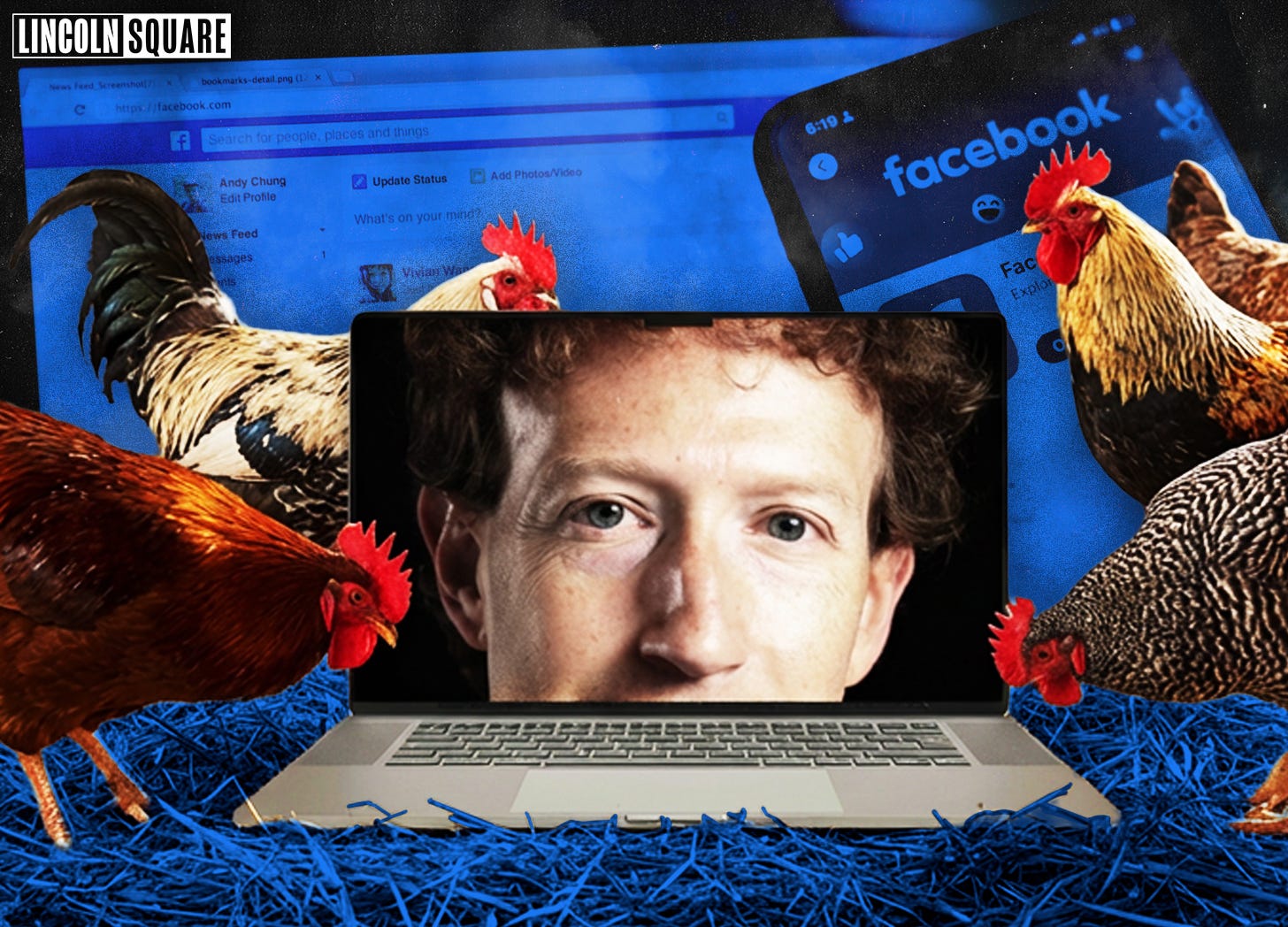
Two juries in two days said otherwise. The chickens, as they say, have come home to roost.
 | A guest post by
|
Kara Swisher was on to these phonies a few years back, in her “Burn Book.” She figured out that all the lollipop, rainbows and sparkly unicorn bullshit these guys were spewing was just that and nothing more. They are in it only for the money and the power, always have been.
Greedy fools deserve comeuppance. This includes shareholders.