

Inside the Jaw-Dropping 2026 ACA Premium Hikes | The Waiting Room
The Big Ugly Bill’s first victims: 240,000 low-Income Americans have lost health coverage.

Charles Gaba is a health care analyst who tracks policy and politics at ACASignups.net. Subscribe to his Substack!
Greetings, Lincoln Square readers!
In the last edition, I regaled you with the long, stupid saga of a lawsuit which sought to undermine one of the ACA’s most critical provisions, how the Trump Regime and RFK Jr. attempted to co-opt that provision to actively harm people, and how a federal judge has wisely blocked their efforts ... at least for now.
PREPARE TO WONK OUT A BIT …
The biggest healthcare news since then (at least from where I stand) is that the Centers for Medicare & Medicaid Services (CMS), which is also in charge of the Affordable Care Act, published the much-anticipated 2026 ACA Open Enrollment report.
While I’ve previously had access to a limited set of semi-final data re 2026 enrollment, this is the official, definitive data set which includes all of the last-minute stragglers as well as much greater detail on a whole slew of wonky demographic info.
It breaks annual Open Enrollment Period plan selections* out by household income levels, metal levels, new vs renewing enrollees, gross & net premiums, financial assistance, age brackets, gender, racial/ethnic populations and so forth.
It even includes enrollment data for stand-alone dental plans as well as the Basic Health Plan (BHP) programs operating in New York, Minnesota, Oregon, and (new this year) the District of Columbia.
There’s so much data for me to wade through here (especially when comparing it year over year to 2025’s OEP report) that I’m still digging through some of it nearly two weeks later.
For that reason (as well as my not wanting to make your eyes glaze over), I’m not going to attempt to do a deep dive into every facet of the enrollment data, but I’ll try to cover the main highlights (or lowlights?) for you to keep in mind.
If you’d like to read the full series where I go deeper into the data, here you go (just keep in mind that I still have 2-3 more sections to go as of this writing):
Part 1: Topline Numbers
Part 2: New vs. Renewals
Part 3: Premiums/Financial Aid
Part 4: Demographics & Dental
Part 5A: Metal Levels (Overview)
Part 5B: Metal Levels (Deep Dive)
Part 6: Household Income (< 138% FPL)
*(Keep in mind that while I generally use the terms “enrollees” or “enrollment” when writing about this data, plan selections are actually not the same as effectuated enrollment.)
The main takeaway from the CMS report is that total ACA health insurance policy plan selections ended up around 1.2 million lower than during the 2025 Open Enrollment Period, down around 5%.
I’ve cautioned many times before, however, that this is likely to be extremely misleading: The actual number of people losing ACA healthcare coverage this year will almost certainly be far more than that for a variety of factors.
The biggest of these is the 3-month grace period to pay the first premium, which expired at the end of March. Unfortunately, effectuated enrollment for April probably won’t be published until sometime in July, although I should have spot data for a handful of states prior to then.
Officially, the national plan selection tally is 23.1 million people, or almost exactly 25 million when you include BHP enrollees. States like North Carolina, Ohio, West Virginia, and Indiana saw double-digit drops by as much as 22%.
On the other hand, a handful of states actually saw enrollment increases thanks largely to various mitigation policies they put in place ranging from supplemental subsidies to Premium Alignment pricing. Texas, in particular, saw their enrollment jump by a whopping 200,000 people by beefing up their Premium Alignment factor, while New Mexico’s jumped by 18% thanks to them fully covering all of the lost federal tax credits.
Around 15% of ACA enrollees are new this year; the rest are returning from last year. The good news is more people did so actively … but nearly 2 in 5 still passively auto-renewed, which means a lot of them were hit with sticker shock. It also looks like perhaps 1/3 of all enrollees switched to a different policy this year (up from less than 1/4 last year) … including yours truly.
People switch plans from year to year for a variety of reasons, but this year in particular the most obvious one is that millions of were scrambling to avoid (or at least mitigate) the massive net premium hikes caused by the GOP allowing the tax credit formula to revert back to 2020 levels.
Speaking of which, I’m finally gonna throw a couple of colorful graphs your way: Here’s what the average gross (unsubsidized) and net (after subsidies) monthly premiums look like for every state.
The blue bars are what they were last year; the orange bars are how much they increased this year. On average, gross premiums shot up around 20% while net premiums—what ACA enrollees actually pay—jumped by 58% nationally:
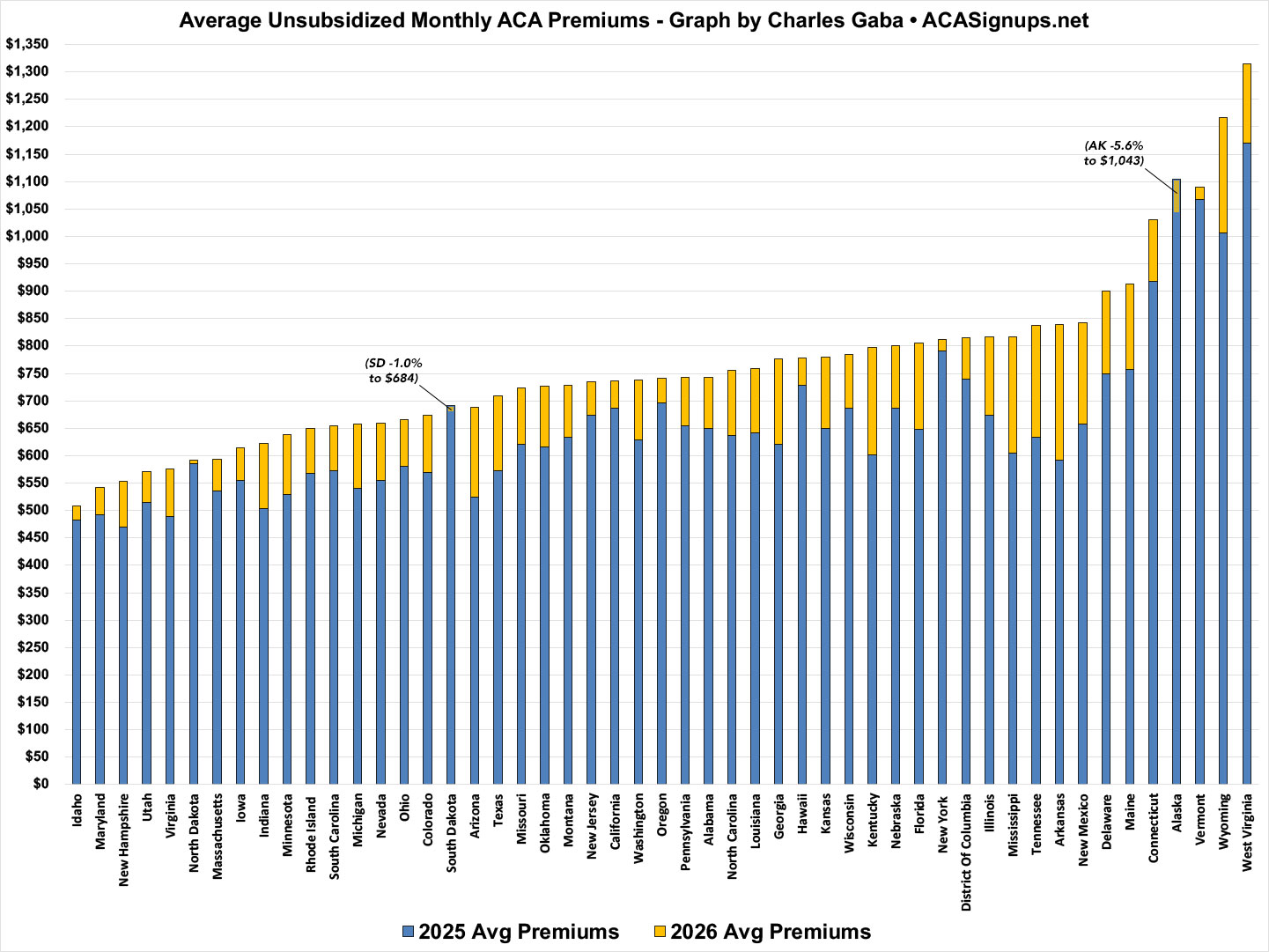
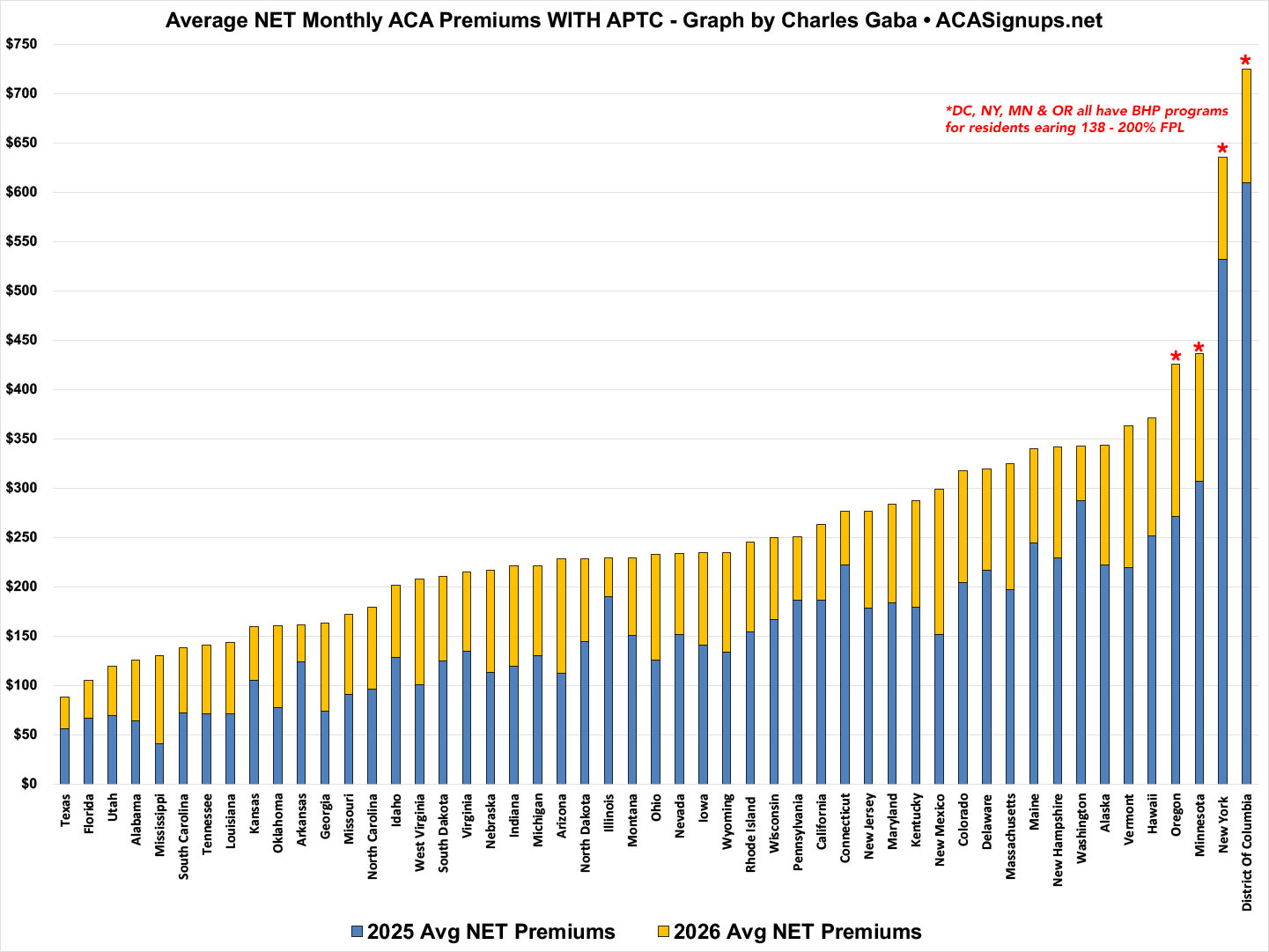
While both of these are lower than projected last fall, that was to be expected (and in fact I warned of exactly this) since those projections had to assume 100% of existing enrollees would re-enroll into the same policy, which of course never happens even in years without massive rate hikes. And of course you have to keep in mind that both 20% and 58% premium hikes in a single year are still absolutely jaw-dropping.
Overall, there are 2.3 million fewer Americans receiving any financial help to pay for their premiums…as well as over 3.7 million who have lost assistance paying their deductibles, co-pays & coinsurance (via Cost Sharing Reduction (CSR) assistance).
In terms of enrollment by age, it’s dropped substantially among young people, which will in turn cause gross premiums to go up even more in 2027. I don’t have a lot to say about the other demographic data due to it being too incomplete (ethnic/racial info is voluntary and a lot of people choose not to enter it, which I can certainly understand, especially these days).
To be honest, the racial/ethnicity/gender data which I found most surprising (given how hostile the Trump Regime is towards all things “DEI”-coded) is the fact that they chose to publish it at all.
Oh, yeah … 2.79 million people also selected standalone dental plans, which is down a bit from last year.
A Quick Refresher on Metal Levels
ACA plans fall into 5 categories: Catastrophic, Bronze, Silver, Gold and Platinum. Catastrophic/Bronze have the lowest gross premiums and highest out-of-pocket costs (deductibles, co-pays, coinsurance); Platinum has the highest premiums and lowest out-of-pocket costs … officially.
However, there are a lot of exceptions to these thanks to the way that CSR assistance works: It effectively boosts Silver plans up to Platinum levels … but only for those who meet the low-income threshold.
Officially, here’s what the year over year enrollment choices look like:
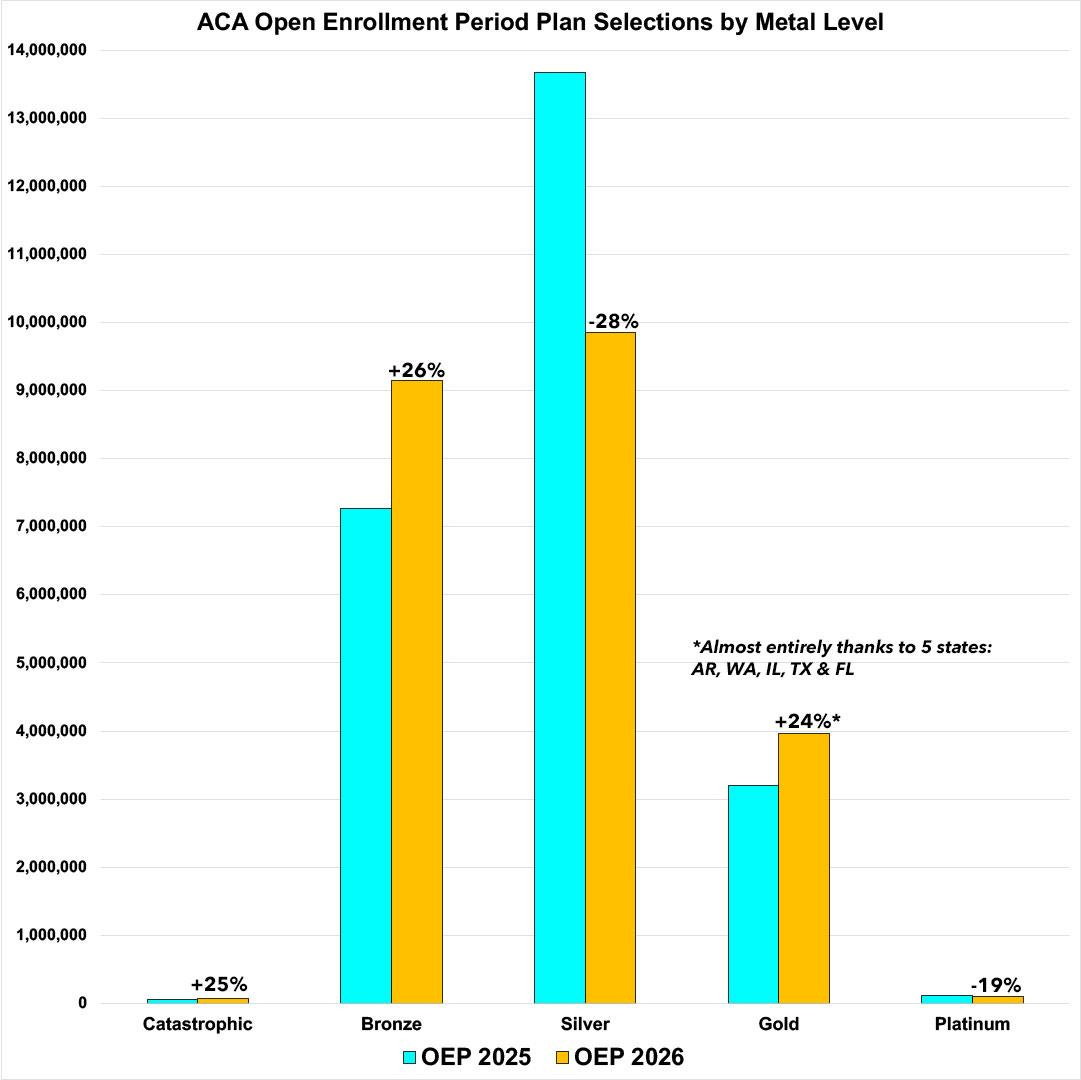
The most obvious thing is that people downgraded from Silver to Bronze to avoid those massive premiums spikes, and that’s largely the case (that’s what my own family did, in fact). However, at first glance, this also makes it look as though another chunk of enrollees switched from Silver to Gold instead, which seems counterintuitive!
To be clear, that is what happened…but this is where the exceptions I just mentioned come into play. Again, if you earn less than 200% FPL and enroll in a Silver plan, you’re actually enrolled in a policy which effectively provides the same coverage as a Platinum plan…and as it happens, there’s a massive number of ACA enrollees who qualify for this “Secret Platinum” coverage.
CMS only provides hard data for 30 states, but based on that I estimate that around 11.9 million enrollees—nearly half the total—were in that category last year … but only around 8.3 million are in 2026.
This means that millions of “Platinum” enrollees actually downgraded to worse coverage after all, which looks something like this (the categories are listed left to right from least comprehensive coverage (Catastrophic) to most comprehensive (Silver CSR AI/AN)):
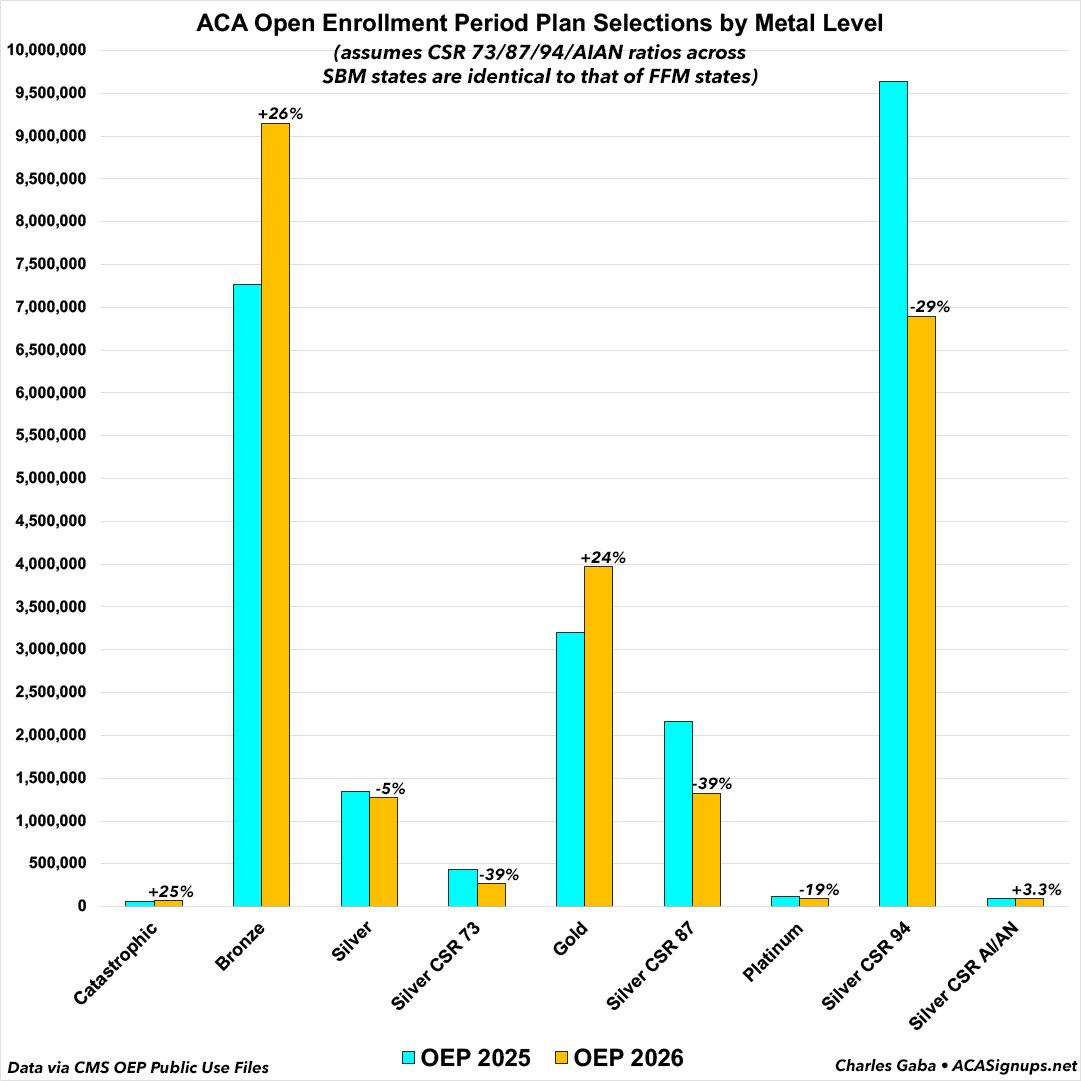
Suddenly that 24% spike in Gold plan enrollment doesn’t look like such cheery news after all.
As I said earlier, even now I’m still only part way done digging through the household income level data, so I don’t have a lot to say about that yet other than that due to one of those nasty provisions in the Big Ugly Bill, over 240,000 enrollees who earn less than the federal poverty level (just $15,650/year for a single adult) were forced to drop their coverage this year.
WHEW! I hope I didn’t dump too much on you. … Feedback welcome (as long as you’re polite about it).
We Fought the Trump Regime … and Probably Won
Thank God for Small Favors: CMS may kick some NBPP changes down the road another year or two …
Last month, I posted a massive three-part series which looked at nearly three dozen changes being proposed by the Trump Regime’s Centers for Medicare & Medicaid Services (CMS) to how the Affordable Care Act will be administered starting this fall (for the 2027 plan year), including a link for folks to submit public comments on the proposed changes.
In late March it was reported that those comments have a positive impact! While nothing is certain yet, it looks like some of the dumber/more destructive ideas will either be modified or at least delayed by another year or two, likely including the ones related to catastrophic plans, “no-network” plans and so on.
In other news …
Virginia: VA Marketplace Posts Detailed 2026 OEP Data...With One Really, Really Weird Head-Scratcher
For the most part this is what I expected: Enrollment in higher-value coverage dropped significantly while it increased in lower-value (Bronze/Catastrophic) plans, and the average net premium jumped by a whopping 41% year over year.
However, there’s also a confusing data point re. premiums for those no longer eligible for financial aid which makes zero sense … and I’ve yet to hear back from the state exchange with clarification.
Silver Loading coming full circle? Republicans may be about to hurt ACA enrollees even more...in the most ironic way possible...
I’ve written about Silver Loading and Premium Alignment more times than I can count, but the bottom line is that they both refer to insurance pricing strategies which leverage the ACA subsidy formula in a way which greatly benefits millions of enrollees…and the Trump Regime & Congressional Republicans are inching closer & closer to killing these techniques off, which would harm millions of Americans.
Of course, at the time I wrote about this proposal, they wanted to do so in order to help pay for Trump’s illegal war on Iran … which may (or may not) be a moot point as of this writing, so ….
CMS posts claimed December 2025 Medicaid/CHIP enrollment report: 75.7M, down 3.7M since December 2024
Not much really stands out here, but it at least provides a baseline for the real gutting of Medicaid caused by the major healthcare-related provisions of last year’s Big Ugly Bill (officially the “One Big Beautiful Bill Act”) which are going to start ramping up soon…
🚨 There’s also some important recent stories which I haven’t gotten around to writing about myself yet but which I wanted to give you a heads up about:
🚨 Ohio: Bill mandates doctors inform abortion patients about experimental reversal option
🚨 Oklahoma: House lawmakers approve measures to send Medicaid expansion back to ballot
🚨 Trump administration personnel agency is asking for federal workers’ medical records
And with that, I’ll see you again in two weeks!

Typo correction: In the 2nd graph above, the BHP programs are for residents EARNING 138 - 200% FPL, not EARING.👂
well the orange bloated gas bag TACO needed the money from somewhere, to pad the bottom line for the rich and obscene and to pay for his war crimes to steal oil, money and raise the body count....here and abroad.....all while still trying to deflect from the Epstein Files....