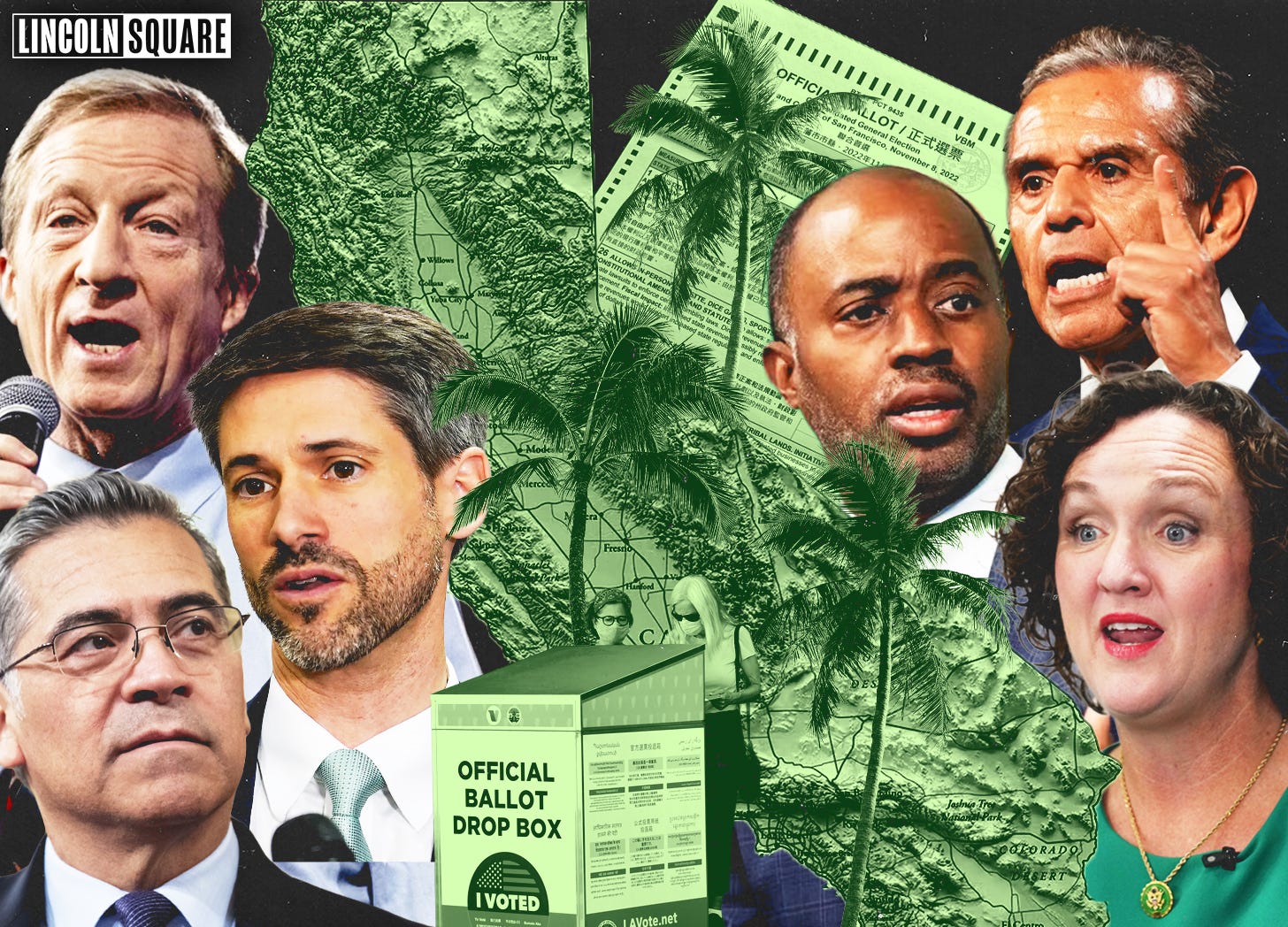
California’s Jungle Primary Could Eat the Democratic Party Alive
A crowded field, a broken political machine, and a simple equation California Democrats are still refusing to solve.
Welcome to the jungle, we got fun and games We got everything you want, honey, we know the names.
There are moments in politics where a metaphor stops being a metaphor and starts feeling like a diagnosis. This is one of those moments. California does not just have a primary — it has a jungle primary, which sounds like something a political scientist invented after watching too many nature documentaries and deciding democracy needed more survival instincts and fewer guardrails. Top two advance. Party labels optional. Coalition-building encouraged. Cannibalism, at this point, strongly implied.
And right now the jungle is doing exactly what jungles do. The biggest predators are circling. The smaller ones are making a lot of noise. Nobody wants to be the one who steps aside, and everyone is pretending that if they just stay in long enough, the vines will part and a path to victory will magically appear. Meanwhile, two Republicans are sitting at the top of the polling like they wandered into someone else’s ecosystem and realized nobody locked the gate.
So yes — Welcome to the Jungle felt appropriate. We have fun and games, if your idea of fun is watching a dominant political party accidentally engineer a scenario where it gets locked out of its own general election. We have everything you want — endorsements, money, name recognition — and none of it is being deployed in a way that resembles strategy. And we absolutely know the names, because California Democrats have made sure to put all of them on the same ballot at the same time and dared voters to sort it out.
The band choice is not accidental either. Guns N’ Roses is a Los Angeles band, born out of the Sunset Strip in the mid-1980s, famous for massive success, massive egos, and long stretches where the members could not stand being in the same room with each other. They made some of the biggest music in the world while constantly threatening to implode, cycling through breakups, reunions, and lineup changes held together with duct tape and nostalgia. When they were aligned, they were unstoppable. When they were not, it was chaos dressed up as a performance.
If that sounds familiar, it should. Because what we are watching right now is the political version of a band that knows all the songs, has all the talent, has the crowd, has the stage — and still cannot figure out how to play in sync long enough to get through the set without somebody storming off mid-show.
Fun and games, indeed.
I was born in California. I was raised here. I have lived in other places — done my time in other cities, other states, other chapters — but I have made Los Angeles County my permanent home. Not just because of the weather, though I will not pretend that does not factor in. Seventy-five degrees in February has a way of making your political frustrations feel slightly more manageable.
I stay because, more often than not, I agree with the politics of this state. Not always. Not even close to always. The current governor, Gavin Newsom, gets on my nerves with a consistency that deserves its own performance review. But that is the nature of governance when you actually believe in it. The politicians who represent your values will still find a hundred different ways to frustrate you, and you learn to live with it because the alternative is handing power to someone who does not share those values at all — and might actively be working to destroy them.
That is not an abstract concern right now. That is the scenario we are staring at, in real time, with ballots about to hit mailboxes and a political jungle that has decided to start acting like one.
I have been covering California politics for nearly fifteen years. In that time, I have watched this state operate like a well-oil machine — not perfect, not without dysfunction, but structurally formidable in the way that only a state with a $4.25 trillion economy, fifty-four electoral college votes, and a Democratic supermajority in both chambers of the legislature can be. And at the center of that machine, for as long as I have been paying attention, has been Nancy Pelosi.
I am going to be mindful of how I say this, not because I am unsure of the point, but because when you are talking about someone with this level of power, precision matters more than volume. Nancy Pelosi is not simply powerful. She is the kind of powerful that makes other powerful people check the room before they speak. She does not just operate within the rules of politics — she has spent decades bending them to her will.
Her endorsements in California Democratic politics have not historically been suggestions. They have been coronations. I watched it happen over and over again across nearly fifteen years of covering this state. When Nancy Pelosi put her name on a candidate, that candidate won. Full stop. The field adjusted. The money followed. The party fell in line like they had just received a group text they all agreed not to acknowledge.
That is not my opinion. That is a pattern I documented in real time, with my own eyes and my own pen.
So when Pelosi endorsed Eric Swalwell for governor, I was not worried. I will say that plainly. While other Democrats were wringing their hands about the crowded field, about too many candidates splitting the vote, about the jungle primary math — I was calm. When Adam Schiff added his endorsement alongside hers, I became even more settled. My read was simple: the machine had made its move. Everyone else will fall in line eventually. The consolidation will happen. It always does.
I was wrong.
And I am not talking about the scandal itself — but about what the collapse of that certainty means for the broader argument about how this party operates, and who has been protecting whom for how long.
I had heard the rumblings. Not about sexual assault — let me be clear about that — but about Eric Swalwell being, let us say, something of a philanderer in political circles. Those whispers were not new. They moved through a tight, insular network of Democratic insiders for years, the kind of information that lives just below the surface of public reporting. And I never wrote a word about it, because I do not report rumors. I do not deal in hearsay. I write what I can verify, and that standard has guided my work for nearly fifteen years.
So let me be equally clear on the other side of this: I am not suggesting Swalwell is guilty or innocent of anything. These allegations are serious. They deserve to be handled in a court of law, not a column. He deserves due process. So do the women who have come forward.
What I am adjudicating is something different. Joy Reid — one of the most plugged-in political journalists in this country — said on air that nobody in the Democratic Party ever brought any of this to her attention. Nobody. And I believe her completely. In a party where information flows like water through every consultant, donor, staffer, and operative in the ecosystem, that kind of silence is not accidental. That is infrastructure. That is the Pelosi machine doing what the Pelosi machine does. If political information were a group chat, she is the one who decides who gets added, who gets muted, and who never even knows the thread exists.
I say that not as an accusation but as an observation: when something circulates in insider circles for years and never reaches one of the most prominent political voices in the country, that is not a leak problem. That is extraordinarily effective information management.
I have interned at law firms. I have worked in courthouses. I have spent enough time around powerful people in high-pressure professional environments — people logging long hours away from their families, their friends, their normal lives — to understand what proximity and power tend to produce in those spaces. I am not naive about it. Which is exactly why what concerns me here is not the personal conduct itself but the institutional decision to look the other way while someone was being positioned to lead the most consequential Democratic state in America.
When Pelosi is good, she is the best political operator this country has produced in a generation. When she overplays her hand, she does not just lose — she loses in ways that pull the floor out from under everyone around her.
This is not the first time. I wrote about it at Lincoln Square and on my Substack: I believe — and I am owning this as my opinion because I cannot verify it — that Nancy Pelosi was the architect behind George Clooney’s New York Times op-ed calling on Joe Biden to step aside. The minute I read that piece, I did not think, “Wow, George Clooney just woke up and chose political courage.” I thought: Pelosi got to him. Because everything about it felt produced. The timing. The messenger. The framing. The way Rob Reiner immediately materialized on every cable news set like he had been waiting backstage for his cue. That did not read like spontaneous celebrity conscience. That read like a rollout. That read like somebody had already workshopped, edited, and greenlit the whole thing before Clooney’s byline ever appeared.
And then what happened next is what always happens when Pelosi runs a play without a full contingency. Biden stepped aside. Kamala Harris became the nominee. And Pelosi — who had the institutional power and the moral authority to deliver a full-throated, unconditional endorsement of the first Black woman nominee of a major party — gave something noticeably less than that. The same woman who can move mountains for her chosen candidates could not find that same energy for Kamala Harris. And I believe that half-measure, in a race decided by razor-thin margins in a handful of states, is part of why we are living through Donald Trump’s second non-consecutive term right now.
Overplaying your hand has consequences. Sometimes those consequences are measured in governorships. Sometimes they are measured in presidencies.
We are the people that can find whatever you may need If you got the money, honey, we got your disease.
That line hits differently when you realize the jungle is now producing candidates who look less like leaders and more like symptoms. Because what this system is spitting out right now are not solutions — they are consequences. Meet the two men currently positioned to potentially lock Democrats out of the California governor’s race entirely, not because they built some unstoppable coalition, but because the other side cannot stop tripping over itself long enough to close the door.
Chad Bianco is the Riverside County Sheriff. He is also a former member of the Oath Keepers — membership confirmed through a 2021 database leak that exposed hundreds of law enforcement officers across the country. His department was placed under investigation by the California Department of Justice in 2023 for patterns of unconstitutional policing, excessive force, and dangerous jail conditions. That same year, eighteen people died in Riverside County jails — the highest number in fifteen years. Earlier this year, Bianco seized over 650,000 ballots based on claims from a conservative activist group, with no forensic analysis, no witnesses, and no independent evidence — essentially running an election audit like it was a Facebook comment section with a badge. The California Supreme Court stepped in and shut it down . He is now running to govern the same state whose elections he was trying to undermine while actively campaigning for the office those elections would decide. If you are looking for a textbook conflict of interest, that is it — wearing a badge and holding a press conference about it.
Steve Hilton is British. Born in London. Worked as a political strategist for former UK Prime Minister David Cameron , moved to the United States, got a show on Fox News, and has decided that qualifies him to run the fourth largest economy on the planet. After Trump lost in 2020, Hilton used his Fox News platform to amplify election fraud claims — clips Trump himself retweeted. During COVID, he went on television and told America the cure was worse than the disease and attacked the “ruling class” for “whipping up fear” about a virus that killed over a million Americans. Trump endorsed him last week, which Hilton is treating like a coronation rather than what the data suggests it actually is: a political forehead kiss from someone whose endorsement has been quietly losing its power from New Jersey to Arkansas to Budapest. More on that shortly.
Here is what is actually at stake for anyone who thinks this is just a California story. California’s GDP hit a record $4.25 trillion in 2025, representing nearly fourteen percent of the entire United States economy, outperforming every other state for the sixteenth consecutive year , growing faster than China, Germany, and Japan. The Port of Los Angeles alone moves over $300 billion in cargo annually . California sends over $83 billion more to the federal government than it receives back . If California were an independent nation, it would be the fourth largest economy in the world . The state holds fifty-four electoral college votes. No Democrat has ever won the presidency without California. No path to 270 exists without it.
Yes, Democrats hold supermajorities in both chambers of the state legislature. That matters. A Republican governor cannot unilaterally pass MAGA legislation. But the governor controls implementation. The governor controls enforcement priorities. The governor controls cooperation — or deliberate non-cooperation — with federal immigration operations targeting communities that have never been charged with anything. A MAGA governor of California is not just a political setback. It is a structural threat to the democratic architecture of the most consequential state in the most powerful country on earth. The world has a stake in this race. I mean that literally.
I did the work. I went through every major credible poll from the past several months — Emerson College, PPIC, RealClearPolitics, David Binder Research, FM3 Research — and I aggregated the numbers so you do not have to. Think of it as a public service. Or think of it as a political intervention. Either way, somebody had to do it, and the results are not subtle.
The RealClearPolitics average before Swalwell’s collapse had Hilton at 14.7%, Bianco at 13%, Porter at 11.3%, and Steyer at 10.3%. The PPIC February survey had Hilton at 14%, Porter at 13%, Bianco at 12%, Swalwell at 11%, and Steyer at 10%. The most recent Emerson poll from early March had Swalwell leading at 17%, Hilton at 13%, Steyer and Bianco both at 11%, and Porter at 8%.
And then there is everyone else. Xavier Becerra: 5%. Antonio Villaraigosa: 5%. Betty Yee: 5%. Matt Mahan: 3% to 4%. Tony Thurmond: 1% to 2%. In some polls, Thurmond and Yee are each pulling 1%. Combined, those two are doing the electoral equivalent of finding a parking spot at the Grove on a Saturday — technically possible, functionally a fantasy.
I have met some of these people. I have no personal issue with any of them. Becerra served as California Attorney General and as Secretary of Health and Human Services. Villaraigosa was Mayor of Los Angeles. These are not names pulled out of a hat. These are people who have done real work in public life. Respect where it is due.
But respect does not override reality, and right now the math is not mathing.
I did not spend six months aggregating polling data so anyone could feel validated. I did it so people could read a room that has been trying to tell them something — loudly, consistently, repeatedly — for months. When you are polling at one percent, two percent, three percent, you are not in striking distance. You are in the way. And this is not personal. This is cold, unforgiving, no-feelings math. Because the last thing California needs right now is a collection of what-if dream scenarios held together by probabilities that only exist if the wind is blowing exactly the right way, Mercury is in retrograde, and half the electorate forgets to check their mail. That is not a path to victory. That is a group project where nobody wants to be the one who drops the class.
When Becerra was excluded from a USC-hosted debate using a formula based on polling and fundraising data, he accused the university of racially rigging the selection process . USC responded that the criteria were entirely objective. I understand the frustration. But calling the math racist because you do not like what it is telling you is not a campaign strategy. It is a press release dressed up as a grievance. The numbers are not discriminating against you. They are describing you. There is a difference.
I want to go on record about something, because my readers know my habits. I do not endorse candidates in primaries. That is a tradition I have maintained throughout nearly fifteen years of political writing in this state, deliberately and consistently. Primary voters should make their own choices. It is not my place to tell Democrats who their candidate should be.
But with three weeks left before ballots close on June 2, I am breaking that tradition — not to pick a winner, but to read a clock. The only two Democrats with a viable mathematical path to the general election are Katie Porter and Tom Steyer. That is not my preference. That is the polling. Every other Democrat still standing at 1%, 2%, 3%, 4% is not running a campaign at this point. They are running a fantasy. And the price of that fantasy is not paid by the candidate. It is paid by every Californian, every American, and every person on this planet who has a stake in whether the fourth largest economy in the world is governed by someone who believes in democracy or someone who spent the better part of this year seizing ballots while filing for the office those ballots would decide.
Becerra, Villaraigosa, Yee, Mahan, Thurmond — I respect the careers, and I mean that sincerely. No personal beef. But the data has been saying the same thing for months and the response has been to rearrange deck chairs and issue press releases. That is not public service anymore. That is stubbornness with a campaign logo on it. California does not have time for it. The country does not have time for it. The world does not have time for it.
Here is the one piece of genuine good news, and it connects directly to what I wrote in a piece called, Budapest Didn’t Get the Memo — And Neither Should You.
Trump’s endorsement of Steve Hilton may actually save us. I know how that sounds. Stay with me.
Since Trump returned to the White House in January 2025, Democrats have flipped nine Republican state legislative seats in special elections. Republicans have flipped zero Democratic seats. Zero. Nine for zero. Virginia went Democratic by fifteen points . New Jersey by fourteen. In Arkansas — a state Trump won by thirty-one points in 2024 — a Democrat flipped a Republican seat in March 2026. In Georgia’s 14th Congressional District , formerly held by Marjorie Taylor Greene, Trump endorsed a candidate and seventeen Republicans refused to drop out anyway. His guy could not clear fifty percent in the most Republican district in the state.
And then last month, Hungary. Trump endorsed Viktor Orbán — a man who spent sixteen years building a system specifically designed to keep himself in power. He changed the election laws. He captured the press. He gerrymandered the maps. He packed the courts. He got the Vice President of the United States to fly across an ocean and hold a rally for him. The Hungarian people showed up at seventy-seven percent turnout — a record in post-Communist Hungarian history — and handed Orbán’s party fifty-five seats while his opponent walked away with 138 seats in a 199-seat parliament . A supermajority large enough to amend the constitution.
Trump’s endorsement is not the superpower it used to be. At the California Republican convention this past weekend, even with Trump’s full backing, Hilton could not secure the party’s endorsement — the final tally was 49% for Bianco to 44% for Hilton , neither clearing the 60% threshold required. In a room full of California Republicans, Trump’s word was not enough to close the deal. That split keeps both Republican candidates viable enough to divide the GOP vote, which is structurally the best scenario Democrats could hope for heading into June 2.
And if the worst case happens anyway — if two Republicans somehow advance to November — yes, California has a recall process. It has been used. The only governor ever successfully recalled in this state’s history was Gray Davis in 2003 . Triggering one requires valid signatures equal to twelve percent of votes cast in the last gubernatorial election — somewhere between 1.5 and 1.8 million signatures for this cycle — followed by months of verification, legal challenges, and an election scheduled within 88 to 125 days after certification. We are talking about well over a year of organized political warfare before anything gets resolved. Nobody who cares about this state wants that. Nobody who understands what is at stake has the appetite for that fight when the alternative is consolidating now, while there is still time.
The fire extinguisher exists. Nobody should want to need it.
It’s a jungle, welcome to the jungle Watch it bring you to your n-n-n-n-n-n-n-n knees, knees.
That lyric is not dramatic flair. It is a warning. Jungles do not reward indecision. They do not reward ego. They do not reward candidates clinging to one-percent polling like it is a personality trait. Jungles reward survival. They reward clarity. They reward the people who understand the environment they are operating in and act accordingly. Everyone else gets swallowed up by it.
California does not need a recall election. California does not need a MAGA governor learning on the job how to weaponize the executive branch of the fourth largest economy in the world. What California needs right now is for its Democratic candidates to read the polling, respect the stakes, and make the decision the moment demands. The bottom feeders need to go. Porter and Steyer need the room. And every Democrat, every anti-MAGA voter, every person who understands what this state means to this country and this world needs to show up on June 2 like the outcome actually matters.
Because it does. Budapest just showed us what happens when enough people decide it does.


Wow! Another dead-square punch thru the veneer into the heart of the matter. As a Californian (Marin) most of my life (now PNW) I am breathless at your dissection of the Pelosi phenomenon. She is indeed super powerful and that power can misfire with spectacular results. I describe my political upbringing (I'm 58) as "Pelosi democrat" which I think explains a lot. The warm glow of the machine when it works is very pleasant and can lead one to comfortably believe that it's all going to work into the future. We really need to get this jalopy back on the rails FAST and get it rolling so we can have nice things that seemed like wallpaper back in the day, such as some notion of support for basic rights, streets free of masked federal thugs bodysnatching, and some shreds of bodily autonomy. Now I'm getting nostalgic and I will see myself out
Well stated. Let's hope the message is clear enough to those who need to hear it.