Breaking Down the Historic Damage of Two SCOTUS Rulings
John Roberts and Donald Trump are moving so fast it's hard to breathe. Let’s stop and look at how SCOTUS just ruled that racial discrimination simply doesn't matter to the law.
Edwin Eisendrath hosts It’s the Democracy, Stupid on Lincoln Square and WCPT820 AM/Heartland Signal. He’s the former CEO of the Chicago Sun-Times, a long-time management consultant, a former Chicago Alderman, HUD Regional Administrator and teacher in Chicago’s public schools. Subscribe to his Substack.
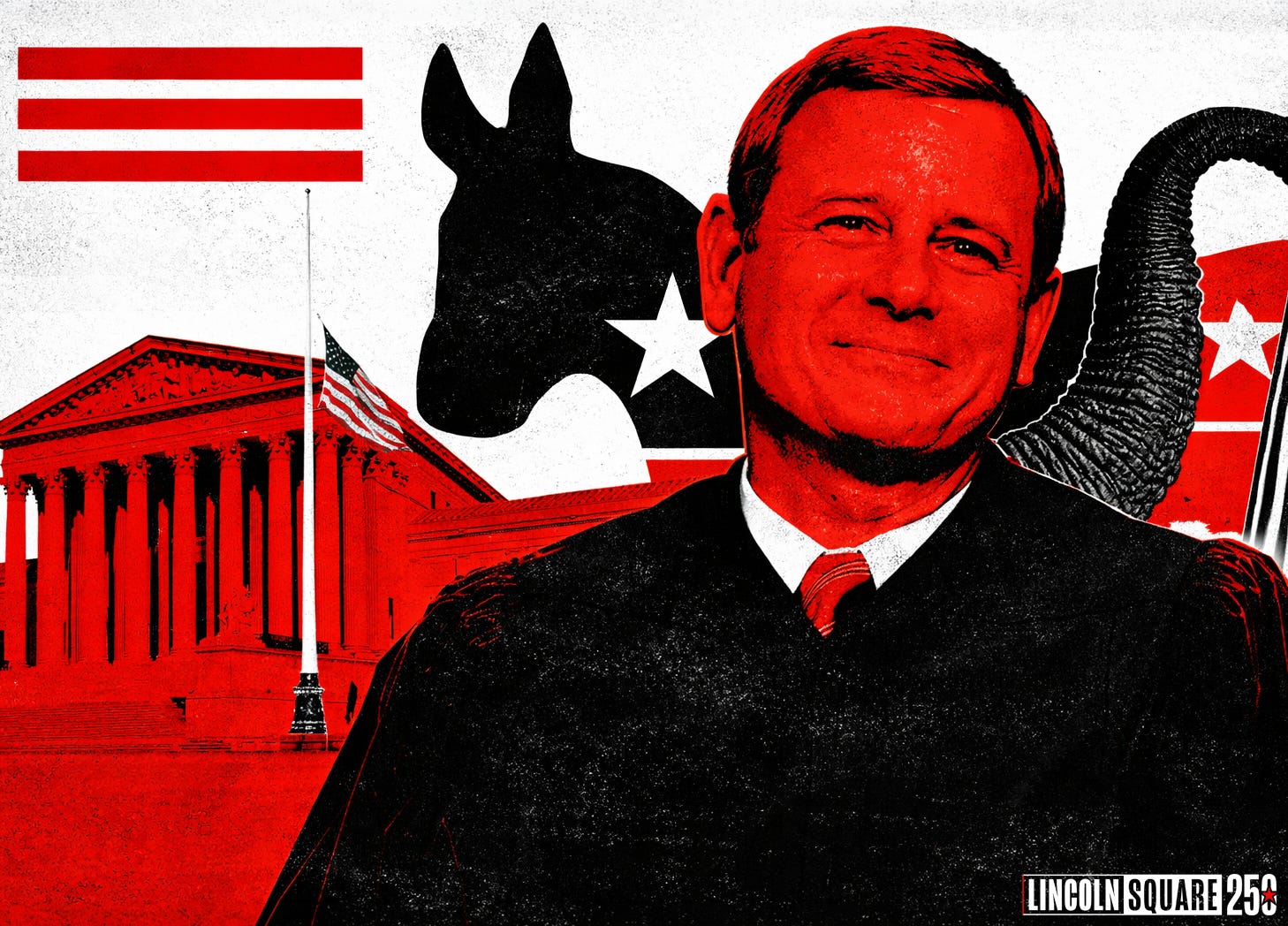
Donald Trump and John Roberts deliver so much bad news so fast that keeping up becomes so all-consuming that there’s no time to think about the extent of the damage they are doing.
That’s part of the autocratic playbook.
I’m not going to fall for it. Instead, I’d like to stop and consider the damage SCOTUS has done this term in just two of its decisions. They cover very different topics, but suffer the same flaws. Together, the decisions in Callais and Mullin v. Doe damage the rule of law, damage American society, and further cement this court’s historically terrible reputation.
Callais overturned the 1965 Voting Rights Act, but that’s not what the conservative Supreme Court said. In its opinion, the Voting Rights Act remains the law of the land. The court was merely clarifying the standards to be used in its application.
But a funny thing happened. A three-judge panel, including two Trump appointees, then applied those new standards to Alabama’s proposed congressional maps and found them in violation of the act. They further found the maps were expressly drawn to weaken Black voters’ power in the state.
The Supreme Court quickly heard an appeal to the lower court’s ruling and overturned it. Never mind what they said in their fig leaf of an opinion. In their view, the law no longer considers the outcome of map making decisions to see if they illegally discriminate on the basis of race and they no longer consider the factual record that maps were enacted for specifically racially discriminatory purposes.
For this court, apparently, Black Americans have no safeguards in political mapmaking which the white man was bound to respect.
Inside the Roberts Court and its Failures
Edwin Eisendrath hosts It’s the Democracy, Stupid on Lincoln Square and WCPT820 AM/Heartland Signal. He’s the former CEO of the Chicago Sun-Times, a long-time management consultant, a former Chicago Alderman, HUD Regional Administrator and teacher in Chicago’s public schools. Subscribe to his
Last week, the Court released its opinion in Mullin v. Doe, which ended Temporary Protected Status (TPS) for at least 350,000 people. In this case, the court expanded Executive Branch powers by declaring they had no power to enforce the procedural obligations of the law.
This is in keeping with the court’s wildly expansive view of executive power, a view that leaves that branch largely unaccountable and unchecked. Then it ignored a lower court determination that found “the decision to end Haiti’s TPS designation was motivated, at least in part, by racial animus.”
In both cases, lower courts had established the facts. In the TPS case, the Trump administration itself has said that Haiti remains highly dangerous. To get to their desired outcomes, the court ignored the factual record, ignored precedent, and ignored the plain intentions of Congress.
In both cases, SCOTUS found that no amount of racial animus, nor any real impact of racially motivated decisions, is relevant to the law. Very oddly, for any court, they have effectively told us that neither motive nor outcome matter.
You really cannot just make racially discriminatory law without undermining the entire edifice of the rule of law for everyone. To apply the principles, SCOTUS uses in these two cases to another context makes the point. A man on trial for murder can now say, “Judge, everybody knows I hated the victim, and I hate his race, and I know everybody’s seen the picture of me standing over his dead body. But according to the Supreme Court my motives and the outcome of any decision I made is not relevant. Heck, you can’t do anything about it so I don’t even need to pay for a pardon.”
This is what the Roberts Court has done.


I know that at one time the Supreme (I laugh as I type that) Court was useful. At this point it ranks with the Electoral College as one of the most useless and corrupt monoliths in these United States. SMDH
The Roberts Court is a success in achieving its objective: supporting and expanding corrupt Presidential power. The Federalist Society has been successful in grooming these people to take down our democracy. Forget what these justices said in their Senate hearings. Their record speaks for itself.