

As America Turns 250, the Free Press Has Never Been More Imperiled
All presidents have hated the press. But Donald Trump's attacks are unprecedented — and they're designed to destroy our democracy.

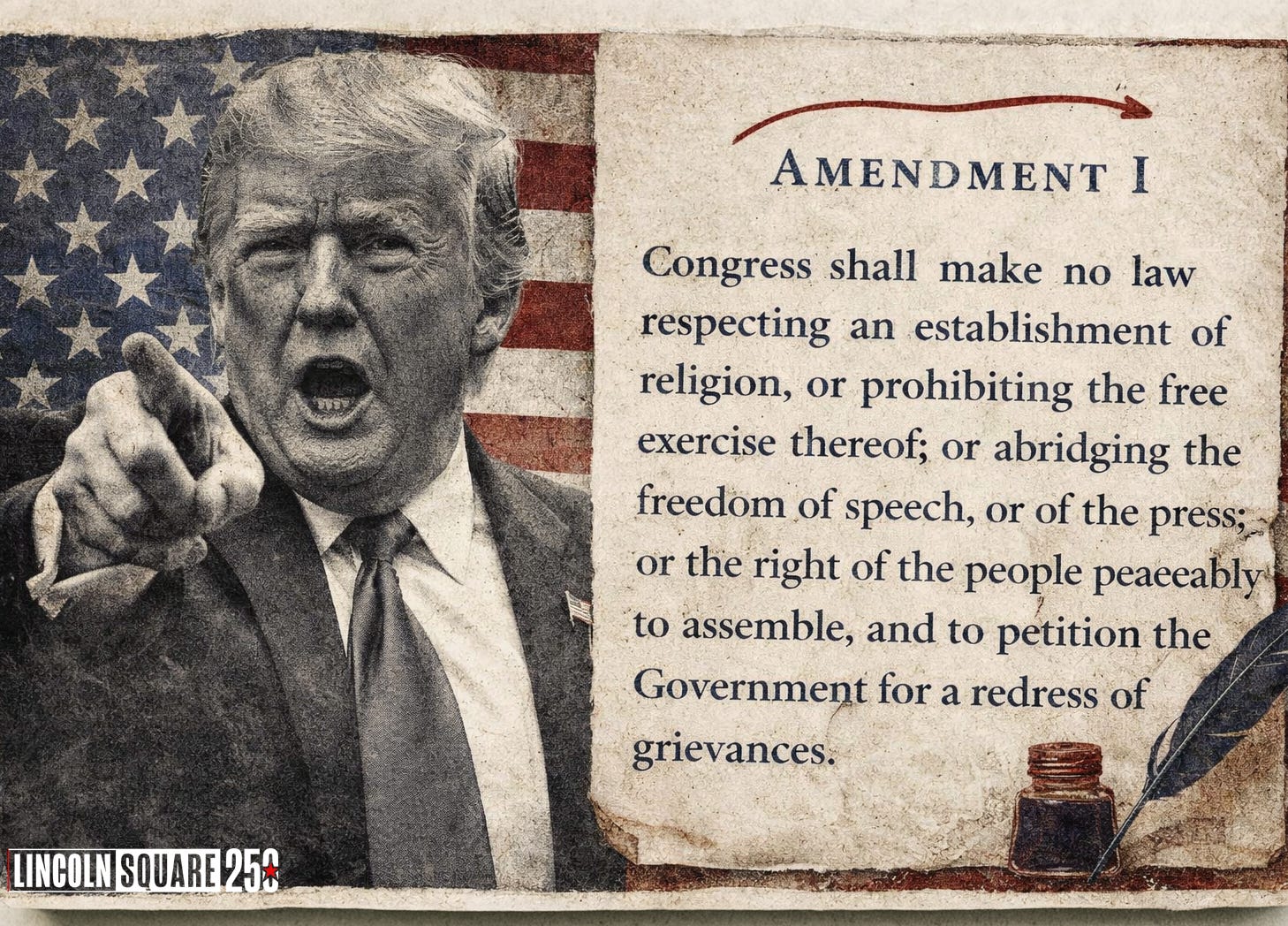
There is a reason the Founders put freedom of the press first in the Constitution.
Not fifth. Not ninth. First — before the right to bear arms, before protections against unreasonable search and seizure, before any of the rights we spend the most time arguing about. The men who wrote the Constitution had just finished fighting a revolution against a king who decided what could be spoken, printed, and protested. They understood, from hard and bloody experience, that a free press was not a luxury of democracy. It was the instrument by which democracy sustained itself.
Without it, everything else collapsed.
Many of them also hated the press with a passion. That’s worth saying plainly on the 250th anniversary of our nation’s birth. Our Founders weren’t saints who loved the idea of journalists holding them accountable. The reality was messier, more human, and ultimately more instructive.
Thomas Jefferson wrote that he would prefer newspapers without a government to a government without newspapers. He also secretly funded a partisan paper to savage John Adams and George Washington, and spent most of his presidency furious at the coverage he received. Adams — who had championed a free press before the Revolution — signed the Alien and Sedition Acts in 1798, making it a crime to publish “false, scandalous, or malicious writing” about the government. He used it to prosecute his political opponents’ newspapers. It was one of the most nakedly unconstitutional things an early American president ever did, and it helped cost him his reelection.
The tension has never fully resolved. Woodrow Wilson signed the Sedition Act of 1918 during World War I, making it a federal crime to criticize the government, military, or flag. Roughly 2,000 people were convicted, including Socialist presidential candidate Eugene Debs, who was sentenced to ten years in prison for a speech opposing the draft. Congress repealed the Act in 1920.
Richard Nixon maintained an enemies list that included journalists. His administration attempted to stop the publication of the Pentagon Papers — classified documents revealing that the government had systematically lied to the public about Vietnam. The Supreme Court ruled 6-3 against prior restraint, and papers ran the story. Barack Obama prosecuted more people under the Espionage Act than all previous presidents combined, creating a chilling effect on whistleblowers and the journalists who worked with them.
Every president has hated the press. Every president has, at one point or another, tried to work around it, punish it, or shame it into silence. This isn’t surprising. Power will always chafe at accountability.
But what Donald Trump is doing is categorically different — and that’s why his threats to the First Amendment are uniquely dangerous.
He is not a president who merely bristles at bad coverage. He is a president who has deployed the full machinery of the federal government in a blatant attempt to make critical coverage impossible — through corporate coercion, regulatory weaponization, physical exclusion, legal harassment, and the outright criminalization of dissent. There is no precedent for the scale and deliberateness of what is happening right now. Not Adams. Not Wilson. Not Nixon.
Let’s start with the corporate machinery. The Trump Department of Justice recently approved the $111 billion Paramount-Warner Bros. Discovery merger — a deal that will consolidate CBS News, CNN, HBO, and two major movie studios under the control of the Ellison family, described by the New York Times as closer to Trump than any mogul outside of Elon Musk. The TikTok deal similarly was handed to Trump’s allies. These are not coincidences. These are transactions — antitrust approval in exchange for editorial loyalty.
And the media companies that haven’t been rewarded are getting the stick instead of the carrot. ABC paid $15 million to settle Trump’s defamation lawsuit — money that went directly to his presidential library. CBS/Paramount paid $16 million more to settle his lawsuit over a 60 Minutes interview with Kamala Harris. These were cases that legal experts said would never survive a courtroom. But the companies settled anyway, because picking a legal fight with this administration costs more than the settlements did. Jeff Bezos fired a third of the Washington Post’s newsroom — after obeying in advance by spiking its 2024 Harris endorsement — rather than give Trump’s DOJ a reason to scrutinize his real cash cow, Amazon.
This is what a free press looks like when it’s being bought off, one settlement and one merger approval at a time.
The mechanism for that coercion has a name: Brendan Carr. Carr wrote the Project 2025 chapter on the Federal Communications Commission before Trump appointed him chair and it shows. He’s threatened broadcast licenses over network coverage of the Iran war, launched investigations into NPR and PBS on false pretenses, and opened an inquiry into The View.
The Paramount-Skydance merger lays the shakedown’s mechanics bare: Paramount executives suspected Carr deliberately slow-walked his merger approval while Trump’s lawyers negotiated the 60 Minutes settlement. Paramount paid its $16 million. Carr approved the merger within days. In September, Carr told a right-wing podcaster that Jimmy Kimmel’s on-air comments were “a very, very serious issue for Disney” — and hours later, Kimmel’s show was pulled. (He was quickly put back on air after public outcry. And to his credit, the comedian still hasn’t pulled any punches when it comes to Trump).
When ‘60 Minutes’ Caved, That Told Trump Everything He Needed to Know

Susan J. Demas is Lincoln Square’s Executive Editor and a 25-year journalism veteran. Subscribe to her Substack.
Legal experts note that the FCC doesn’t actually license television networks, only individual stations, making Carr’s threats legally hollow. But a threat doesn’t have to be airtight to work. It just has to be expensive enough that the target decides capitulation is cheaper than the fight.
Then there’s the administration’s aggressive campaign to reshape who gets to be in the room covering them. The Pentagon, under Defense Secretary Pete Hegseth, announced restrictions requiring journalists to submit reporting to the Pentagon Press Office before publication. Nearly every member of the traditional Pentagon press corps turned in their badge rather than comply. The Defense Department responded by assembling a coterie of loyalist outlets — OAN, the Gateway Pundit, the Epoch Times, and LindellTV, the streaming network of MyPillow CEO Mike Lindell. They don’t do actual journalism and that’s the point. They might have fancy press badges now, but they’re still propaganda operations.
And then there are the reporters who get lambasted by the president every day just for trying to do their jobs. When Bloomberg correspondent Catherine Lucey asked Trump about the Epstein files on Air Force One, he told her: “Quiet. Quiet, piggy.” He has told female reporters they’re “stupid” and “ugly” and asked why they never smile. The Society of Professional Journalists called it “an unmistakable pattern of hostility — often directed at women — that undermines the essential role of a free and independent press.” The pattern is deliberate. It is designed to train reporters to self-censor, and to train the public to dismiss the reporters who don’t.
This assault extends beyond the press. The right to peaceably assemble — also in the First Amendment — is being systematically criminalized by the Trump administration. Six immigration protesters in Chicago — the Broadview Six — were indicted on felony conspiracy charges for attending an ICE protest, before all charges were eventually dropped after prosecutorial misconduct was revealed. Fifteen people in Minneapolis face federal charges for blocking ICE agents, with thirty more indicted over a protest at a church.
Trump has attacked the No Kings protesters — millions of Americans who took to the streets to say, simply, that our country was founded on the idea that we don’t do kings here and we’re not about to start now — as violent, unpatriotic, and extreme. In reality, we were exercising the most fundamental right this country was founded upon. We fought a revolution against a king. The whole point was that we wouldn’t have another one.
Here is what I keep coming back to: presidents who go to war with the press eventually lose. Adams lost his reelection. Nixon resigned. The First Amendment has held, imperfectly (and sometimes barely), because there were always institutions, journalists, and courts willing to defend it.
Trump’s First 100 Days Shows Mainstream Media Is Almost Dead. Long Live Independent Media.

In thinking about Trump’s first 100 days, it’s the endless loop of horrors that first comes to mind:
What is different now — and what terrifies me as someone who has devoted 25 years to this profession — is the stranglehold corporations have on our media and the depth of their capitulation.
Too many of the organizations that should be fighting the hardest are settling the quickest. Too many reporters who should be asking the hard questions are calculating how to preserve their access — as if access to a man who lies constantly is worth having. Access journalism is the enemy of actual journalism. Getting Trump’s personal cell phone number in exchange for softer coverage doesn’t give you better information. It gives you better access to lies.
That’s why independent media matters on this 250th anniversary more than it ever has. Those of us at Lincoln Square and other outlets who don’t have billionaire owners to answer to, who don’t have merger approvals to protect, who don’t have regulatory exposure that makes us flinch — we are not covering this administration because it’s good for business. We are covering it because the Constitution says someone has to. The press is not “the enemy of the people.” The press is the last line of accountability between the people and the powerful. That is exactly why Trump wants it gone.
On the 250th anniversary of a republic that was built on the radical idea that the government answers to the people — not the other way around — the most patriotic thing any journalist can do is refuse to stop saying so.
We’re not stopping.
250 years of democracy means nothing if we give up now. Lincoln Square is launching a massive campaign to arm disengaged voters with the facts about the ongoing assault on our democracy. Help us reach the citizens who will decide America’s future with a $2.50 or $25 donation today.

Bezos' "obeying in advance" is exactly what Tim Snyder warns about, and he's right. It's a fast track to tyranny. I consider his WaPo, along with CBS/Paramount (Ellison), Disney/ABC, and Warner/CNN a cancer just as toxic as Fox – possibly more so because they're a little more subtle and slippery. From a behaviorist POV it's a basic reinforcement loop. Organization X capitulates and gets rewarded. Tyrant Y (or DT) notices the response and doubles down on the tactic. And so it goes. At its core it's greed enabled by unbridled capitalism. We need the modern day equivalent of Jefferson's newspaper, in terms of power, sans the skullduggery. I'm sure we can do better than this.
It doesn't help that so many members of the White House press corps seem to be immune to the concept of "follow-up question." How many times has Trump not answered a direct question, pivots, or goes on one of his idiotic stream-of-conciousness rambles, and then the next reporter in line asks a question on a completely different topic? And why is it not objective journalism for a reporter to challenge him when he opens his mouth and tells one of his endless series of lies? Such as, when he tells us for the millionth time that he won the 2020 election, they could state the fact that "No, you did not, that's a lie." The guy is an authoritarian, doing everything he can turn America into an autocracy, with himself as the King. I wish press corps would treat him as such.