2026 Is the Year to Make Trump Afraid
Stop talking about “making his job harder,” Democrats. Flip the House, force the Senate to choose, and treat “impossible” like a dare.
Kristoffer Ealy is a political scientist, political analyst, and professor in Southern California. He teaches American Government and political behavior, with a focus on political psychology, voting behavior, and political socialization. Subscribe to his Substack, The Thinking Class with Professor Ealy.
I was having a conversation with a few of my friends about Jasmine Crockett and James Talarico—who was more likely to win the Democratic Texas Senate primary. Of course I like Jasmine Crockett. I’ve written about her before, and I’m not going to pretend I suddenly became Switzerland because somebody discovered the word “electability” on TikTok. A few of my friends thought Talarico was the safer bet. But one of my homegirls cut through the whole conversation with the kind of confidence people only get when they’re about to make a statement that sounds like “realism” but is actually just fear with a clipboard.
She said it doesn’t matter because neither of them are going to win.
I asked her to explain herself.
She said Crockett is popular nationally, but she has watched Democrat after Democrat lose statewide in Texas. She said even if every Black person in Texas voted for Crockett, the math still isn’t there for her to win.
I said, “Interesting.”
She said, “Oh come on, Kristoffer, you are smarter than that. You know she is not going to win.”
And I told her, “Because I am smarter than that, I never say things like you just said.”
Because the minute you start speaking in absolutes is the minute you give away your leverage. You’re not describing reality—you’re surrendering to it. You’re telling the other side you’ve already accepted their world, which means they don’t have to beat you. They just have to wait you out.
She asked what I meant, and I said what I always say when people talk about politics like it’s a weather forecast and not a fight: it’s not possible until it becomes possible. Nothing is guaranteed. And before anybody starts clutching pearls, understand what I’m not saying. I’m not pitching some magical third-party rescue mission where the math doesn’t exist and the “movement” is basically a group chat with a logo. I’m talking about strategy—real, boring, ruthless strategy: voter turnout, persuasion, coalition expansion, and yes, manipulating the map in our favor the way Republicans have been doing for years.
People used to say AOC was a nobody until she beat Joe Crowley, a ten-term incumbent who had been in Congress since 1999 and walked around like the seat came with his name stitched into it. People used to say we would never have a Black president until Barack Obama made that sentence look stupid in real time. People used to say abortion was settled law until it wasn’t. That’s the point: politics is full of things that were “impossible” until the day they happened, and then everybody rewrites their memory like they always saw it coming. That’s not insight. That’s denial management.
My homegirl wasn’t moved. She pivoted and said, “Well one thing that is definitely guaranteed is that if Democrats take back the House and Trump gets impeached, the Senate won’t vote him out.”
I said, “Well?”
She said, “Don’t tell me you’re saying that’s going to happen.”
And I told her the truth: all I’m saying is I can’t emphatically say it won’t happen.
Right about now, some of you are reading this thinking Professor Ealy has finally snapped. I promise you, I have not. I just think Democrats think way too small. They let Trump get away with everything and then present the only “realistic” plan as holding our breath for the next three years and hoping a new president shows up like a contractor with five stars, a free estimate, and “Democracy Repair” listed under services. That’s small time. That’s surrender in a blazer. It’s the political equivalent of watching your house catch fire and deciding the solution is a nicer smoke detector—like the flames are going to see the new model and go, “Oh wow, my bad.”
From the moment Donald Trump beat Kamala Harris, I’ve been strategizing in my head: how do we get rid of this motherfucker in two years? Not in a “post a meme and manifest” way. In an actual, adult, structural way. In the “how do we remove the tools he’s using to do damage” way. The kind of thinking that makes you sound like you’re spiraling at brunch until you remember spiraling is what happens when you’re watching your country normalize authoritarian behavior like it’s a new streaming service package.
I started thinking about it the way people think about getting out of a gym contract. You don’t just “hope it ends.” You look for the cancellation policy. You read the fine print. You hunt for the clause that says they have to let you out if the building collapses. And then—purely in the spirit of research—you start wondering how close the place is to being declared structurally unsound. Not literally, calm down. I’m talking metaphorically, before somebody on cable news pretends they’re doing homeland security because a Black man used an analogy.
Then the special elections in 2025 started happening and I remember thinking, damn… this Trump-era brand of governance is not popular at all. Not “people complain online” unpopular. I mean the kind of unpopular where voters who barely show up for anything are suddenly showing up to vote like somebody told them the rent is due in 30 minutes. Special elections are not perfect predictors of general elections, but they are real-time indicators of intensity. They show you who’s mad enough to get off the couch when nobody is watching. That matters, because anger and motivation are fuel. In low-turnout elections, the side that is more motivated can turn a “safe” seat into a problem.
I was disappointed that Aftyn Behn lost that special election in Tennessee, and I’m not going to pretend otherwise. I always want to see Democrats win, especially in places where the Democratic brand has been treated like a disease. But as someone who went to part of middle school and high school in Tennessee, I had a pretty good feeling she was going to lose. Some districts are so red they don’t even vote; they just show up to the polling place to confirm their identity as Republicans. You can drive through parts of Tennessee’s 7th and feel the air itself looking at you like, “What church do you go to, and why is it not the right one?” It’s conservative out there in a way that doesn’t even feel political. It feels cultural. It feels like an inherited reflex.
Still, when I saw the actual margin, I was genuinely surprised. Not because I expected her to win—but because of how much movement she created in a district that treats Democrats like a communicable disease. Behn lost, but she didn’t get vaporized: Matt Van Epps beat her 53.9% to 45.1%—about 97,034 votes to 81,109, a gap of roughly 15,925 votes (about 8.8 points). When you know a place, you know what “impossible” usually looks like. You know what “no chance” usually sounds like. So when a Democrat pulls that kind of share in Tennessee’s 7th, it tells you something: the environment isn’t locked in, persuasion exists in places people swear are unreachable, and the Republican hold isn’t a law of nature—it’s a habit. And habits can break.
Then you get to Texas, and you can stop pretending this is just a story about “deep red places.” Texas gave us a flashing sign in the sky, because in State Senate District 9—a district Donald Trump carried comfortably in 2024—a Democrat named Taylor Rehmet won a special election runoff by a margin that was not cute, not squeaky, not “we’ll see in November.” He flipped it. In Tarrant County. In north Texas. In a place Republicans assumed would behave. They tried to downplay it as local, as weather, as turnout, as anything except what it really was: a warning.
I want you to understand what that means. Republicans have spent years insisting they are the permanent majority, the silent majority, the real America, the people who don’t need to change because demographics and institutions and the rules will do the work for them. A special election like that isn’t just a seat. It’s an interruption. It’s voters saying, “We see what you’re doing, and we don’t like it.” And that has consequences if Democrats are willing to act like consequences are possible.
This is the part where Republicans tell you not to get excited because “more voters will vote in the general election.” That is true in the most basic, boring sense. Midterms have higher turnout than special elections. But higher turnout does not automatically restore Republican dominance. It doesn’t automatically erase backlash. It doesn’t automatically undo persuasion. It doesn’t automatically refill enthusiasm for policies voters don’t like. If anything, higher turnout can amplify discontent if the discontent is the reason people are waking up.
What happened in Texas wasn’t an apparition. It wasn’t a ghost story. It was a data point—one of those moments that makes people in power start sweating through their confidence.
And to be clear: Republicans were already reaching for the ugliest tool in the box months earlier. Back in the summer of 2025, Trump leaned on Governor Greg Abbott and Texas Republicans to redraw congressional districts mid-decade—because when you can’t reliably win voters, you try to win the lines. That’s what these redistricting games always are: an admission that your product is unpopular, so you’re going to rearrange the shelves and hope the customer can’t find an alternative. Texas Republicans were reportedly reluctant at first, and then Trump got involved, Abbott called the special session, and suddenly the “reluctance” turned into political muscle memory: do what he wants, avoid his wrath, keep the coalition together, pretend this is normal.
But here’s the part that matters now: a redrawn map is not a force field. Gerrymandering is a bet. It only works if the electorate behaves the way you need it to behave. And that Texas special-election swing is exactly why the “map fix” isn’t guaranteed—because it shows the environment can shift hard enough to blow through the assumptions Republicans are counting on. If voters are moving in places Trump carried comfortably, then slicing the state into prettier shapes doesn’t automatically save you. It just means you’re trying to game the rules while the public mood is turning against you.
Here’s the thing Democrats have to say out loud: redistricting is not a force field. Gerrymandering is a bet. It’s a bet that the electorate will behave normally while you govern abnormally. It’s a bet that swing voters will keep acting like referees while you’re turning the entire sport into a cage match. It’s a bet that outrage will burn out before it reaches suburban voters and working-class voters who are watching their lives get worse while politicians laugh on camera. Texas just showed that bet can fail.
If Republicans are rushing to manipulate the map, that’s not dominance. That’s panic.
Now, we need to talk about Trump himself, because the most important thing about Trump is that he is not popular. Never has been. He postures like a man beloved by the nation, but he has spent his entire political life surviving on narrow margins, structural advantages, media addiction, and the willingness of elites to tolerate him because they think they can control him. He’s not popular. He’s loud. Those are not the same thing.
In 2016, he won the Electoral College and lost the popular vote. In 2020, he lost to Joe Biden, and it drove him so crazy that it inspired some idiots to storm the Capitol like they were reenacting a Civil War fanfiction. In 2024, he won again, but not by some historic margin that proves the nation embraced him. He barely beat Kamala Harris in the popular vote by a couple million votes—close enough that nobody with a functioning brain should be calling it a mandate. His brand is not majority America. His brand is a radicalized coalition, a captured party, and a set of institutional levers that can turn minority rule into national control.
And let’s not pretend Election Day was normal. The FBI publicly acknowledged bomb threats to polling locations in several states, many tied to Russian email domains—and Reuters reported the threats hit five battleground states: Georgia, Michigan, Arizona, Wisconsin, and Pennsylvania. None were deemed credible, but credible or not, the point is disruption. The point is intimidation. The point is chaos aimed at the exact states that decide elections, designed to make people wonder whether voting is safe or whether showing up is worth the hassle. That’s the kind of environment Trump thrives in—not because he’s loved, but because confusion and fear do part of his work for him.
So if you’re going into November 2026 believing Trump is some unstoppable political force, you’re already playing his game. His obsession with getting back into the White House has to become his downfall, and there are strategic ways to do this. The posture from Democrats has to be: we want to get rid of this guy. Have him removed. Not “make his job harder.” Not “hold him accountable in the court of public opinion.” Not “send a message.” People are exhausted. People are angry. People are scared. “We’ll try to slow him down” is not a message that moves people. That is the political version of telling somebody, “I know you got robbed, but we’re going to put the thief on a performance improvement plan.”
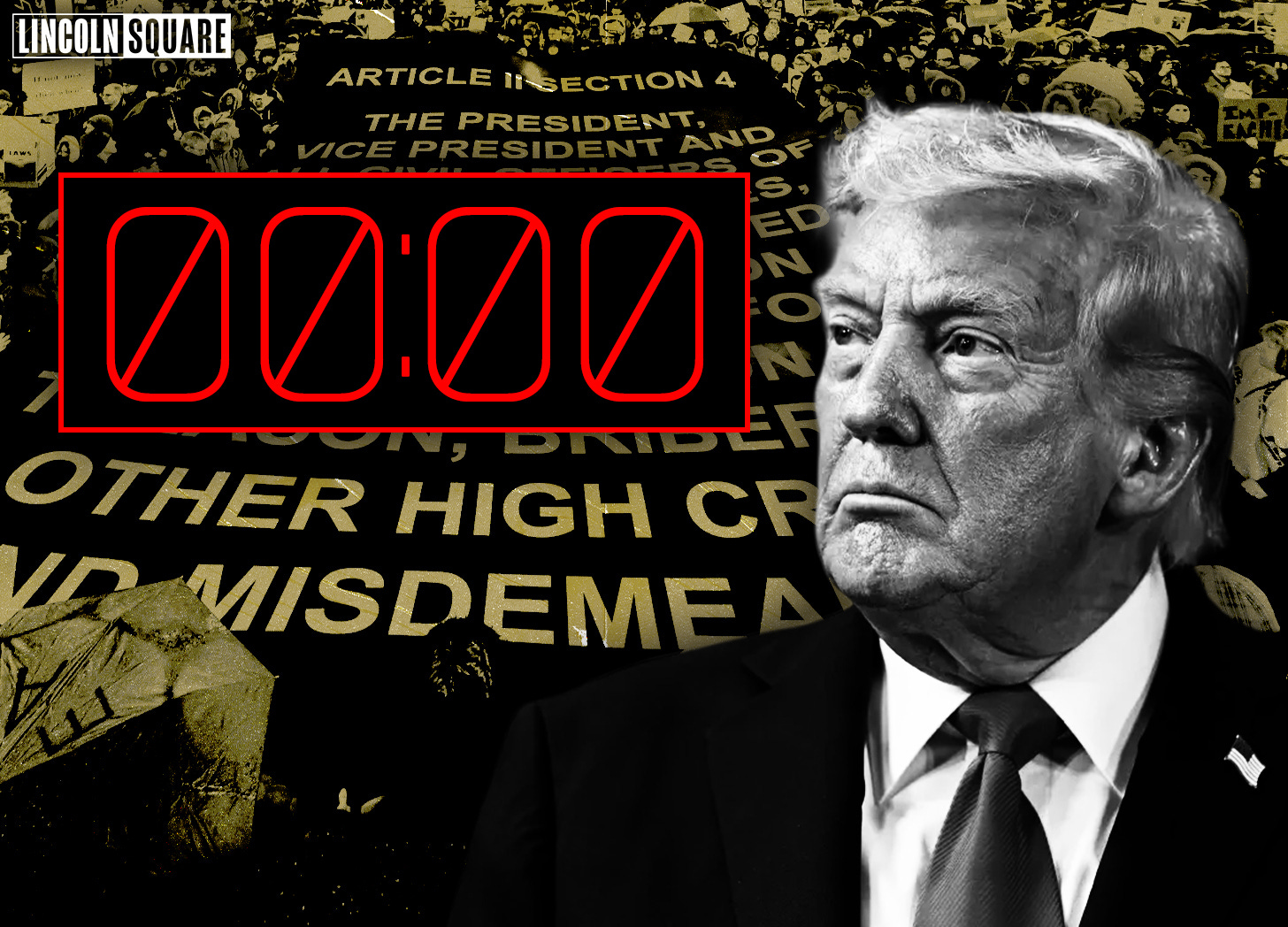
Now, this does not mean you promise voters you will have him removed. Politics is not a guarantee. It is a fight. But you also cannot walk into November 2026 saying, “Our goal is to make his job harder.” That is not going to cut it. People running for office need to make clear that every legal path to kick this man out of power will be explored, and removal is one of those paths. That’s not extremism. That’s literally how the Constitution is designed to respond to a president who abuses power. The only reason it feels “radical” is because Democrats have been trained to treat normal accountability as if it’s impolite.
To make this realistic, we have to talk about the Senate map. It’s difficult. Thirty-five Senate seats are up in 2026, and the distribution does not automatically favor Democrats. That’s the part people use as an excuse to shut their brains off. They say “the map is hard,” and then they act like the map is the will of God instead of a political problem to solve. But the question for anyone who cares about democracy is not: “Is it hard?” The question is: “How do we manipulate the map in Democrats’ favor?” Because politics is manipulation. Not in the shady sense. In the strategic sense. You’re trying to assemble majorities. You’re trying to shape turnout. You’re trying to recruit candidates who can win. You’re trying to force the other party into bad decisions. You’re trying to turn their panic into mistakes.
I believe the House gets more locked up for Democrats with each passing day that Republicans choose cruelty, chaos, and corruption over governing. The House is where the removal strategy begins because the House is where impeachment begins. If Democrats take the House, they get committee gavels, subpoena power, investigative power, and the ability to force the country to confront what’s happening without waiting for corporate media to decide it’s safe to talk about. That matters because sunlight is not enough, but sunlight plus power becomes leverage.
Republicans are going to tell you what happened in Texas doesn’t matter. They’re going to tell you it was a one-off. They’re going to tell you it was weather. They’re going to tell you Democrats got lucky. They’re going to tell you the district was “changing anyway.” They’re going to tell you anything except the truth: that voters in a Trump-friendly district just told them to go to hell.
And here’s why it wasn’t an apparition: the margin wasn’t razor thin. It wasn’t a coin flip. It wasn’t “a few hundred votes.” It was a swing that reflected intensity. It reflected an energized Democratic base and persuadable voters breaking away from Republicans. Special elections don’t manufacture that. They reveal it. They reveal who is motivated and who is complacent. They reveal whether the party in power is bleeding support. They reveal whether the other party is waking up.
Then look at the special elections this past November. Democrats didn’t just win. They destroyed Republicans in key contests and flipped a meaningful number of state legislative seats that Republicans had treated as safe. And I wrote about this already: Democrats showed up, organized, and overperformed. They didn’t do it because the media told them to be hopeful. They did it because voters are reacting to what Republicans are doing. That’s the part Democrats keep missing: voters respond to power. They respond to consequences. They respond to seeing a party actually fight back with the tools available.
Now, right about now you’re probably asking if I’m on drugs and if I honestly think Democrats can get a Senate supermajority. No. That is not the claim. The claim is that trends matter, and fear matters, and incentives matter. A supermajority might not be over the horizon. But don’t think for one second that a three-, four-, or five-seat majority is out of the question if Democrats stop acting like they’re allergic to strategy.
This is where people get tripped up, so let me say it plainly: you don’t need every Republican senator to become a hero. You need enough of them to become afraid.
If Republicans get mollywopped significantly in 2026, the ones left over are going to have to seriously consider what their 2028 looks like. That is how politics actually works. People talk about “courage,” but most politicians don’t move because they found morality in a jar behind their desk. They move because the incentives changed. They move because the risk changed. They move because they can feel the ground shifting under them and they don’t want to be the last person standing on the wrong side of history when the cameras are rolling.
A significant shellacking can put the fear of God in Republicans in a way that normal election cycles do not, because this cycle is not normal. Trump is not a normal president. Trump is not a normal political figure. He is a chaos engine, and every Republican tied to him is betting their future on the idea that chaos is sustainable. If 2026 delivers a clear voter rebuke, that bet becomes expensive. And when it becomes expensive, the behavior changes.
That’s why the goal is not just “win seats.” The goal is to reshape the incentive structure inside the Republican Party. You want the survivors looking at the next two years thinking, “If I keep tying myself to Trump, I may not have a career.” You want them thinking, “If I keep defending him, I might not survive a general election.” You want them thinking, “If I keep pretending this is normal, voters will punish me.” Fear is not pretty, but fear is effective. Republicans understand that. Democrats act like it’s impolite to say.
This is also why Democrats need to stop talking like they’re writing a gentle email to a hostile employer. This is not customer service. This is power. If you want removal to be possible, you need the House to be willing to impeach and the Senate to be in a political environment where conviction becomes plausible. Plausible does not mean guaranteed. It means there is a path. It means there is pressure. It means there is a coalition. It means there are defectors. It means there are Republicans who decide their future matters more than their loyalty to a man who will throw them under the bus the minute it’s convenient.
And Democrats need to stop telegraphing weakness. Stop telling voters, “We just want to make his job harder.” That is safe language for politicians who don’t want to be held accountable for outcomes. It is the political equivalent of saying, “I didn’t come here to solve the problem, I came here to manage the optics of the problem.”
People do not vote for optics. People vote for outcomes. People vote because they want relief. They vote because they want protection. They vote because they want stability. “We’ll make it harder for him” is not a reason to stand in line. It’s not a reason to donate. It’s not a reason to volunteer. It’s not a reason to convince your cousin who hates politics to get off the couch. It’s not a reason to believe. It’s a reason to yawn.
So the posture has to be: we will do what is necessary to get rid of him.
Again, not as a promise. As intent. As a plan. As a commitment to use the mechanisms available. If the mechanisms are there, removal has to be a possibility. That includes JD Vance, too, because this is not just a personality contest. This is a political project. It’s about staffing the government with loyalists. It’s about weakening checks. It’s about turning agencies into personal weapons. It’s about punishing enemies. It’s about rewarding allies. It’s about turning the machinery of the state into a tool of political intimidation. That does not end because you “make his job harder.” It ends because you remove the people running it or you strip them of the power to keep doing it.
This is where Democrats need discipline, and Democrats rarely have discipline. Democrats love to fall in love with rhetoric and abandon strategy. They love to chase the next headline instead of building a coherent narrative for voters. They love to treat elections like therapy sessions where the goal is to feel morally pure instead of win. That has to stop. The stakes are too high for Democrats to keep acting like the objective is to demonstrate they are nicer people than Republicans.
You want to sound like a strategist? Then talk like one. A strategist says: here is the objective, here are the constraints, here are the levers, here is the timeline, here are the indicators, here are the ways we can win even if the map is hard. A strategist does not say “it’s hopeless.” A strategist does not say “we’ll see.” A strategist says “we’re going to force a choice.”
That’s what impeachment talk is, at its core: forcing a choice. Forcing Republicans to go on record. Forcing senators to decide if they want to be the last defenders of a man who is politically radioactive. Forcing the media to cover the facts instead of the spin. Forcing voters to see the stakes in a concrete way. Even if removal is uphill, the pursuit itself can shift the political landscape because it turns abstract fear into a visible fight. And voters respond to fights when they believe someone is actually trying to win.
Texas showed Republicans are not invincible. Tennessee showed movement exists even in deep red places. Special elections showed intensity is shifting. Trump’s history shows he has never been beloved by a majority of Americans. The myth of Trump as some unstoppable force is a psychological trick he plays on the country and on the Democratic Party. He wants Democrats to think they can’t beat him. He wants Democrats to shrink their goals. He wants Democrats to pre-surrender by telling themselves “it can’t be done.”
That’s why I keep repeating it: it’s impossible until it becomes possible.
Politics has no permanent truths—only temporary assumptions. The rules don’t “hold” because pundits repeat them; they hold because voters keep behaving the same way. Change turnout and you change the math. Change the mood and you change what’s possible. The only thing that’s inevitable is whatever you stop fighting.
Democrats need to abandon the safe words. This is not S&M. Don’t run with the plan of “we’ll put up with Trump’s bullshit for the next three years and then fix everything with a new president.” That posture is how you lose people. That posture is how you demobilize voters. That posture is how you tell the country, “We have accepted our role as the opposition party in a system where opposition doesn’t stop the damage.”
No. The posture has to be: we will do what is necessary to get rid of him. We will use the House. We will use oversight. We will use subpoenas. We will investigate. We will impeach if the evidence and the moment demand it. We will force the Senate to choose. We will make every enabler decide if their future matters more than their obedience. And if the mechanisms are there, removal has to be a possibility. Not a promise. A possibility. Because telling voters you won’t even try is political malpractice.
Democrats don’t need to sell voters a fairy tale. They need to sell them a plan with a spine: win power, apply pressure, force accountability, and make every enabler choose—publicly—between Trump and their own survival. That’s how “impossible” starts becoming possible. Not through hope. Through leverage.
And that’s the part Republicans fear more than any Democratic speech: the moment they realize the fear isn’t “I can’t survive.” The fear is “I am no longer guaranteed to win.”


Thank you, Kristoffer. I so needed to hear this. I have done a bit of table slapping when I have heard from the other end of the table, "Well, we need to be careful. We might get a worse Republican candidate than the one now in position." Like that worse candidate is a foregone conclusion. I didn't exactly yell after the hand slap, but in my most scary voice (I do have one.) I said the state dems. and government can do more. Let's use the power we have. etc... I have also heard people so disgusted with the dems. that they are walking away. I don't know where they are going--but away. What the "hey" walkers--not helpful. Plan and fight. And tell the world how we will hold the regime accountable. Keep yelling and also plan.
You put this out so well Prof. I have nothing to add except another big thank you. 😼❤️🙏
Thank you for the article, Kristoffer. Today we are in political populism and not culture populism. Only this administration wants to live in both populism. President Andrew Jackson was not a hero. The Indian removal act Aka Trai of tears. To myself it was a brokered land deal for whites only! If you like Independent Journalism and Columnist please subscribe to Kristoffer Early.