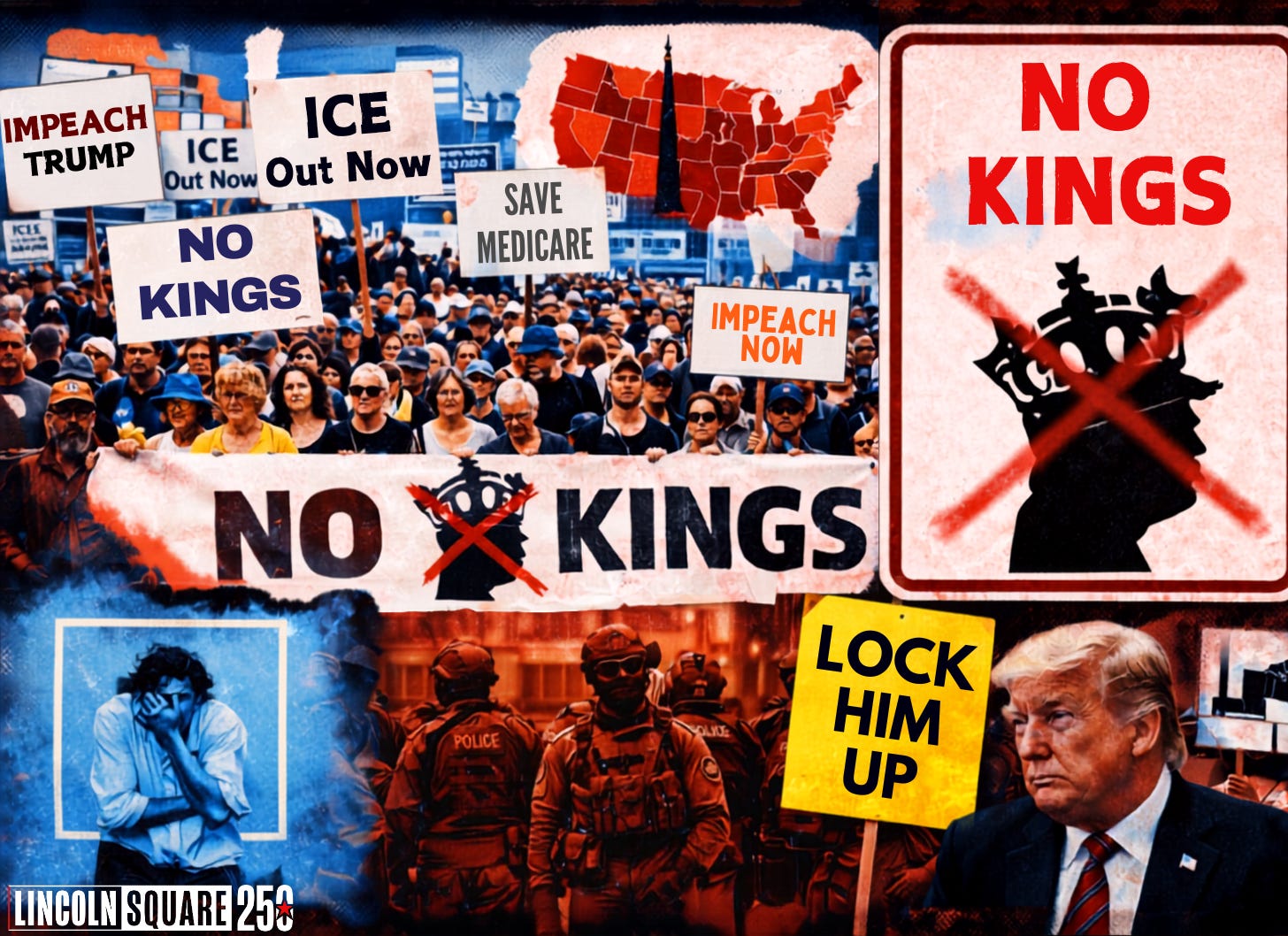
We Need Another No Kings Protest Before November
The mass rallies were joyful, unifying events. After a long, hot Democratic primary season, we're going to need that energy going into the November election.
I’ve attended all three No Kings rallies in different cities across the country. And after the last one in March, I felt something I hadn’t felt in a long time: actual hope. Not the gritted-teeth, we-have-no-choice variety. Something far more inspiring.
Eight million people — the largest single-day demonstrations in American history — showed up in more than 3,300 locations across all 50 states, as well as in other countries, waving signs against ICE, the Iran war, health care cuts, gerrymandering, tax breaks for billionaires, and more. Our message was clear: This is not who we are. Donald Trump may be president, but we don’t do kings in this country. We still have the First Amendment and we’re not afraid to use it.
There were families with kids in strollers. People brought their dogs. There were old union guys, college students, and former Republicans attending their very first protest. There was music. There were booths where you could sign up to canvas.
Four months later, a good chunk of the pro-democracy coalition seems to be screaming at each other online during the last gasps of a heated Democratic primary season.
And I’m worried that we’re losing sight of job one: winning in November so we can stop as much of the damage Trump is inflicting on our country as we can. Before it’s too late.
The No Kings movement didn’t emerge from nowhere. It was the result of serious organizing — led by groups like Indivisible, 50501, the ACLU and dozens more — responding to the spectacle of Trump staging a military parade for himself on his birthday on June 14, 2025.
The media was skeptical that significant numbers would show. Some of that was the usual corporate media timidity — some of the same outlets whose parent companies were busy seeking merger approvals from a Trump administration that rewards fealty.
But some of it was a genuine misreading of the 2024 election as a ringing endorsement of MAGA, rather than what it actually was: a hangover from the pandemic, rage at inflation, and a desire for change from people who didn’t fully understand what that change would mean.
They found out. And many of them showed up at No Kings.
That first protest drew 5 million people to more than 2,000 events. The October 2025 rally drew 7 million to 2,500 rallies. March 28 was the biggest yet.
The trajectory was unmistakable: each wave brought more people, more cities, and a broader coalition. Mainstream Democrats. DSA members. Independents. People who voted for Trump in 2016 and 2020, but couldn’t stomach Jan. 6. People who watched border agents shoot and kill Renée Good, a 37-year-old mother and U.S. citizen in Minneapolis, on Jan. 7 — and then saw them kill Alex Pretti, a VA nurse who stepped in front of an agent to protect a woman being shoved to the ground, two weeks later. People who made the calculation that you don’t have to agree on everything to agree on this: Donald Trump is a disaster who must be stopped.
That’s the coalition that wins in November. And it worries me that we haven’t had a mass unifying event since the spring.
No Kings Protests in Photos: Scenes from Across the U.S.
Saturday was a big day for people who are sick of Donald Trump’s brutality, chaos, and endless wars — and are demanding something better.
What we’ve had instead is primaries. And some of those primaries have gotten ugly, particularly on social media.
There is a legitimate argument for contested primaries, of course. That’s how the system works. Right now, many voters are angry at establishment Democrats who took too long to fight Trump, at a gerontocracy that can’t get out of its own way, and at a party that hasn’t always delivered on healthcare, immigration enforcement, or economic fairness.
Those arguments deserve to be made. Debates over whether to abolish or reform ICE, adopt Medicare for All or expand the ACA, or if the Democratic Party’s problem is going too far left or not far enough — these are worth having.
But constructive policy discussions are in short supply these days. And the amount of time Democrats spend savaging each other online versus attacking Trump and Republicans — the people actually in power — is a warning sign. It warps perspective. It hardens positions. It turns potential allies into enemies even though they share 90 to 95 percent of your politics (or more).
Maine is a cautionary tale. It’s a bluish-purple state and Republican Sen. Susan Collins is particularly vulnerable in a year when Trump’s numbers have tanked.
Graham Platner ran as the progressive Senate candidate in the mold that the movement had decided was the future: a Bernie Sanders-endorsed outsider coursing with insurgent energy against the machine. The red flags were there early on — the Nazi tattoo, the Reddit posts, the pattern of behavior toward women that should have given any serious political operation pause.
Too many supporters waved them away. Then one of his former partners went on the record with a rape allegation, and the whole thing collapsed, leaving Maine Democrats scrambling to fight for a Senate seat that should have been theirs — with a destructive primary that divided people who should be working together.
That is what happens when the online ecosystem — with its premium on purity and its allergy to nuance — becomes a substitute for the kind of in-person coalition-building that actually wins races.
Since the last March rally, the No Kings coalition has been busy. They’ve done trainings to combat ICE and hosted “Rise Up, Sing Out: A Concert for the First Amendment,” counterprogramming to Trump’s 80th birthday featuring Bette Midler, Patti Smith, Joy Reid, and more.
The May Day Strong event was the most ambitious effort, but it wasn’t nearly as successful as the Minneapolis action during the height of the ICE occupation. Most people went to work. Most businesses stayed open. That’s not a failure of will. It’s a structural reality we’re not yet past in America, which doesn’t have the same history of recent general strikes as they do in Europe. And the No Kings movement shouldn’t be measured by that standard.
But what’s been missing is another nationwide protest. Now I don’t want to overstate what mass rallies can do. But one very important function they serve is making it physically harder to write off your neighbors.
When you’re standing with 8 million other people, you are forced to confront that the coalition is broader than your TikTok feed. The DSA member and the suburban mom who voted for Obama twice and Trump once end up at the same booth where they’re handing out water. They discover they’re not enemies, even if they’re voting for different Democrats in Michigan’s U.S. Senate primary. That’s not a small thing.
And we need that reminder more urgently now because the warning signs are real. Yes, Democrats have flipped 30 state legislative seats since Trump’s election, without Republicans winning a single Democratic-held seat — including a special election in the Florida House district where Trump resides at Mar-a-Lago. The trend line has been extraordinary.
But polling analysts like Sarah Longwell are flagging something troubling: despite everything Trump has done, swing voters are not rushing toward Democrats. She argues that association with the socialist left is actively hurting the party with the voters it needs in key states that will determine control of Congress this fall.
Even if you disagree with that analysis, it’s still worth considering that Democrats’ average generic ballot lead has narrowed from 7.4 points in June to 4.7 now. That’s still a lead. But it’s not a wave. And Democrats are not playing on easy terrain.
The Supreme Court’s Louisiana v. Callais decision in April gutted the Voting Rights Act and greenlighted racial gerrymandering — a ruling that could cost Democrats up to 19 House seats when new maps take effect.
Trump is running a sustained campaign to intimidate Americans who vote by mail through executive orders and USPS pressure. And there are credible scenarios for November that go beyond disappointing election results, like Trump dispatching ICE and the military to polling places. Republican House Speaker Mike Johnson could refuse to seat Democrats who win. We could have a constitutional crisis that doesn’t resolve on election night (and may not resolve cleanly at all).
If that happens, people need to know what to do. They need to be organized. They need to know their neighbors.
Radical Acts of Courage in Deep-Red America
We’ve all seen the footage from this past Saturday’s No Kings III protests. In the massive crowds of D.C., New York, and Chicago, it’s easy to feel the power of numbers. But there is a story often missed in the national conversation: the groups of people showing up in deep-red rural communities.
That is exactly what mass demonstrations are for.
I hope Indivisible and the other groups that have made No Kings possible are planning another mobilization before November. I understand some of these organizations have also taken sides in key Democratic primaries, and that’s been another focus for them this year.
But the election that matters most is the one on Nov. 3, and the coalition that wins it runs from Liz Cheney to Bernie Sanders. It doesn’t run through any one ideological faction, and it certainly doesn’t run through the part of Bluesky where Democrats spend all day trashing each other as corrupt sellouts for clout.
The No Kings movement is, at its best, joyful. That matters more than it sounds. Movements powered entirely by anger — especially anger at each other — burn out. Movements that give people music, dancing, trainings to sign up for, and a reason to believe they are not alone — those are sustainable. They can get us to November — and the hard fights after.
We have a long road between now and then. Another No Kings protest won’t resolve the Medicare for All debate or heal the wounds from Maine. But it might remind a few million people that the person they’ve been arguing with online is also the person they’ll need standing next to them in November.
We can’t do this alone.


Project 2025 is the real problem. Trump is a declining puppet.
Coming from a Red State, Oklahoma were you have a HUGH racist named Governor SHITT! it's virtually impossible to get them to rally for REAL DEMOCRACY! they don't inform ALL citizens of their rights, especially to VOTE! it's not a King they want, it's a white savior! BUT, little do they know or care that Trump is ABSOLUTELY NOT IT! he doesn't give a DAMN about AMERICA OR AMERICANS including them! AMERICA ⚠️ ✅️ 🇺🇲