Don Moynihan is the J. Ira and Nicki Harris Family Professor of Public Policy at the University of Michigan Ford School of Public Policy. Subscribe to his Substack, Can We Still Govern?
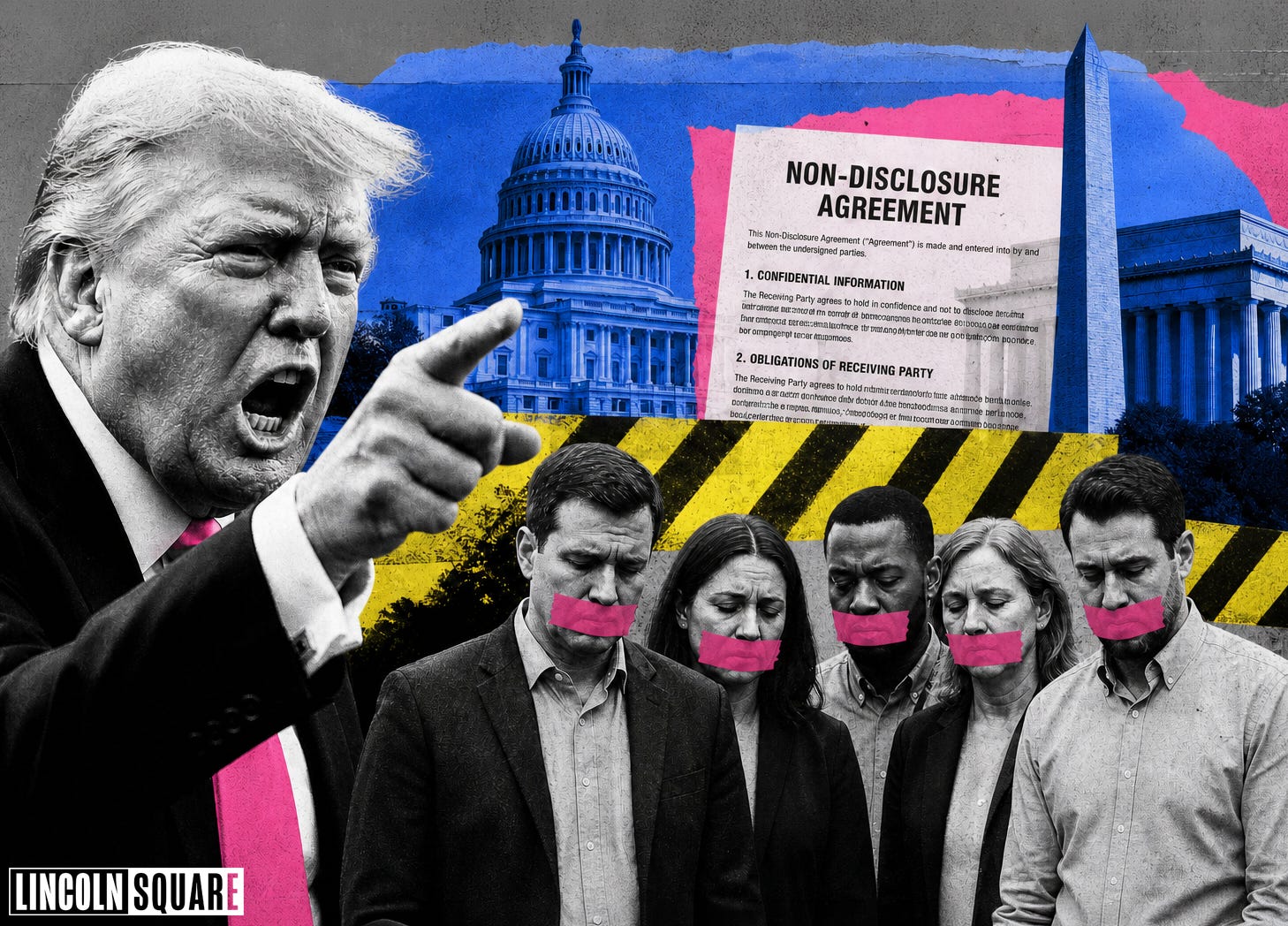
Scott Kupor, the Director of the Office of Personnel Management, has explained why nearly every federal employee should sign a Non-Disclosure Agreement:
In much of the private sector, employees handling sensitive business or customer information are routinely required to sign confidentiality agreements, and the federal government should not be held to a lower standard.
Set aside the small problem that Kupor — previously a longtime executive at Andreessen Horowitz — does not work in the private sector anymore, and that the public sector has somewhat different normative expectations about transparency than a venture capital fund. There is another problem with his argument: venture capitalists themselves famously refuse to sign NDAs. They know what NDAs are and are not for. They are not, mostly, for protecting genuinely sensitive information.
So what are NDAs for? NDAs are a tool of the powerful to protect themselves by threatening the less powerful. The private sector has used them so promiscuously and so abusively that they should be a warning for the public sector, not a model for it.
Many Americans first found out about NDAs when they learned that Harvey Weinstein used them systematically to hide his pattern of sexual abuse. When state governments restricted the use of NDAs, the type of venture capital-backed firms that Kupor supported started hiring about 8% fewer women per year. Without NDAs to cover patterns of gender discrimination or sexual harassment, the tech world decided to become even more of a boys club.
The proposed rule, would require federal employees to sign an agreement promising not to disclose “non-public, confidential, or proprietary information” or “any sensitive, pre-decisional or deliberative material that is not currently publicly available and should not be disclosed under applicable law.” The administration insists the new policy merely codifies “current legal obligations.” If that were true, there would be no reason to write the rule!
As a reminder, all rules are subject to public comment, and the federal government has to read those comments. You can submit a comment on this new rule until June 26. Let them know how you feel! (Guidance on writing a public comment — which is super easy — can be found here).
The reason for the new rule is to substantively close off transparency in government. “Pre-decisional or deliberative material that is not currently publicly available” could describe almost every conversation a career employee has with a political appointee. Or internal memos, draft analyses, and the candid advice we have, until very recently, expected federal employees to give without fear. The vagueness is not a drafting flaw. It is the product. Federal employees won’t know what they can say.
Ray Limon, who previously worked at the Office of Personnel Management proposing the new rule wrote the following:
My former employer, the U.S. Office of Personnel Management, frames this as simply documenting obligations that already exist. I don’t buy it…It’s a chilling mechanism. My concern is straightforward: language this sweeping will create confusion about what employees can and cannot lawfully disclose — and confusion is a powerful silencer, even when whistleblower protections technically remain on paper. It is the U.S. Office of Special Counsel - not OPM - that has statutory responsibility for enforcing NDA compliance and informing agencies of their obligations…This is one more measure in a sustained effort to tighten control over the federal workforce.
Trump’s History of NDAs
We know what Trump’s NDAs are for because he has used them his whole career. The people Trump has compelled to sign NDAs are not the holders of valuable trade secrets. They are his ex-wives. Porn stars he wanted to hush up. The contestants on his television shows. His campaign staff. None of them were sitting on the proprietary formula for Trump Industries.1
They were sitting on unflattering information about him.
Those Trump NDAs were also staggeringly broad. They placed no defined limit on what could or could not be disclosed; that was for Trump to decide, after the fact. They operated in perpetuity.
When a former female campaign officials accused Trump’s 2016 campaign of sexual harassment and sex discrimination, they were hit with massive counter-lawsuits for violating their NDAs, as well as an accompanying campaign of personal harassment. As one of those targeted put it, NDAs are:
representative of the levers of fear that this campaign and administration wield over people. And if this lever of these NDAs is lifted, it is significant not only for the direct effect it has on people who have signed it, but for a general environment of people who are afraid to speak out.
That is the lever the Trump administration now wants to impose across the federal government.
You Can’t Spell Scandal without NDA
The Freedom of the Press Foundation’s Lauren Harper said:
The proposal by the ‘most transparent administration in history’ that millions of federal employees sign a blanket NDA is not just absurd, it’s unnecessary and dangerously secretive…It comes at a time when agency watchdogs are sidelined, FOIA officials are being fired, and leaks to the press — which are the sole reason the public knows about so much of this administration’s misconduct — are being demonized and prosecuted…Its sole intent would be to protect the administration from the leak of embarrassing, politically damaging, or unlawful information.
Go to any credible news site today. There will be a story about wrongdoing in the Trump administration, most of it extraordinary in terms of its scale and lack of precedence. Many of these stories are about abuses of power, or the looting of the treasury that the Trump administration would prefer there be little coverage of in order to rob opposition of their most tool: the information to demand accountability.
For example, the Trump families that their sudden business success with companies that have contracts with the government reflect favoritism. But reporting shows just how much cronyism is occurring.
Or internal documents show that the administration is quietly punishing specific companies, like universities, by withholding the money for grants that have been awarded. There is no policy announcement, but the policy is happening.
If it were up to the Trump administration you would never read these stories. And the new NDAs are designed to stop these stories from being told. Because their goal is to kill oversight and accountability. They know that principled public servants are not revealing confidential information that creates national security risks, but will expose wrongdoing that is running rampant in this administration. So they want to gag them in an effort to kill one of our few remaining mechanisms of oversight.
.The At-Will Problem
The Trump White House used NDAs in the first term for senior political appointees. The second term has produced its own examples, including in the Department of Defense and for employees overseeing firings at the Department of Veterans Affairs. None of that was the same as what is being proposed now. This is the first serious attempt to draw a single veil of secrecy across the entire federal workforce.
What is also different now is that federal employees, after the dismantling of civil service protections, are effectively at-will, meaning they can be fired on the whim of Trump appointees. An accusation of violating the NDS provides an easy pretext for firing an employee and then setting government lawyers upon them.
This matters. For example, Trump lost his lawsuit against former White House official Omarosa Manigault Newman (still feels weird saying that) for violating her NDA, and had to pay her $1.3 million in legal fees. If federal lawyers are the ones prosecuting federal employees, he can treat them as a free law firm, knowing there is no risk on his end. All of the risk is on the federal employee.
That changes what the NDA is. It is not a contract between equals. It is a loyalty oath, enforced with the full weight of federal prosecutorial power, demanded of people who already swore a different oath — to the Constitution. That older oath, the one we asked them to take, said they serve us. The new agreement says they serve Trump. It is part of Trump’s pattern of imposing loyalty tests into his personalist regime.
Seven Signs that Donald Trump Has Transformed the US Government into a Personalist Regime
Don Moynihan is the J. Ira and Nicki Harris Family Professor of Public Policy at the University of Michigan Ford School of Public Policy. Subscribe to his Substack, Can We Still Govern?
Max Stier, the President of the nonpartisan, nonprofit Partnership for Public Service said in a statement:
Federal employees already know what they can and cannot disclose to the public. Those obligations are written into law, spelled out in regulation and reinforced through mandatory ethics and disclosure trainings…A blanket, governmentwide NDA does little to meet any pressing need. It seems more intended to make ethical employees think twice before coming forward and to chill the lawful disclosures that hold government accountable. When that happens, the public knows even less about how their government works and how their tax dollars are being spent.
Culture of Governmental Secrecy and Coverups
This is, clearly, more bad news for federal employees whose morale is already at basement levels. But you should care about this even if you are not a public servant, or a journalist looking for a scoop, because the accountability of the federal government depends upon the candor this rule is designed to extinguish.
Federal employee confidence that they could report misconduct already dropped from about 72% in 2024 to 22.5% in 2025. Now it will be even lower. The NDAs will protect wrongdoing from exposure.
The survey that collected these numbers featured employees describing a new culture of secrecy that the NDAs will expand. An IRS employee said:
I’ll be honest, [at the] political level, I have minimal confidence that if we reported anything, any misbehavior, that it would be taken care of. In fact, quite honestly, I would fear retribution if we reported an ethical violation of a political level person in the IRS. I would do it anonymously. I’d probably do it through the union. I would not do it through the normal channels.
The administration has already told staff not to write things down, in apparent tension with the Federal Records Act. It has normalized the use of Signal — and not only by Pete Hegseth — to keep government business off the books. At the same time, it is compelling federal workers to install a Trump propaganda app on their phones, a measure that will almost certainly create more security exposure than the NDAs purport to prevent.
Meanwhile, the administration itself leaks promiscuously when leaks serve its narrative. The objective is not less disclosure. It is asymmetric disclosure, privileging Trump’s handpicked leakers, punishing everyone else. The double standards don’t end there. The Trump administration has also encouraged a culture of snitching. Right wing social media posters can get federal employees they dislike fired, and federal employees are told to report any use of DEI or anti-Christian bias. It’s secrecy for me, snitching for thee.
The existing rules already restrict federal employees from disclosing classified information and information with national security implications. Those rules have teeth. While the order says it exempts legally whistleblower complaints about waste, fraud, or abuse, it is worth noting the administration is already weakening whistleblower protections and the NDA policy will further chill such speech. To choose to be a whistleblower means your career in government is over and you will be the subject of Trump-driven harassment, creating too high a price for most employees. Even employees who exit but want to draw attention to wrongdoing with some sort of public statement must now worry that they will face a lawsuit.
There is always a debate about what are the appropriate limits of government employees communicating non-public information to the public. For every President, the interest is in withholding information, but in many cases there is a public interest in disclosing it. That public interest becomes a lot stronger in an environment of depleted accountability and mass wrongdoing. That is the environment we have right now. The Trump administration routinely lies about its actions, and has neutered traditional accountability figures like Inspector Generals and General Counsels. It appears to be breaking laws and engaging in massive corruption, but Congress is not investigating.
In this context, silencing public employee voice removes one of the last remaining accountability mechanisms we have.
Moynihan (the Other One) Was Right
One of the top two Moynihans of all time — Senator Daniel Patrick Moynihan — wrote about exactly this drift towards the end of his career. In Secrecy: The American Experience, he argued that the American state’s tendency toward classification was a sign not of strength but of fear, a bad sign for our democracy.
Open governments win arguments and self-correct. Closed governments make bad decisions and then cover them up. Does that sound like any administration you might know?
“Secrecy,” he wrote, “is for losers.”
A federal NDA covering “any sensitive, pre-decisional or deliberative material that is not currently publicly available” is a confession. It says: we do not believe what we are doing can survive being seen. It says: we are afraid of our own employees. It says: the employee’s loyalty must be to the King, not the constitution.
1 Don’t tell anyone, but here is the proprietary formula for Trump’s success: Carnival barking self-promotion + spray tan + corruption.


Thank you for the article, I thought when employees enter the White House under a new administration that each had NDA. Every administration that has had federal employees leaked information to the press. At least that is how it’s been explained to me. My question is why bother when leaking information happens?