Why the American Dream Increasingly Feels Like a Mirage
We've kicked the can down the road—but the road itself is now breaking apart.
Brian Daitzman is the Editor of The Intellectualist. Subscribe to his Substack.
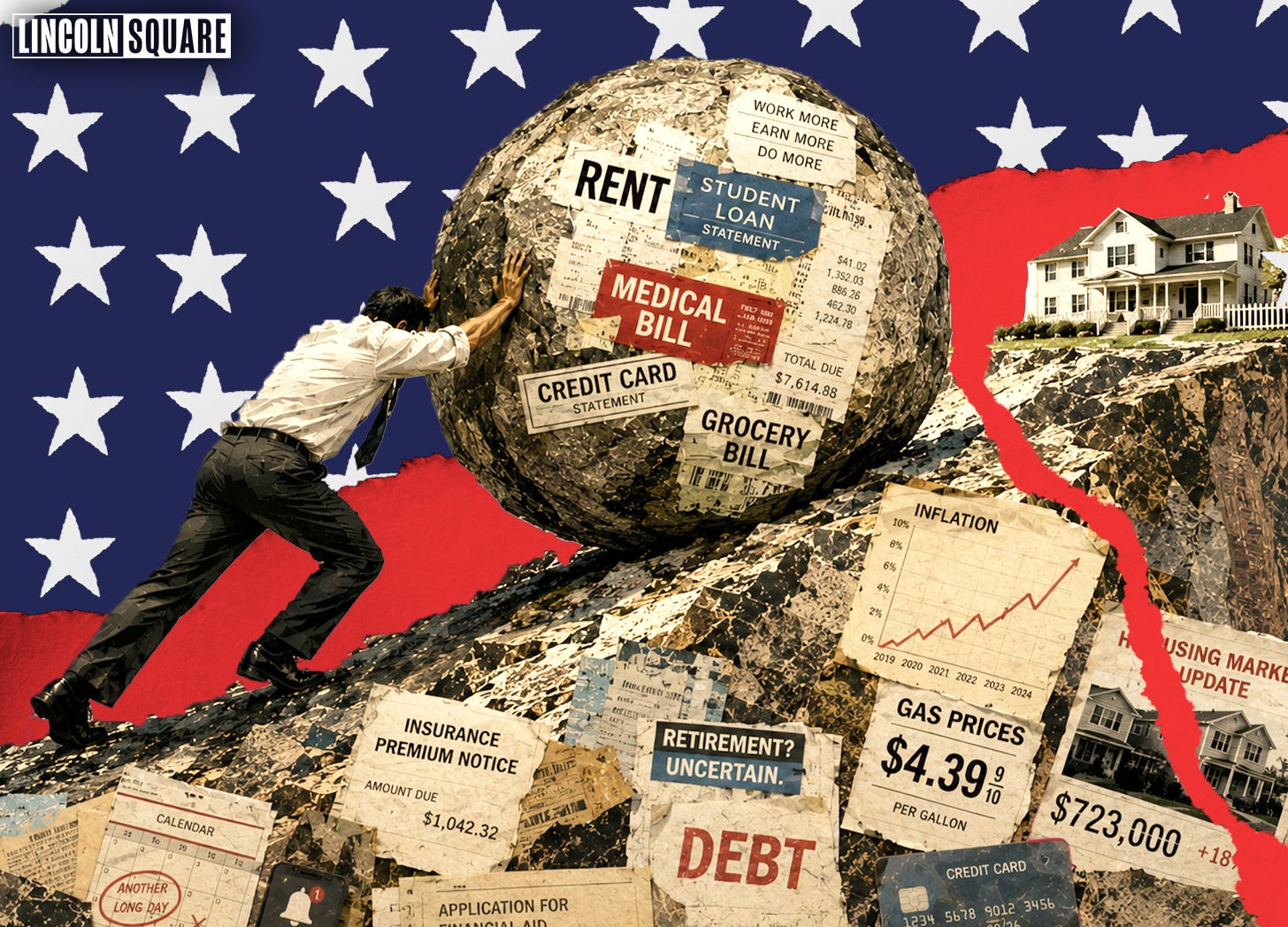
In Greek mythology, Sisyphus was condemned to spend eternity pushing a boulder up a mountain only for it to roll back down each time he neared the summit. The punishment was not simply physical exhaustion. It was repetition without arrival. Endless striving without durable security.
The twentieth-century philosopher Albert Camus later transformed Sisyphus into a metaphor for modern life itself: human beings continuing to search for meaning, dignity, and purpose inside systems that often refuse permanent resolution.
The American dream increasingly resembles a Sisyphean mirage.
A mirage does not deceive because it is imaginary. It deceives because it remains visible while continuously receding. The worker keeps moving upward: more hours, more credentials, more productivity, more optimization, more sacrifice, more endurance. Yet stability drifts further away. Housing becomes more expensive. Healthcare becomes more financially destabilizing. Education costs rise faster than wages. Retirement feels increasingly uncertain. The raise disappears into insurance premiums, groceries, rent, and debt before it is ever fully felt.
The boulder never reaches the summit because the summit itself keeps moving.
For millions of Americans, the dream now functions less like a destination than a horizon. The next promotion, the next credential, the next move, the next investment, the next year of sacrifice — each appears as the final push that will eventually produce stability. Yet for large portions of the population, the destination continues receding even as the pace of effort intensifies.
The problem is not hard work itself. Human beings can endure extraordinary hardship when sacrifice produces meaning, continuity, dignity, or security. The deeper crisis emerges when effort no longer reliably converts into stability.
That failure of conversion increasingly defines modern American life.
America remains wealthy, technologically advanced, financially deep, militarily powerful, and saturated with consumer abundance. Its corporations dominate global finance, artificial intelligence, aerospace, software, logistics, biotechnology, entertainment, and digital infrastructure. Its economy generates nearly $30 trillion in annual output. The United States still possesses immense productive capacity, world-class universities, extraordinary concentrations of talent, and some of the most sophisticated capital markets in human history.
From a distance, the country can still appear extraordinarily prosperous.
Packages arrive the next morning. Food appears on command. Streaming platforms deliver endless entertainment. The financial markets continue climbing. Airports remain crowded. Smartphones compress entire industries into the palm of a hand. Artificial intelligence accelerates daily life. Consumer convenience continues deepening at extraordinary speed.
The visible machinery of abundance continues functioning, which is part of what makes the underlying instability so difficult to immediately recognize.
The problem is more specific — and more destabilizing.
The United States has become increasingly poor in social convertibility.
Social convertibility describes whether ordinary participation in society still reliably turns effort into stability — whether work can still become housing, income can still become savings, education can still become mobility, and long-term sacrifice can still produce durable ground beneath a person’s feet.
A society can be wealthy in output and poor in convertibility. It can produce abundance while making ordinary life harder to build.
The supermarket remains stocked, but food and household costs still consume the margin. The card reader approves the transaction, but the payment may be debt. Americans collectively hold more than $1 trillion in credit-card debt. The housing market rises, but renters face persistent cost burdens while homeownership drifts further beyond ordinary wages. In 1980, the median American home cost roughly three times median household income. In many metropolitan regions today, that ratio has doubled or even tripled, fundamentally altering what ordinary work can realistically purchase.
The economy may continue growing while large portions of the population experience less stability, less margin, and less confidence in the future.
That contradiction increasingly defines the emotional reality of American life.
On a Friday evening, the supermarket can still look like proof that everything is working. The shelves are full. The self-checkout machines chirp. The parking lot is crowded. A parent moves through the aisles with a cart full of ordinary American life: cereal, paper towels, ground beef, school snacks, a birthday card.
Nothing in the scene looks like collapse, which is part of what makes the instability so difficult to fully recognize. The parent in the grocery store may look financially secure, socially integrated, and unmistakably middle class. She may have a job, a car payment, a streaming subscription, a retirement account, and a credit score that still appears respectable.
But privately she may be performing a different kind of arithmetic: whether the rent increase can be absorbed, whether the prescription can wait another month, whether the child can play soccer this season, whether the credit-card balance can survive another billing cycle, whether the aging car can survive another winter, whether the raise that finally arrived has already disappeared into insurance, groceries, gas, debt, and housing.
She may check her bank account before walking into the grocery store. She may leave items behind at self-checkout after mentally recalculating the total. She may remain in a job she no longer wants because the health insurance feels too dangerous to lose.
None of these decisions individually resemble collapse. Collectively, though, they create a society organized around continuous low-level exposure. The surface still feels normal even as the sense of long-term security quietly weakens beneath it.
The point is not that everyone is poor, or that nothing works, or that opportunity no longer exists. America still produces extraordinary fortunes, extraordinary careers, extraordinary companies, and extraordinary upward mobility for some people. Those stories are real, which is part of what makes the larger instability so difficult to fully recognize. Highly visible success can preserve belief in a system even while ordinary stability becomes materially harder to achieve for much larger portions of the population.
The old American promise did not require equality of outcome. It required a believable path. Work hard. Participate. Build a life. Raise a family. Your children may do better.
That promise never applied equally to everyone. American history is full of exclusions, betrayals, racial hierarchy, inherited advantage, and unequal access to opportunity.
The problem is not that opportunity has never existed. The problem is that the national mythology increasingly treats partial opportunity as universal proof.
That mythology allowed the country to defer reckoning for a very long time. America possessed land, resources, population growth, immigration, technological dynamism, military power, and an unusually enterprising culture. Those strengths were real. They allowed the system to continue functioning even while many of its contradictions remained unresolved.
But momentum is not justice. Growth can conceal structural failure for decades. A society can continue kicking the can down the road until the road itself begins breaking apart.
That is where the United States increasingly finds itself.
The defining feature of modern American instability is not absolute poverty so much as chronic exposure.
The concept of the “precariat,” most closely associated with the British economist Guy Standing, emerged from late twentieth-century labor analysis and gained wider recognition after globalization and the 2008 financial crisis exposed how instability had spread far beyond traditionally poor populations into broad sections of the middle and professional classes.
The precariat is not simply the unemployed or traditionally poor. It increasingly includes people who outwardly appear functional, productive, educated, insured, and socially integrated while privately living under conditions of persistent instability. What defines the condition is exposure: the awareness that ordinary stability now depends upon the uninterrupted functioning of fragile systems including income, employment, healthcare access, housing affordability, debt servicing, childcare, transportation, and broader economic continuity.
In practical terms, millions of Americans increasingly live one disrupted paycheck, medical bill, rent increase, or layoff away from meaningful instability. If roughly two-thirds of Americans now report living paycheck to paycheck, lack meaningful emergency savings, remain vulnerable to medical or housing shocks, carry substantial debt burdens, or depend heavily upon uninterrupted income continuity to preserve stability, then the precariat increasingly includes not merely the poor, but broad sections of the working, middle, and professional classes. The modern precariat may therefore encompass a majority of the country.
Many people inside it still possess jobs, degrees, retirement accounts, mortgages, subscriptions, professional identities, and outward signs of middle-class participation. What increasingly separates them from genuine stability is not participation, but margin. A rent increase, medical emergency, layoff, childcare disruption, insurance denial, aging parent, market downturn, or technological displacement can rapidly destabilize what outwardly appeared secure.
Ordinary life increasingly requires people to think like financial risk managers, healthcare navigators, debt strategists, housing analysts, retirement planners, labor-market forecasters, and personal-brand managers simply to maintain stability. The burden is not merely paying for life. It is managing the permanent uncertainty surrounding it.
Previous generations often experienced adulthood as a process of gradual stabilization. Many Americans increasingly experience adulthood as permanent maintenance.
The dream remains visually intact even as the structure beneath it becomes increasingly unstable.
The shelves remain full. Parking lots stay crowded late into the evening. Airports still fill before dawn. The markets continue rising. Advertisements still promise aspiration. Universities still promise mobility. The culture still promises reinvention.
From a distance, the machinery of prosperity still appears to function.
Which may be why the instability often feels so difficult to fully name.
Nothing visibly collapses. Ordinary life simply becomes harder to secure. Stability becomes harder to reach, harder to keep, and easier to lose. Millions of Americans continue working, optimizing, adapting, borrowing, recalculating, and enduring inside systems that still promise eventual stability even as the conditions required for durable security continue receding beneath them.
The old American promise depended upon a believable relationship between effort and stability. Work hard. Participate. Build a life. The dream did not require guarantees of wealth, only confidence that ordinary participation could eventually produce durable ground beneath a person’s feet.
For increasing numbers of Americans, that confidence has begun quietly deteriorating.
The wheel keeps turning, the horizon keeps receding, and the summit remains visible even as it becomes increasingly difficult to reach.
That may be what makes the modern American condition feel increasingly Sisyphean: not the disappearance of ambition or effort, but the growing sense that the boulder never quite reaches the top of the hill.
References
Camus, Albert. The Myth of Sisyphus. Translated by Justin O’Brien. New York: Vintage International, 1991.
https://www.penguinrandomhouse.com/books/23470/the-myth-of-sisyphus-by-albert-camus/
Relevance:
Provides the essay’s primary philosophical and symbolic framework. The essay’s central argument that modern American life increasingly resembles endless striving without durable arrival directly derives from Camus’s reinterpretation of Sisyphus as a figure of perpetual labor, psychological endurance, and unresolved modern existence. The essay’s recurring imagery of the moving summit, the perpetually receding horizon, and the inability of effort to reliably convert into lasting stability are structurally rooted in Camus’s existential analysis.
Federal Reserve Board. “Economic Well-Being of U.S. Households in 2024.” Board of Governors of the Federal Reserve System, May 2025.
https://www.federalreserve.gov/publications/files/2024-report-economic-well-being-us-households-202505.pdf
Relevance:
Provides empirical grounding for the essay’s claims regarding financial fragility, emergency savings vulnerability, economic anxiety, and the growing instability shaping ordinary American life. The report supports the essay’s broader argument that visible prosperity and consumer abundance can coexist with widespread household insecurity, financial precarity, and declining confidence in long-term economic stability.
Federal Reserve Board. “Unexpected Expenses.” Economic Well-Being of U.S. Households in 2024 — Data Visualization.
https://www.federalreserve.gov/consumerscommunities/sheddataviz/unexpectedexpenses-table.html
Relevance:
Directly supports the essay’s concept of “continuous low-level exposure” by quantifying how many Americans are unable to absorb relatively modest unexpected financial shocks without borrowing, accumulating debt, or experiencing financial distress. The data reinforces the essay’s argument that large portions of the population live under conditions of persistent economic precarity despite outward participation in middle-class life.
Fisher, Mark. Capitalist Realism: Is There No Alternative? Winchester, UK: Zero Books, 2009.
https://www.johnhuntpublishing.com/zer0-books/our-books/capitalist-realism
Relevance:
Provides philosophical and cultural context for the essay’s analysis of late-modern exhaustion, permanent maintenance, psychological burden, and the normalization of instability within advanced capitalist societies. Fisher’s work is especially relevant to the essay’s portrayal of a society in which individuals continue functioning, consuming, adapting, and optimizing despite growing structural insecurity and declining confidence in durable long-term futures.
Pew Research Center. “Are You in the U.S. Middle Class? Try Our Income Calculator.” Pew Research Center, updated 2024.
https://www.pewresearch.org/short-reads/2020/07/23/are-you-in-the-american-middle-class/
Relevance:
Supports the essay’s examination of middle-class erosion, perceived economic stability, and the widening disconnect between outward middle-class identity and underlying financial precarity. The source helps contextualize the essay’s argument that many Americans who appear economically stable remain vulnerable to housing shocks, debt burdens, emergency expenses, and long-term financial insecurity.
Rosenfeld, Jake, Patrick Denice, and Jennifer Laird. “Union Decline Lowers Wages of Nonunion Workers.” Economic Policy Institute, August 30, 2016.
https://www.epi.org/publication/union-decline-lowers-wages-of-nonunion-workers-the-overlooked-reason-why-wages-are-stuck-and-inequality-is-growing/
Relevance:
Provides structural economic context for the essay’s claims regarding wage stagnation, declining labor leverage, weakening worker bargaining power, and the deteriorating relationship between ordinary employment and durable economic security. The source reinforces the essay’s broader argument that participation in the labor economy increasingly fails to reliably convert work, productivity, and long-term effort into stable middle-class life.
Standing, Guy. The Precariat: The New Dangerous Class. London: Bloomsbury Academic, 2011.
https://www.cambridge.org/core/journals/journal-of-social-policy/article/abs/guy-standing-2011-the-precariat-the-new-dangerous-class-london-bloomsbury-academic-1999-pp-198-pbk/E57E7B6F364EA19171C6637B63E0109D
Relevance:
Provides the essay’s foundational theoretical framework for understanding the “precariat” as a broad social condition defined by chronic instability rather than traditional poverty alone. The essay’s analysis of economic exposure, continuous vigilance, shrinking margin, and the spread of precarious conditions into the working, middle, and professional classes directly builds upon Standing’s formulation of the precariat as an emerging structural condition of modern economic life.
U.S. Census Bureau. “Nearly Half of Renter Households Are Cost-Burdened.” Census.gov, September 12, 2024.
https://www.census.gov/newsroom/press-releases/2024/renter-households-cost-burdened-race.html
Relevance:
Provides empirical support for the essay’s claims regarding housing instability, affordability deterioration, shrinking economic margin, and the weakening relationship between ordinary work and stable long-term living conditions. The source supports the essay’s argument that housing costs increasingly consume disproportionate portions of household income, making long-term financial security and homeownership materially harder to achieve for large portions of the population.
Joint Center for Housing Studies of Harvard University. The State of the Nation’s Housing 2024. Cambridge, MA: Harvard University, 2024.
https://www.jchs.harvard.edu/state-nations-housing-2024
Relevance:
Provides historical and structural context for the essay’s discussion of housing affordability deterioration, renter burden, declining access to homeownership, and the widening gap between wages and housing costs. The report supports the essay’s broader argument that ordinary participation in the economy increasingly fails to produce durable long-term stability, financial margin, or meaningful asset accumulation for large portions of the population.


Thank you for sharing the plight of Sisyphus. That boulder never reaches the top of the hill. If anything, it rolls backwards smashing our dreams. There is a song about high hopes, where we get up, shake it off, and do it all over again. Those high hopes are disappearing. Your excellent article describes it well. Thanks, again, Brian. Well, said.