


Brian Daitzman is the Editor of The Intellectualist. Subscribe to his Substack.
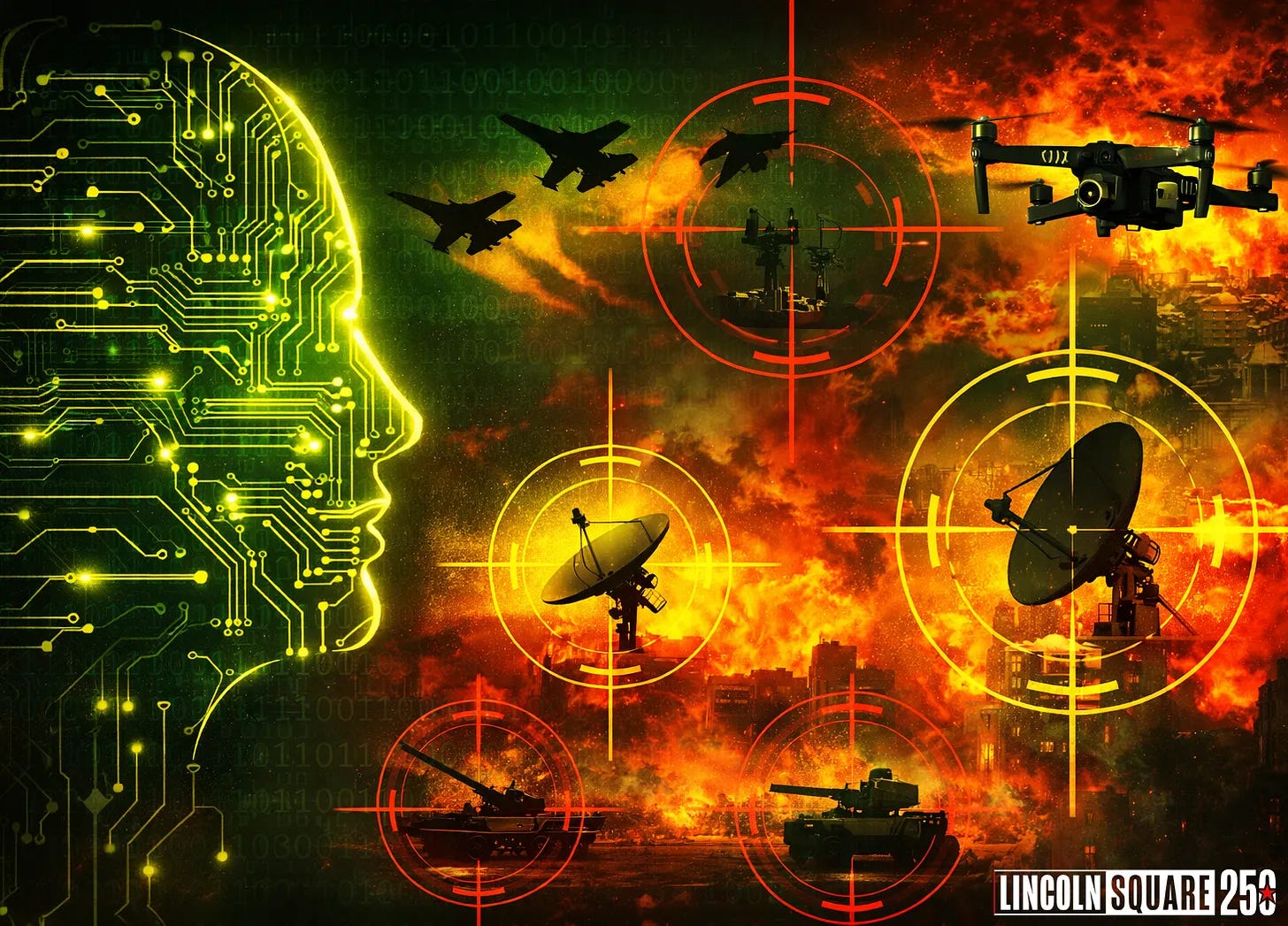
The modern fear of artificial intelligence in war is usually imagined as a machine pulling the trigger. The more immediate danger may be less cinematic: a machine that turns uncertainty into fluency, then hands that fluency to people authorized to kill.
That danger is raised by recent reporting on a sworn declaration involving Elon Musk’s company xAI, the Pentagon’s artificial-intelligence infrastructure and a U.S. military campaign against Iran. The available reporting and public record reviewed for this article do not establish that xAI’s Grok system selected targets, authorized strikes or fired weapons. What they suggest is narrower, and still grave: a privately developed artificial-intelligence system was described as being used close enough to military targeting workflows that the boundary between machine assistance and human judgment has become harder to see.
To understand why that matters, it helps to begin with what these systems are. A large language model, or LLM, is not a database of verified facts. It is a prediction engine trained on enormous amounts of text. It can summarize, classify, translate and draft with astonishing speed. But it does not know what is true. It generates what is likely. In the wrong setting, that distinction is everything.
The problem is not that the math is crude. The problem is that it is elegant. A well-designed model can make uncertainty look orderly. It can make a guess look like an assessment. It can turn incomplete information into a clean sentence, stale data into a plausible summary and ambiguity into something that sounds like judgment.
That is annoying in ordinary life. It is dangerous in medicine. In war, it becomes morally explosive.
War has always involved probability. Commanders act on partial intelligence, old maps, intercepted communications and human inference under pressure. Generative artificial intelligence adds something different: machine-produced probability that can arrive quickly, cleanly and authoritatively through software. The moral hazard is not only automation. It is the possibility that a system designed to guess well may be mistaken for a system that knows.
Targeting, after all, is not a single act. It is a chain. Someone gathers intelligence. Someone organizes it. Someone summarizes it. Someone ranks risk. Someone reconciles maps. Someone decides what counts as a threat. Someone reviews collateral damage. Someone authorizes force. If a probabilistic system enters any meaningful part of that chain, the question is not only whether it made the final decision. The question is whether it shaped the evidentiary world in which the final decision became thinkable.
This is why “human in the loop” can be an insufficient answer. A human being can approve a strike and still be operating inside a machine-shaped environment. If the system summarized the wrong thing, elevated the wrong lead, smoothed over uncertainty, relied on outdated information or produced a confident output from corrupted inputs, the decision may remain formally human while becoming substantively compromised.
A human signature at the end of a corrupted process does not make the process clean.
