Trump’s Swamp of Lies
When something feels true — when it neatly and viscerally fits with your beliefs about immigrants, the economy, or the country’s direction — the details become almost irrelevant.
Susan J. Demas is Lincoln Square’s Executive Editor and a 25-year journalism veteran. Subscribe to her Substack.
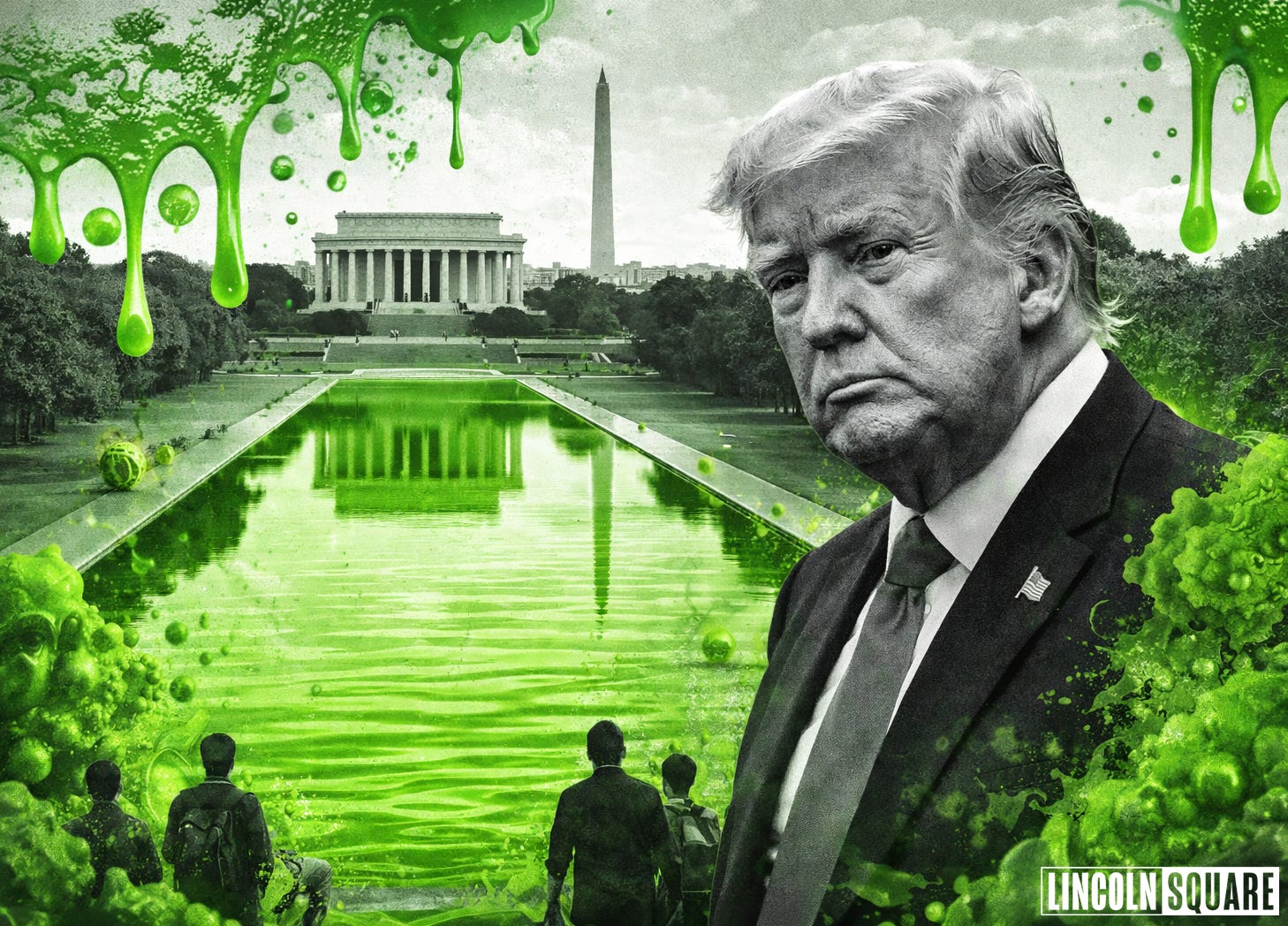
The Lincoln Memorial Reflecting Pool is turning as green as the swamp Trump once promised to drain.
We’ve been watching this happen, in real time, since the Trump’s administration spent more than $16 million on a no-bid contract to paint it “American flag blue” earlier this month for our country’s 250th anniversary. The paint peeled within two weeks. Then the algae arrived (as it does in a warm ornamental pool, especially after renovations disrupt the balance of nutrients in the water).
Science doesn’t care about symbolism.
Trump’s response, of course, was not to acknowledge facts. Because, as it turns out, facts hurt his feelings. So instead, he devised fantastical stories blaming vandals for his own folly. People have been arrested. Prosecution has been threatened. No evidence of vandalism has been provided, because there isn’t any.
Welcome to the defining political machinery of the Trump era: the performative lie. Not the lie told to conceal wrongdoing — that’s as old as politics. But it’s the lie told openly, flagrantly, in the face of obvious contradictory evidence, precisely because sustaining it requires everyone around you to go along with it.
That’s the point.
At this same moment, a giant banner hangs on the Theodore Roosevelt Federal Building in Washington — put up by the Office of Personnel Management — featuring a quote attributed to TR: “Courage is not having the strength to go on; it is going on when you don’t have the strength.” Historians have confirmed Roosevelt never said this. The quote appears to originate in a 1990s self-help book about grief. When asked, OPM said it “captures the spirit of the federal workforce.” Experts called the error “inexcusable.“ The banner remains.
This administration lies about things big and small, obvious and obscure, with or without any strategic necessity.
Agriculture Secretary Brooke Rollins blamed the New World screwworm outbreak on Biden’s immigration policies. In reality, DOGE cut the $15 million federal program specifically designed to prevent screwworm, fired 25 percent of the USDA staff responsible for tracking the disease, and paused the Biden-authorized containment facility in Mexico. Now Trump wants $1 billion to manage a crisis that $15 million of maintained funding would have helped prevent.
More disturbingly, JD Vance claimed during the 2024 election that Haitian immigrants in Springfield, Ohio were eating cats and dogs — which the city’s own officials told his staff was flat-out false. But he word-vomited about it anyway. When called on the lie, Vance told CNN, “If I have to create stories so that the American media actually pays attention to the suffering of the American people, then that’s what I’m going to do.”
Vance didn’t say the quiet part out loud by accident. He said it because the admission has no consequences for him.
Trump’s claims about the precarious Iran peace deal offer a masterclass in the genre. He insists the agreement will prevent Iran from developing nuclear weapons, even though there’s no such provision in the text. He says it’s far stronger than the 2015 JCPOA Obama negotiated, even when every serious analyst who has compared the two says the opposite. He attacked Obama for authorizing the unfreezing of a fraction of Iranian funds while his own deal unlocks vastly more.
None of this is hidden or ambiguous. The facts are readily available. They simply don’t matter to him — or his supporters.
Authoritarian movements use performative lying to sort the loyal from the disloyal. When Trump insists the DOJ announced he’s “100% exonerated” in the Epstein scandal, even though the department made no such statement, MAGA isn’t expected to believe him because the evidence supports it. They’re expected to believe him because that’s the price of membership. Saying something is true when everyone can see it’s false is a loyalty oath. It’s how you prove you belong to the club, and it’s how the club identifies who doesn’t.
But here’s what makes this harder to dismiss as a purely MAGA problem: the preference for feeling over fact — the pull toward information that confirms what we already believe, regardless of the evidence — is a feature of human cognition, and it’s not exclusive to Republican politics.
Take the “vibecession.” The original iteration happened during the Biden years as we were climbing out of the COVID pandemic. Republicans convinced themselves, despite all evidence, that the economy under his presidency was a catastrophe — even as wages rose, unemployment fell to historic lows, and GDP grew. That was wrong.
But here’s the part that’s harder to say out loud: something very similar is now happening on the other side. I talked with University of Michigan economist Justin Wolfers last month about exactly this, and he was refreshingly blunt. “If you look right now at the University of Michigan measure of consumer sentiment,” he told me, “it’s at the lowest level it’s ever been. There’s no way the American economy is as bad as it’s ever been right now.”
Democrats, he pointed out, are looking around saying everything is terrible — doing the same thing Republicans did under Biden.
That’s the uncomfortable truth. The willingness to believe what feels true rather than what is true cuts across the aisle.
And yet — here’s where the distinction matters — Wolfers wasn’t arguing that things are fine. Far from it. “I think we have the worst quality of economic policy in this presidency in any part of history that I can remember,” he told me. “The quality of economic advice that this team gives is the worst of any industrialized country I’ve ever seen.” Those making policy are selected for loyalty to Trump’s personal interests rather than for anything resembling competence or commitment to factual data. Only a third of Americans approve of how he’s handling the economy — lower than during COVID in his first term. The policy is genuinely terrible. People are right to be alarmed.
But “the policy is disastrous” and “the economy is already destroyed” are not the same thing. “This year will be the richest year in the richest country in the history of humanity,” Wolfers told me — a deliberately provocative claim. This doesn’t end the policy debate, he stressed, because the whole point is to ask whether we could be doing better (and we obviously could be). Yet the distinction matters. Conflating catastrophic governance with a catastrophic economy is exactly the kind of feeling-over-fact reasoning that’s eroding our collective reality.
So as it turns out, the vibecession is bipartisan. And that’s not an accident — it’s what happens to any information environment optimized for outrage, in which one major political party has decided the lie is the point. Eventually, most of us absorb the lesson.
Here’s the thing about telling people that immigrants are eating pets and crime is out of control: a lot of people are already primed to believe it. In 23 of 27 Gallup surveys conducted since 1993, at least 60 percent of Americans said crime nationally was higher than the year before — during a period when violent crime fell more than 50 percent from its early-1990s peak. Homicides get 40 to 50 percent of “causes of death” coverage in major news outlets despite representing less than 1 percent of actual deaths. New federal data shows violent crime fell another 5.8 percent in 2024, homicides are down 44 percent from their 2021 peak.
None of this breaks through. The feeling that crime is rising is more powerful than the fact that it isn’t, and has been for three decades.
When something feels true — when it neatly and viscerally fits with your beliefs about immigrants, the economy, or the country’s direction — the details become almost irrelevant. Nobody is reading a policy paper on the housing market before accepting a social media post that blames immigrants for rent prices. Nobody is cross-referencing algae biology before deciding Trump’s vandal story sounds plausible.


Studies are not as persuasive as memes. Data is not as compelling as a story that confirms your priors. This isn’t new. But what’s new is how completely we have optimized the information environment to exploit it.
And so a president who governs by performative lying is far more dangerous in a country that has already lost the habit of demanding evidence. And a country that has lost that skill is far more vulnerable to a president who has decided the lie is the whole point.
We will be grappling with this long after Trump is gone. What he has accelerated — the erosion of shared factual reality, the normalization of believing what feels true rather than what is true — does not disappear with any election.
The reflecting pool will eventually be cleaned up. The banner with the fake Roosevelt quote will come down. The deeper problem, the one that made all of this possible in the first place, will still be there.
And we haven’t even started solving it.
The Hypocrisy Is the Point
When Britney Spears’ younger sister, Jamie Lynn, got pregnant at 16, Bill O’Reilly routinely assailed her parents on Fox News and slammed her as a “pinhead.” It was evidence of Hollywood’s moral rot, the godless left, the collapse of American values. There was a particular relish to it — the kind of gleeful condemnation that suggests Bill O. had been waiting years for some ingenue to make exactly this mistake.


Stephen Colbert had s very short description of this much more detailed article:
Truthiness.
As far as crime is concerned, there's one epicenter at 1600 Pensylvania Avenue since January 20, 2025:
- Continuous hate speech via one so-called "social" platform;
- Continuous and organised killing by neglect in ICE facilities;
- Open corruption and emoluments.
So that in the end, for overseas tourists considering a trip to the US feels like China, Russia, North-Corea... What a GREAT America to celebrate 250 these days!