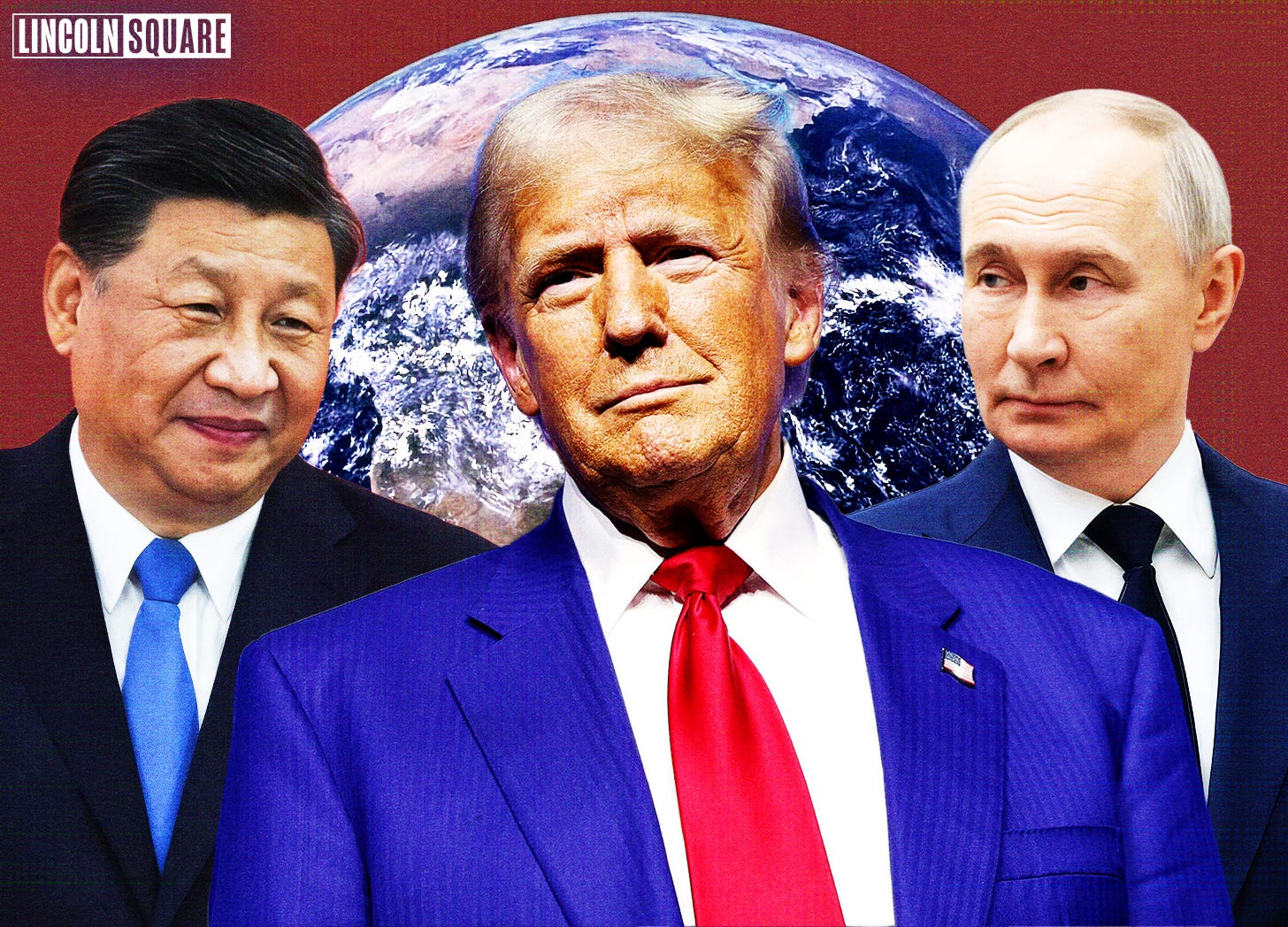
Trump’s National Security Plan Revives the Logic of Molotov-Ribbentrop — and Puts U.S. Allies at Risk
The plan signals a spheres-of-influence order, making great-power confrontation more likely.
By Brian Daitzman
President Donald Trump’s 2025 National Security Strategy moves the United States back toward a world of spheres of influence, where major powers claim regions as their own and smaller border states are treated as negotiable. It is not a claim of a literal secret protocol, but the same Molotov–Ribbentrop logic: great powers treating borderlands as bargaining terrain rather than protected commitments. That shift matters because two public readiness clocks are approaching at once. Western intelligence and defense assessments warn that Russia could rebuild enough military strength to regain capability in the late 2020s to probe or threaten NATO’s eastern members, including the Baltic states. U.S. intelligence leaders, meanwhile, say Xi Jinping has directed the People’s Liberation Army to be ready by 2027 for a Taiwan contingency, while stressing that readiness is not a decision to invade.
In that overlapping window, the Strategy’s posture changes sharpen risk. The United States is reducing some troops on NATO’s eastern frontier before European forces can fully replace the deterrent weight those deployments provide. At the same time, Washington is tying Taiwan’s security relationship to trade and semiconductor demands, making protection appear conditional. Both moves rest on a documented first-term precedent of using Ukraine aid as leverage, a pattern Fiona Hill has argued helped convince Vladimir Putin that a large-scale offensive could succeed.
Two readiness horizons now run in parallel, and both are public.
In Europe, the United States is telling NATO allies through policy and posture that they must assume much greater responsibility for their own conventional defense in the near term. That demand arrives as intelligence services and defense analysts warn that Russia could regenerate enough capacity in the late 2020s to probe NATO militarily on its eastern flank if it chooses to test the alliance.
In Asia, U.S. intelligence leaders continue to cite 2027 as a People’s Liberation Army readiness benchmark for a Taiwan contingency, while stressing that readiness is not, by itself, a decision to attack. A published deadline is not a prophecy, but it does alter incentives. When deterrence shifts and adversary regeneration converge on the same period, the gap between promise and readiness becomes a corridor of risk.
The National Security Strategy, finalized in November 2025 and released publicly in early December, makes that corridor legible. It opens with a definitional claim: strategy is not aspiration, but the disciplined alignment of ends with means.
From there, it rejects what it describes as unfocused post–Cold War approaches and replaces them with hierarchy. Sovereignty and homeland security come first. The Western Hemisphere is the first foreign-policy priority. Engagement elsewhere is framed as selective. In a security doctrine, hierarchy is not stylistic. It is triage. Once triage is public, allies and rivals read the sequence as guidance on where the United States expects to bear automatic costs and where it expects others to carry them.
The strategy’s first move is to define a protected core.
Its thickest line is drawn in the Western Hemisphere. The document revives a Monroe Doctrine posture through what it calls a “Trump Corollary,” asserting hemispheric primacy and committing the United States to push back “non-hemispheric” influence. It treats migration and cartel violence as central security threats and links hemispheric control to military posture and sustained regional pressure campaigns. This is a formal sphere claim. In international politics, when the leading power declares a home sphere, it makes spheres of influence a more permissible grammar of order for others as well.
The strategy’s second move sets the terms of a European handover. Europe is portrayed as civilizationally exposed and politically unreliable — weakened by migration pressures, demographic decline, and supranational rules that, in the document’s view, hollow out sovereignty.
Alongside that diagnosis, the strategy states that an expeditious end to the Ukraine war is a core U.S. interest, links that objective to strategic stability with Russia, and warns against the “perception or reality” of perpetual NATO expansion. These lines operate as a single posture.
Europe is depicted as failing, instructed to assume far greater responsibility for its own conventional defense on a near timeline, and pressed to accept rapid settlement in the war now defining its security order.
Alliance conditionality supplies the connective tissue. The strategy demands extreme burden sharing and uses a 5 percent of GDP defense-spending target as a benchmark for allied seriousness. Over time, that pressure may raise allied capability. In the near term, it changes the deterrent signal. Deterrence rests on the expectation that U.S. costs will be automatic if an ally is attacked. When protection is framed as conditional on performance, those costs look negotiable, and negotiation is where deterrence thins.
The hardware shift in Europe has followed the rhetoric. The United States has notified allies of planned reductions to American forces on NATO’s eastern flank, including units positioned closest to the Russia-Ukraine front. Public reporting has not yet clarified the full scale or permanence of the drawdown, but even limited pullbacks matter when they remove the nearest tripwire. Forward deployments are not gestures. They are the tripwire that turns a probe into an immediate clash with U.S. troops.
If that tripwire is shortened before Europe can field an equivalent replacement, the result is a deterrence gap defined by today’s posture, not tomorrow’s pledges. Set against allied warnings that Russia could reconstitute offensive capacity in the late 2020s, that gap marks a period in which testing NATO becomes cheaper and therefore more tempting.
Ukraine sits inside that window.
In Trump’s first term, U.S. security assistance to Kyiv was explicitly turned into leverage for domestic politics. In 2019 he was impeached for conditioning military aid on domestic political demands, and the GAO later found the hold on appropriated funds violated impoundment law. That episode set a clear precedent: U.S. support to Ukraine can be paused to compel compliance with Washington’s priorities.
The 2025 strategy now elevates a rapid end to the war as a core U.S. interest.
When speed becomes the objective and U.S. leverage rests more heavily on the invaded state than on the invader, pressure concentrates first on Kyiv. Moscow is treated as a counterpart to be stabilized; Ukraine is treated as the party to be moved.
The same conditional structure appears in Asia under the same late-2020s clock. The strategy calls deterrence of a Taiwan contingency a vital U.S. interest, rooted in semiconductors, geography, and the balance of power along the First Island Chain. It also states that Washington will not carry the burden alone and that Indo-Pacific allies must assume greater conventional responsibility. Conditionality, again, is written into the deterrent message.
That logic is reinforced by parallel economic posture. In U.S. trade and industrial messaging, Taiwan is treated as leverage in bargaining over supply chains and production. Trump has repeatedly threatened sweeping tariffs on foreign-made semiconductors unless production shifts to the United States, threats framed around Taiwan’s chip dominance.
The administration has opened national-security tariff probes aimed at Taiwanese supply chains, and Taiwanese firms have sought relief by moving core capacity onto U.S. soil. Economic nationalism here is explicit. The deterrent effect is indirect but real: when a partner’s security is negotiated in the language of commercial compliance, protection reads as conditional, and conditional deterrence is fragile.
A third signal reinforces the same bargaining geometry even when publicly denied. In late 2025, reporting described Trump floating the idea of Chinese troops serving as peacekeepers in a post-war Ukrainian neutral zone, and the White House flatly rejected the account. Even denied, the idea widens the bargaining menu. China is a close economic and diplomatic partner of Russia.
Inviting a Russia-aligned power to police the settlement of Russia’s war would place that partner inside the enforcement architecture of any ceasefire. For Kyiv and for European allies, the very circulation of the idea sharpens the perception that Ukraine’s security terms are being treated as negotiable within a broader “stability” bargain rather than as a fixed alliance commitment.
Put together, the structure is plain without resort to secret motives.
The strategy asserts uncontested primacy in the Western Hemisphere. It narrows commitments elsewhere and makes protection explicitly conditional on allied performance. It depicts Europe as civilizationally weakened, accelerates the transfer of conventional deterrence responsibility, and reduces the forward tripwire where Russian probing would be cheapest. It frames Ukraine as a bargaining arena in which urgency falls first on the invaded state. It frames Taiwan as a bargaining arena in which protection is intertwined with transactional trade and industrial concessions under a publicly discussed 2027 readiness horizon. This is not an argument about hidden protocols. It is an argument about visible sequencing and the incentives that sequencing creates.
Even on cold arithmetic, the consequences run against declared aims. Europe’s combined economic and industrial weight exceeds Russia’s by a wide margin. Publicly diminishing Europe’s reliability while seeking “stability” with Moscow shifts pressure inside the alliance rather than onto the aggressor. Russia is already dependent on China for markets, technology, and diplomatic cover. Treating Russia as a partner to be stabilized while pivoting toward Beijing does not pry that dependence loose. It makes it cheaper for Moscow to accept and deeper for Beijing to exploit. The intended wedge turns into a subsidy.
The final danger is procedural, not prophetic.
Deterrence gaps invite tests, especially when they open in more than one theater at the same time. Russia does not need a written pact to take advantage of a moment when NATO’s eastern tripwire is thinner, European cohesion is being publicly questioned, and Washington is visibly committed to a rapid settlement.
China does not need coordination with Russia to see opportunity when Taiwan deterrence is discussed in terms of commercial compliance as the readiness clock approaches. Parallel incentives are sufficient.
Simultaneous tests become more plausible when the leading power signals triage, because each challenger can expect the leader’s attention and escalation bandwidth to be stretched across two fronts.
History records outcomes. In a world sliding back toward spheres, what matters is sequence: the order in which commitments are asserted or narrowed, and the order in which pressure is applied.
The 2025 strategy makes that sequence plain: the hemisphere claimed first; Europe degraded and burdened second; Russia approached as a stabilizable power third; Ukraine pushed toward fast settlement fourth; Taiwan framed through trade leverage fifth. Sequencing is a signal. It is already reshaping expectations abroad. Aggressors see room to maneuver. Allies hear terms and contingencies.
The map is being redrawn in public, and deterrence failures often follow once the new map is understood.
References
Reuters | December 5, 2025 | “Trump strategy document revives Monroe Doctrine, slams Europe” | https://www.reuters.com/business/finance/trump-strategy-document-revives-monroe-doctrine-slams-europe-2025-12-05/
Associated Press | December 5, 2025 | “Trump’s security strategy slams European allies and asserts US power in the Western Hemisphere” | https://apnews.com/article/trump-security-strategy-europe-russia-america-first-068488ca7e6d1c92ccaddd1649958218
Wall Street Journal | December 5, 2025 | “Trump’s New National-Security Strategy Takes Aim at Europe” | https://www.wsj.com/politics/national-security/trumps-new-national-security-strategy-takes-aim-at-europe-22f03581
War on the Rocks | December 5, 2025 | “Ten Jolting Takeaways from Trump’s New National Security Strategy” | https://warontherocks.com/2025/12/ten-jolting-takeaways-from-trumps-new-national-security-strategy/
Council on Foreign Relations | December 5, 2025 | “Unpacking a Trump Twist of the National Security Strategy” | https://www.cfr.org/expert-brief/unpacking-trump-twist-national-security-strategy
The Guardian | June 6, 2025 | “Russia is at war with Britain and US is no longer a reliable ally, UK adviser says” | https://www.theguardian.com/politics/2025/jun/06/russia-is-at-war-with-uk-and-us-no-longer-reliable-ally
Newsweek | June 6, 2025 | “NATO Ally ‘Can’t Rely’ Solely on US for Protection, Ex-Trump Adviser Warns” | https://www.newsweek.com/nato-ally-cant-rely-solely-us-protection-ex-trump-advisor-warns-2082427
Le Monde | November 23, 2025 | “Fiona Hill: ‘The US is giving Russia tremendous influence over Europe’” | https://www.lemonde.fr/en/international/article/2025/11/23/fiona-hill-geopolitical-strategist-the-us-is-giving-russia-tremendous-influence-over-europe_6747742_4.html
RFE/RL | May 5, 2025 | “Russia Analyst Fiona Hill On ‘The End Of The International System As We Know It’” | https://www.rferl.org/a/fiona-hill-foreign-policy-trump-ukraine/33400410.html
Military.com (AP) | October 29, 2025 | “The US Draws Down Troops on NATO’s Eastern Flank as Europe Frets About Security Vacuum” | https://www.military.com/daily-news/2025/10/29/us-draws-down-troops-natos-eastern-flank-europe-frets-about-security-vacuum.html
Defense News | October 29, 2025 | “The US draws down some troops on NATO’s eastern flank” | https://www.defensenews.com/global/europe/2025/10/29/the-us-draws-down-some-troops-on-natos-eastern-flank/
CBS News | October 29, 2025 | “Trump administration’s Europe troop drawdown fuels concern amid NATO debates” | https://www.cbsnews.com/news/trump-us-troop-drawdown-europe-nato-concern-republican-rebuke/
CBS News | February 3, 2023 | “CIA chief William Burns says Xi told PLA to be ready by 2027 for Taiwan” | https://www.cbsnews.com/news/cia-chief-william-burns-speaks-on-ukraine-war-vladimir-putin-iran-china/
Foreign Policy Research Institute | July 8, 2025 | “The Impacts of Trump’s Tariffs on Taiwan” | https://www.fpri.org/article/2025/07/the-impacts-of-trumps-tariffs-on-taiwan/
Ars Technica | October 16, 2025 | “Taiwan rejects Trump’s demand to shift 50% of chip manufacturing into U.S.” | https://arstechnica.com/tech-policy/2025/10/taiwan-says-trump-cant-pressure-it-into-giving-up-half-its-chip-supply/
Kyiv Independent (FT-sourced) | August 29, 2025 | “Trump pitched Chinese peacekeepers in post-war Ukraine, FT reports; White House denies” | https://kyivindependent.com/trump-pitched-chinese-peacekeepers-in-post-war-ukraine-ft-reports-white-house-denies/
Newsweek | August 31, 2025 | “White House Reacts to Report of ‘Chinese Peacekeepers’ in Postwar Ukraine” | https://www.newsweek.com/white-house-reacts-report-chinese-peacekeepers-post-war-ukraine-2121901
White House | January 20, 2025 | “America First Policy Directive To The Secretary Of State” | https://www.whitehouse.gov/presidential-actions/2025/01/america-first-policy-directive-to-the-secretary-of-state/
Americas Quarterly | August 8, 2024 | “Donald Trump and the Return of the Monroe Doctrine” | https://www.americasquarterly.org/article/donald-trump-and-the-return-of-the-monroe-doctrine/
U.S. Naval Institute Proceedings | December 2025 | “Monroe Doctrine Revisited” | https://www.usni.org/magazines/proceedings/2025/december/monroe-doctrine-revisited
Brian Daitzman is the Editor of The Intellectualist. This is part of The Intellectualist’s History of the Present series. Read the original article here.


Thank you for the wonderfully written response and article. I left four questions with Professor Vance. I like the bibliography left also siting sources. Again many thanks.
Brain, you always tell it like it is...I feel we are falling into pre World War I thinking. Thanks for your clear writing on this subject. Now what do we citizens do????