Trump's Green-Ribbon Presidency
There's a quiet desperation of powerful men who need to invent awards to prove they’ve already won.
Kristoffer Ealy is a political scientist, political analyst, and professor in Southern California. He teaches American Government and political behavior, with a focus on political psychology, voting behavior, and political socialization. Subscribe to his Substack, The Thinking Class with Professor Ealy.
Every spring in elementary school, the entire student body filed out onto the blacktop for Field Day. Long jump. Distance throw. The mile run. Speed relays. Basketball. Softball. Soccer. It was the one day of the year where the academic hierarchy collapsed and something more primal took over. And when the dust settled, the ribbon system was brutally honest. Blue was first. Red was second. White was third. In later years, they added yellow for fourth, which I didn’t love winning, but could live with — at least you medaled. At least there was something to hold up and say I competed and I placed.
But there was one ribbon nobody wanted. The green ribbon. The participation ribbon. The we-feel-sorry-for-you ribbon dressed up in school colors. Every kid I knew understood exactly what the green ribbon meant, and it wasn’t encouragement — it was pity with a safety pin on it. Teachers handed it out with that particular smile adults use when they’re trying to convince a child that losing is actually winning if you squint hard enough. Nobody squinted hard enough. The green ribbon went in the pocket, then in the trash, and was never spoken of again.
I was competitive enough to avoid it most years. But in fifth grade, during the distance throw, I finished fourth. This was before the yellow ribbon existed, which meant there was nothing standing between my performance and the green. I was furious — not at the kids who beat me, but at myself for not performing well enough to medal. I did not want anyone to manufacture comfort for me. I did not need the adults in my life to invent a new category of achievement so I could feel better about where I finished. If the school had pulled me aside and said “Kristoffer, we created the Distance Beyond Award and we think you deserve it because your throw was beyond special,” I would have been humiliated. Because even at ten years old, I understood that a fake award isn’t recognition. It’s an announcement that you needed one.
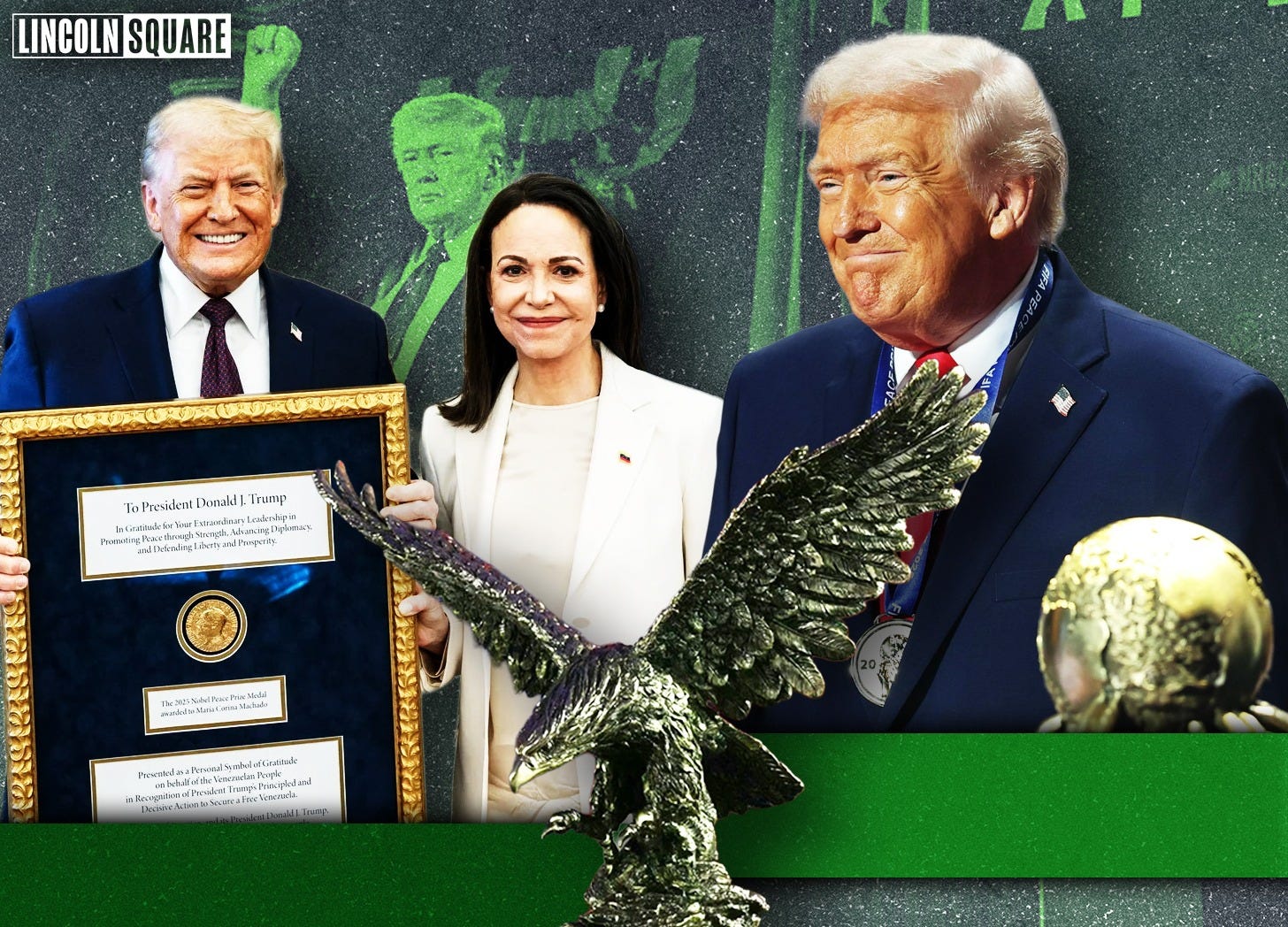
Mike Johnson stood at a podium at the National Republican Congressional Committee fundraiser in Washington, D.C. this week and announced — with a straight face, in front of cameras, as the sitting Speaker of the United States House of Representatives — that he had invented a brand new award. Not presented one. Not bestowed one that existed before he walked into that room. Invented one. On the spot. For one man. “Tonight, we have created a new award,” Johnson told the crowd. “We are going to do something we’ve never done before. We’re going to honor him with a new award that we will present annually from this point forward.” He then produced what he described as “this beautiful golden statue” — appropriate, he assured everyone, “for the golden era.” The award had a name. The America First Award. Its first-ever recipient was, surprise, surprise, Donald J. Trump.
What in the fuck is this? The America First Award sounds like the prize you receive for finishing first in a contest where you were also the only entrant, the only judge, and the one who designed the trophy. It sounds like something generated by a committee of one at 11 p.m., which is exactly what it was — except the committee member happened to be the third most powerful elected official in the United States. Mike Johnson basically went to Kinkos, typed something up in bold, laminated it, and handed it to the leader of the free world like it was a certificate of completion for not eating the glue. This is what Johnson has decided to do with his speakership.
Let’s be clear about what Mike Johnson is. He is not a man who stumbled into sycophancy reluctantly. He is a man who has made the calculated decision that his entire political identity — his career, his relevance, his survival — depends on never once telling Donald Trump anything he doesn’t want to hear. Johnson has the theological and educational background to know better. He has the institutional responsibility to do better. He is the Speaker of the House, a body that is constitutionally designed to function as a check on executive power, and he has spent his entire tenure converting that institution into a prop for one man’s ego. While TSA agents were waiting for paychecks during a partial government shutdown, Johnson was at a fundraising dinner producing golden eagle statues and calling it governance. The psychological term for what Johnson is doing is sycophantic enabling — the process by which the people closest to a leader, rather than providing honest counsel, compete to deliver the most elaborate and unconditional affirmation. It is a feature, not a bug, of the environment Trump has built around himself. But Johnson isn’t just participating in that environment. He’s decorating it.
The America First Award will go to Donald Trump every year for the rest of his presidency. Everyone in that room knows it. The golden fucking statue knows it. And the second Trump leaves office, this “annual” tradition will be quietly buried in the same unmarked grave as every other ritual that existed solely to manage one man’s psychological needs. There is no selection committee. There are no criteria. There are no future recipients being considered. The award is Trump, has always been Trump, and when Trump is gone it ceases to exist. That is not a tradition. That is a participation ribbon with a procurement budget.
And Johnson isn’t working alone. In December, FIFA president Gianni Infantino invented something called the FIFA Peace Prize — an award that did not exist in any form before Trump began publicly sulking about not winning the Nobel — and presented it to him at the Kennedy Center with full pomp and ceremony. The narrated video described the prize as recognizing “an individual who has taken extraordinary action for peace, and in doing so, helped unite people across the globe.” Trump was approximately two months away from launching a war with Iran when they put that trophy in his hands. Infantino runs a global sporting federation and apparently decided the best use of his institutional credibility was to create a fake peace prize for a man drifting toward a regional war. These are not honors. These are green ribbons dipped in metallic paint and handed out by grown men in suits.
Now to the Nobel itself, because this is the thread running through all of it and it needs to be pulled before we go any further. Trump has been publicly, obsessively, embarrassingly lobbying for the Nobel Peace Prize for years. Not quietly hoping. Lobbying. Campaigning. He went around claiming he had ended wars — six wars, then eight, then nine, depending on the day and the room and how the last applause landed. The number was never fixed because the number was never the point. The posture was the point. He claimed he had been nominated for the Nobel dozens of times, a figure that shifted and inflated with each retelling, none of it independently verifiable because Nobel nominations are sealed for fifty years. He framed the award he hadn’t won as simultaneously the most prestigious honor in the world and a rigged process designed to deny him the recognition he deserved. That level of contradiction doesn’t just happen. It gets reinforced by everyone around him who nods along rather than asking a follow-up question.
The fixation has always had a specific target: Barack Obama. Obama won the Nobel Peace Prize in 2009, less than a year into his first term, and the committee’s reasoning was more aspirational than retrospective. That is a legitimate critique. But Obama did not spend years lobbying for the award. He did not inflate nomination counts. He did not have subordinates invent consolation prizes. He accepted it, acknowledged the awkwardness of receiving a peace prize as a commander-in-chief managing two wars, and moved on. The award did not define him because he did not need it to. If someone else had won that year instead of him, Obama would have sent a congratulatory statement and gone back to work. He would not have lost a single night of sleep.
María Corina Machado then walked into the White House and handed Trump her actual Nobel Peace Prize. Her circumstances are complicated, and her opposition to Nicolás Maduro is real. But handing Trump her Nobel was a mistake that no amount of complexity excuses. The Nobel was the most powerful symbolic asset she possessed — a piece of international moral authority that kept the world’s attention fixed on Venezuela. She surrendered it to a man who, less than two weeks before that visit, had ordered the invasion of her country and the abduction of its sitting president. Whatever she hoped to gain, it was not worth what she gave away. You do not strengthen your negotiating position by handing your most valuable asset to the other side of the table. And the Norwegian Nobel Committee made sure the world understood exactly what that transaction was worth: nothing. The committee issued a formal statement clarifying that the Nobel Peace Prize cannot be transferred. The honor, they said, remains inseparably linked to the person designated as the laureate. No ceremony, no photo op, and no amount of flattery from a sitting president changes that. The adults in Oslo said what the adults in Washington refuse to.
Trump has started a full-blown war. He is actively bombing Iran. The Strait of Hormuz is in crisis. Polling shows most Americans believe the military action has gone too far, and a growing number of Republican senators are beginning to ask questions their leadership would prefer they not ask. Senator Lisa Murkowski (R-Alaska) has already said her constituents want clarity on what comes next and whether troops will be deployed. Democrats just flipped a Florida state legislative seat in the district that includes Mar-a-Lago — the electoral equivalent of losing a fight in your own living room. The economy is wobbling. Inflation anxiety is back. And the man who spent years claiming he ended nine wars just started one.
What Trump’s entire orbit has constructed is a closed feedback loop that Irving Janis would recognize immediately. Janis identified symptoms of groupthink that include the illusion of invulnerability, collective rationalization, and the rise of mindguards who shield leaders from inconvenient information. Trump’s inner circle hasn’t just stumbled into those patterns. They’ve refined them. Nobody in that room has any incentive to tell the president that the America First Award is a participation ribbon. So nobody does. The supply chain of narcissistic validation runs without interruption, and the man at the center of it becomes more insulated, more dependent, and more detached with every cycle.
The green ribbon didn’t fool me when I was ten years old. I knew what it meant the second it landed in my hand. The school hadn’t decided I was exceptional — they’d decided I needed to be handled. And the thing about being handled with manufactured affirmation is that it doesn’t fix anything. It doesn’t close the gap between where you are and where you want to be. It doesn’t make you better or stronger or more capable. It just makes the adults in the room feel better about not having to tell you the truth.
Mike Johnson, Gianni Infantino, and everyone else producing golden statues and invented peace prizes for this man are not helping him. They are telling him, in the language of gilded fuckery, that the real thing was never coming — so here’s something we made for you instead. A trophy you can hold. A title you can repeat. A reality you don’t have to question.
And the rest of us are left governing a country where the people closest to power decided that protecting one man’s ego matters more than telling him the truth.


Happy Easter to all who celebrate. I hope that the people of Minneapolis will win the Nobel Peace Prize.
As a retired teacher, I can confirm that you hit the nail on the head. For the past 20 years, I noticed a remarkable change in student behavior and engagement in school. A smaller number of students are willing to work hard to improve and learn challenging skills/concepts. I am not a fan of competition (awarding prizes), but always challenged my students to compete with themselves. Giving private recognition for perseverance in learning or improving in the activity. We have created a generation that expects a participation ribbon for the smallest amount of effort. One that requires constant positive reinforcement. We have created a generation that takes few risks and is fearful of failure. Thanks for writing a piece explaining something that I have given a lot of thought to over the years.