


Frank Figliuzzi hosts The Frank Figliuzzi Show on Lincoln Square. He is an FBI Assistant Director (retired); 25-year veteran Special Agent; and author of the national bestseller, The FBI Way, and Long Haul: Hunting the Highway Serial Killers. Subscribe to his Substack.
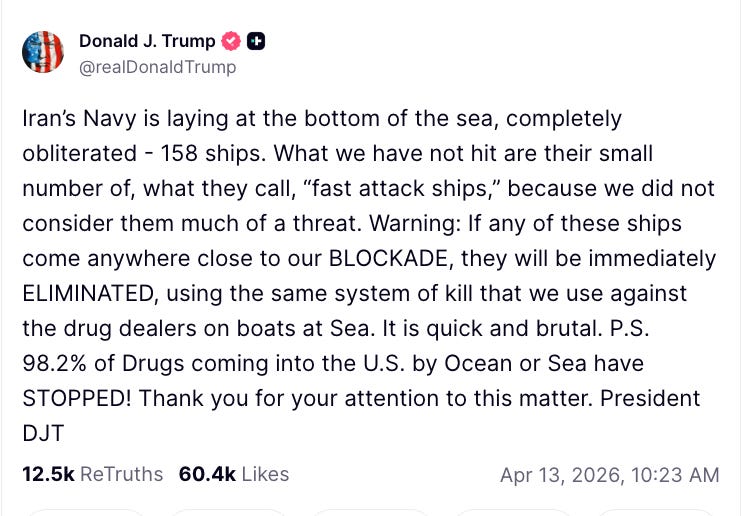
Donald J. Trump has claimed that his deadly military strikes on boats in the Caribbean and eastern Pacific have slashed vessel borne drug trafficking into the U.S. by 97 or 98 percent. “98.2% of Drugs coming into the U.S. by Ocean or Sea have STOPPED!” he exclaimed on Truth Social.
He said this at least fifteen times, and as recently as last month. No matter how many times he says it, uses upper case letters, or adds exclamation points, it’s still not true. In fact, Trump’s use of the American military to counter drugs in the Caribbean has been a colossal failure, performative showmanship, and an affront to the men and women who serve.
The hard facts mock every claim of success in Trump’s feckless foray into fatality as performance art. In the pretend war against drugs, 221 people have been killed in over 60 strikes despite data that proves it simply isn’t working. Derided as executions without trials, Trump’s accomplices say the boat strikes are designed to staunch the stream of “deadly poison” in our country. If only.
At first Trump claimed that his boat strikes were all about stopping Fentanyl. That’s a clue that he was seeking public affirmation, not accuracy or effectiveness. No one wants any more Fentanyl overdoses. But quickly, experts publicly called out the fact that Fentanyl mostly comes from Mexico, over land. It’s cocaine that comes up through the Caribbean, sometimes.
The truth is that Trump’s cavalier carnage has not reduced the metric tons of cocaine plowing through our borders. Instead, his ill-conceived initiative has simply inspired the cartels to pivot. A senior Colombian official explained: “So it has forced them to seek out other methods. Taking the drugs out through ports has increased, stockpiling it on large ships.” Transnational criminal organizations have creatively found new strategies and methods to bypass Trump’s military approach according to a Drug Enforcement Administration report, a closed-door congressional briefing and interviews with current and former U.S. and foreign officials.

According to The Washington Post, DEA analysts found the strikes had “failed to affect the supply or price of cocaine in the United States and had led traffickers to diversify beyond go-fast boats and to avoid international waters, opting instead for larger boats and hemming close to coastlines, where U.S. forces are less likely to open fire.” Sadly, the move to large ships instead of small boats may be responsible for more cocaine entering the U.S., and a commensurate drop in price on the streets.
Behind closed doors, military brass advised Congress members that Trump’s strikes have not reduced the purity of cocaine sold in America. If there was less cocaine, the laws of supply and demand would result in higher prices and adulterated product.