

The Supreme Court Is Getting High on its Own Supply
And why the right-wing court's racist overreach is the beginning of its end.

Kristoffer Ealy is a political scientist, political analyst, and professor in Southern California. He teaches American Government and political behavior, with a focus on political psychology, voting behavior, and political socialization. Subscribe to his Substack, The Thinking Class with Professor Ealy.
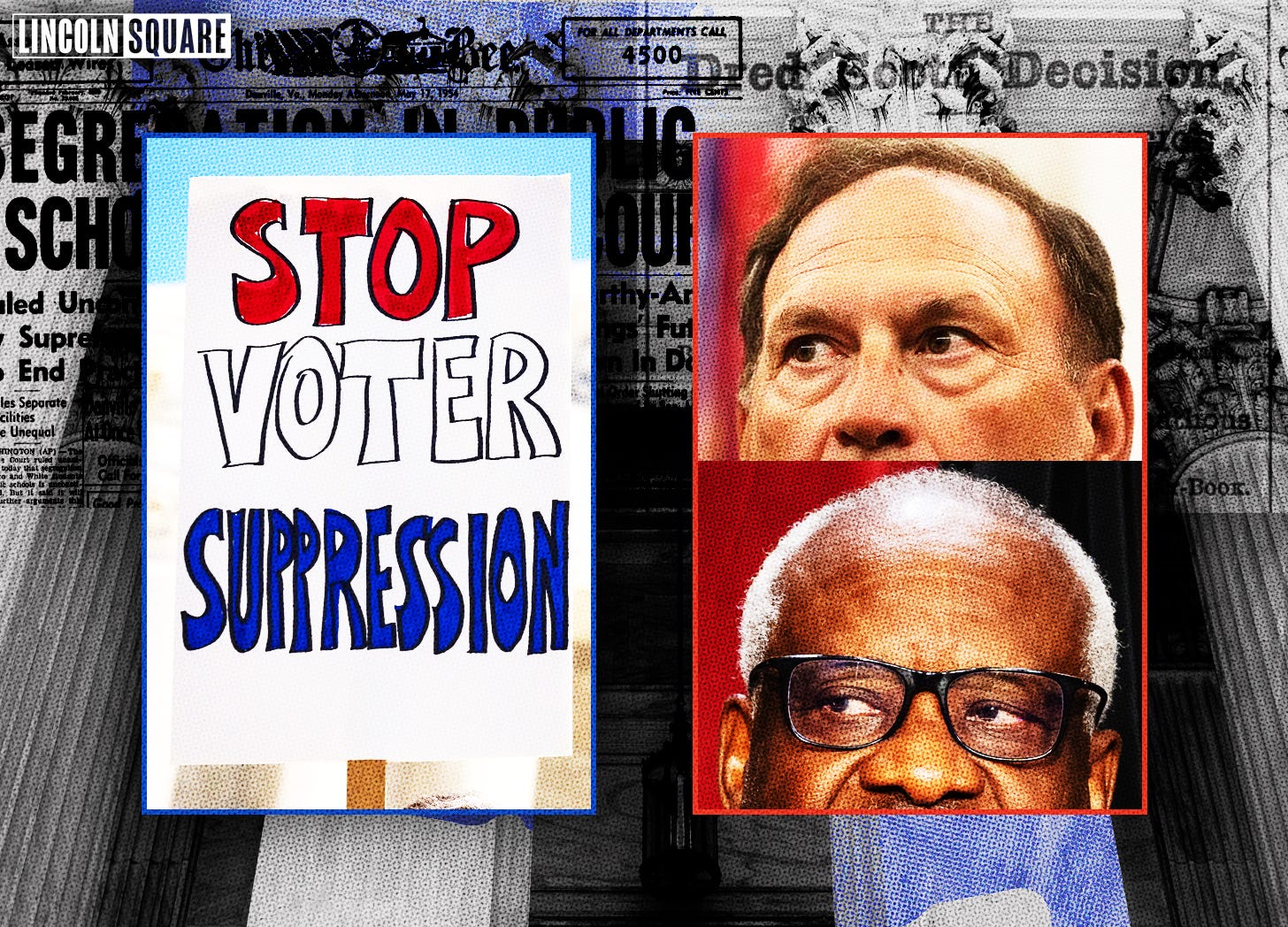
Before we get into what this Supreme Court is doing now, it is worth remembering what it has always been capable of. Dred Scott v. Sandford (1857). Plessy v. Ferguson (1896). It took Brown v. Board of Education (1954) to begin correcting the most catastrophic of those failures — and even then, states had to be dragged toward compliance like toddlers toward a bath. The Court has always had the capacity for moral failure at scale. What is different now is the combination of ambition and costume.
Ever since the conservative supermajority took over, people would ask me how often I thought the Supreme Court was making sound decisions. My answer was 65% of the time. People would hear that and say “well, that’s not too bad” and I would have to explain to them slowly — the way you explain things to someone who just failed a test and somehow thought the curve would save them — that 65% is an F. It has always been an F. The letter F did not recently renegotiate its meaning to accommodate six people in Halloween costumes pretending to interpret law.
That was before Louisiana v. Callais. I can’t give them the 65 anymore. And I say that as someone who watched this chainsaw scene coming from three highway exits back.
I was not one of those hip-hop heads who grew up worshipping Scarface. I thought the 1983 Brian De Palma film was fine — Al Pacino is genuinely electric in it — but I always felt like the die-hard fans learned the wrong lessons. They saw Tony Montana as aspirational. A blueprint. They missed that he was a cautionary tale with a great wardrobe and a catastrophic ending.
It wasn’t until I got deeper into my political science studies that I went back and watched Scarface again and realized I had completely undersold it. What I once thought was just an okay movie — entertaining, loud, a little excessive — started to reveal layers I hadn’t fully appreciated the first time around. The characters hit differently. Tony Montana wasn’t just a chaotic drug kingpin anymore; he was a case study in unchecked ambition, identity construction, and the psychological need to consume power rather than manage it. Frank Lopez, on the other hand, wasn’t just a secondary character in Tony’s story. He was the stabilizing force — a man who understood the limits of power, even if he operated outside the law.
That’s when it clicked for me. This is not a movie about the Miami cocaine trade. This is a movie about Washington, D.C. I don’t think Brian De Palma or Oliver Stone set out to make a film about American political power. But that is exactly what they made.
The character who actually understood power was Frank Lopez. Frank was not a good man. Let’s not romanticize this — he was running a criminal empire, not a nonprofit. But within that world, Frank had discipline. He also, unlike what we’d later learn about Tony, actually took time to enjoy what he built. The nice suits, the quiet dinners, the ability to exist without constantly looking over his shoulder — Frank understood that power is supposed to fund a life, not replace it.
He knew the first rule of sustainable power: don’t get high on your own supply. Don’t show your hand. Don’t reach for more than you can realistically hold without the whole thing collapsing on top of you. Frank liked money. He liked control. He liked not being dead. And it turns out those three preferences tend to reinforce each other when you’re thinking clearly.
His one fatal mistake — the mistake that cost him everything — was misreading Tony Montana. Frank assumed Tony was playing the same game: accumulate, consolidate, maintain. Build something you can keep. What he failed to grasp was that Tony wasn’t trying to win the game. Tony was trying to eat the board. There was no end state for him, no point where he said “this is enough.” More wasn’t a goal, it was a reflex.
Frank didn’t lose because Tony was smarter or even more capable. He lost because he underestimated the length and depth of Tony’s ambition — how far he was willing to go, how fast he was willing to burn everything down, including himself, to get there. Frank was managing power. Tony was addicted to it. And that is a mismatch you only get wrong once.
The Roberts Court played Frank Lopez for about a decade. Even as it moved right — chipping away at voting rights in Shelby County v. Holder in 2013, weakening Section 2 further in Brnovich v. DNC in 2021 — it maintained just enough restraint to preserve the illusion of a functioning institution. John Roberts understood, at least strategically, that the robe only works if people believe in it.
Then Amy Coney Barrett replaced Ruth Bader Ginsburg eight days before a presidential election — a seat that Mitch McConnell had refused to fill four years earlier because, he claimed with a straight face that deserves its own place in the Smithsonian, it was an election year. McConnell treated the Constitution less like a governing document and more like a takeout menu — binding when it suited him, optional when it didn’t. The man didn’t just move the goalposts. He picked them up, drove them across state lines, and then blamed everyone else for not knowing where the game was being played.
Now, to be fair — and I don’t do this lightly — Ruth Bader Ginsburg probably should have stepped down when her health first started declining during Obama’s presidency. That’s not disrespect, that’s structural reality. The stakes were too high, and the Court is too important to treat timing like a personal preference. History is not kind to missed windows, especially when the other side is operating like it’s playing speed chess with a loaded board.
Once that seat flipped, the supply started flowing. Dobbs. The immunity ruling. Chevron. And now Louisiana v. Callais — where the Court manufactured a constitutional question that none of the original parties even asked for, gutted the last meaningful provision of the Voting Rights Act, and called it a principled defense of the Constitution. That’s not jurisprudence. That’s a group of people who realized there are no immediate consequences for excess and decided to test just how far that lack of consequences actually goes.
That’s Tony Montana at the height of his delusion. Nose in the pile. Running out of people to betray. Convinced that more is always the answer.
Let me tell you what actually happened in this case, because the legal theater is designed to make your eyes glaze over and that is entirely intentional.
Louisiana is approximately 33% Black. For decades, the state had exactly one majority-Black congressional district. After the 2020 census, civil rights organizations sued, arguing that a state one-third Black deserved two majority-Black districts so that Black voters might have a meaningful shot at electing someone who actually represents them. Novel concept. Lower courts agreed. Louisiana drew the second district. Then a group of voters who described themselves in court documents as “non-African American” — which is doing a lot of work as a legal classification — sued, claiming the new map was an unconstitutional racial gerrymander.
Justice Samuel Alito, writing for the six-justice majority, agreed with them. His central argument was that “the Constitution almost never permits the Federal Government or a State to discriminate on the basis of race” and that the question before the Court was whether “compliance with the Voting Rights Act should be added to our very short list of compelling interests that can justify racial discrimination.”
Now, if you’re wondering whether that framing sounds like it was assembled out of spare parts and legal jargon found in a clearance bin, that’s because it was. And let’s not pretend this is confusion. Alito knows exactly what the fuck he is doing here. This isn’t a man lost in the weeds of constitutional interpretation. This is a man carefully arranging words into something that looks like principle from a distance and collapses into nonsense the moment you apply pressure. He took the protection of Black voters’ right to meaningful representation — in a state that is one-third Black — and repackaged it as racial discrimination. Not misinterpreted. Repackaged.
Against whom, exactly? Against the “non-African American” voters — a phrase doing Olympic-level work in those filings — who are apparently being harmed by the existence of a congressional district where Black Louisianans might elect someone who actually represents their interests. That’s the argument. That is what six justices signed their names to. And Alito dressed it up like it was a serious constitutional dilemma instead of what it actually is: a word salad designed to make the dismantling of voting rights sound like the protection of them.
Now here is the part that should make every person with a functioning brain stop and sit with the irony for a moment. These are six people with law degrees from the most prestigious institutions in the country. Harvard. Yale. Notre Dame. Combined they have more legal training than most courtrooms have ever seen assembled in one room. And not one of them — not one — bothered to engage with decades of peer-reviewed scholarship on what race actually is and what racism actually does. Ashley Montagu published Man’s Most Dangerous Myth in 1942. Stokely Carmichael and Charles Hamilton defined institutional racism with surgical precision in 1967. Carol Anderson documented the entire historical pattern in exhaustive detail in 2016. These books exist. They are not obscure. They are in libraries. Some of them are on Amazon with two-day shipping.
Six of the most credentialed legal minds in the country looked at a question about race and racism and decided the scholarship simply did not apply to them. That is not judicial independence. That is willful ignorance with a benefits package.
And here is the part that keeps me up at night: if these six legal geniuses had been sitting on the bench in 1954, Brown v. Board of Education would have come out very differently. They would have written forty pages explaining why separate was actually quite equal if you looked at it from the right angle, cited three precedents that technically supported their conclusion, and then scheduled a press conference to accept awards for their commitment to constitutional originalism.
The audacity of Alito’s framing is not accidental. It is the entire con. He didn’t just reach a bad conclusion. He inverted the premise so completely that the remedy became the crime. That is not legal reasoning. That is a magic trick for people who find racism more comfortable when it comes with footnotes.
Justice Elena Kagan was not having it. She read portions of her 48-page dissent aloud from the bench — a move reserved for the Court’s most profound disagreements — and dropped the customary word “respectfully” from her conclusion. She wrote simply: “I dissent.” She called the ruling “the latest chapter in the majority’s now-completed demolition of the Voting Rights Act” and said Section 2 is now “all but a dead letter.” She noted that the decision returns Section 2 to what it was before Congress specifically amended it in 1982 to reject the Court’s previous interpretation. In other words, six justices just undid forty years of congressional intent because they felt like it.
Kagan also noted she would be interested to see whether the “great strides” in Black political representation the majority cited would “hold up after the issuance of this opinion.” Her guess, she wrote, was not.
Mine either.
Let us be clear about what Louisiana v. Callais actually is at its foundation. The highest court in the land — the final word on constitutional law in the United States of America, the institution that is supposed to be the last line of defense between the law and the people who want to bend it — made this decision based on hunches and feelings. Not facts. Not data. Not legal precedent that could survive ten minutes of honest scrutiny. Hunches and feelings dressed up in Latin and footnotes. And before anyone says that’s too harsh, I want to remind you that this is not the first time this goddamn garbage conservative majority has operated this way and it will not be the last. These are not close calls being decided by serious people wrestling with difficult questions. These are predetermined conclusions in search of a rationale — and the rationale keeps getting sloppier because nobody with the power to stop them has been willing to do it.
I need to establish my lane, because it matters to how I analyze this.
I am a political scientist, not a lawyer. I teach American Government, political behavior, political psychology, and voting behavior. When I want to understand the legal architecture of a decision like this, I turn to people whose entire professional life is built around that work — lawyers like Marc Elias of Democracy Docket and Michael Popok, people who treat the Voting Rights Act not as a technicality but as the structural foundation of multiracial democracy.
And I want to say something about lawyers specifically. When Harvard Law professor Ronald Sullivan Jr. — one of the most accomplished criminal defense attorneys in this country, Harvard’s first Black faculty dean, a man who built the conviction review unit at the Brooklyn DA’s office and got more than twenty wrongfully convicted people released — joined Harvey Weinstein’s legal team, students protested until he was pushed out. I hated every second of that. Sullivan’s career was built on the principle that every defendant, no matter how despised, deserves a vigorous defense. That is not a character flaw. That is the Sixth Amendment doing exactly what it was designed to do. The Harvard Black Law Students Association understood this and said so publicly. The administration caved anyway.
The same principle applies to Shawn Chapman Holley, who represented Danny Masterson. I thought Masterson was guilty. I still believe that. It did not matter one bit to whether he deserved a competent defense. The moment we start deciding who deserves sound legal representation, we have broken something that protects everyone — including the people doing the protesting.
A political scientist’s job is different from a lawyer’s. A lawyer asks whether the legal reasoning is sound. I ask a different question: does this decision move the country toward democracy or away from it? Does it expand the circle of political participation or contract it? Does it reflect the actual needs of the society it governs?
By every one of those measures, Louisiana v. Callais is a catastrophic failure. And I am done softening that assessment to make it more comfortable for people who prefer their institutional critiques lukewarm.
This ruling is racist. And I mean that in the academic sense — not the cable news sense, not the Twitter sense, but the framework that social scientists have used for decades.
Anthropologist Ashley Montagu established in his landmark 1942 work Man’s Most Dangerous Myth: The Fallacy of Race that race, as a biological category, is a fiction. A social construct. A classification system invented to organize power, not genetics. The traits we associate with race do not cluster into clean scientific boxes. They shift with geography, history, and politics. If race were purely biological, it would not require a one-drop rule to maintain. It would not change depending on the decade or the country. It would not need the Supreme Court of the United States to manage it. Race is fake. The consequences of race are brutally real. That distinction is the entire ballgame.
But here is where Stokely Carmichael and Charles Hamilton’s framework from Black Power becomes essential. The fact that race is a construct does not mean racism is a myth. Racism is what happens when that constructed myth gets institutionalized. Carmichael and Hamilton were precise: racism is not simply prejudice. Racism is prejudice plus power. It is the deployment of institutional authority in the service of racial hierarchy. Individual bigotry is prejudice. Racism is what happens when that bigotry gets a robe, a gavel, and the full weight of the federal government behind it.
By that definition — the one the six justices could not be bothered to engage with because it would collapse their entire argument on contact — Louisiana v. Callais is a racist ruling. Not because Samuel Alito is sitting in chambers twirling a mustache and using slurs. Because six people with the most concentrated judicial power in the United States took that power and used it to dismantle the one law specifically designed to prevent Black voters from being systematically excluded from political representation.
That is racism by definition. Not by accusation. Not by feelings. By the actual academic framework that has existed for decades — a framework these justices avoid the way a bad student avoids the syllabus and then acts surprised when the exam covers material they never bothered to learn.
What makes this worse — and yes, it can get worse — is that this is being done under the cover of intellectual seriousness. The robes, the citations, the footnotes — all of it functioning like a Halloween costume for people who want the authority of scholarship without the discipline of actually doing it. This is not a disagreement over competing interpretations of law. This is a group of people reverse-engineering a conclusion and then daring anyone to call it what it is.
And the most insulting part is the performance of innocence. The implication that this is just a tough constitutional question, a close call, a matter of principle. There is nothing close about gutting the Voting Rights Act and pretending you are protecting equality. That is not judicial restraint. That is intellectual cowardice dressed up as neutrality, and it would not pass a first-year seminar where someone is actually required to show their work.
This is what Carol Anderson documents in White Rage: The Unspoken Truth of Our Racial Divide — one of the most important books written about American political history in the last two decades. Anderson’s argument is devastatingly simple: every time Black Americans have made meaningful advances toward full democratic participation, white institutional power has responded with a deliberate, legally-laundered rollback. Reconstruction produced the Black Codes and Jim Crow. Brown v. Board produced the shutdown of public schools across the South. The Voting Rights Act of 1965 produced the Southern Strategy. Barack Obama’s presidency produced the Tea Party, voter ID laws, and ultimately the political conditions that gave us this supermajority.
Louisiana v. Callais is the latest entry in that catalog. It is white rage wearing a law degree. And it connects directly to what I have written about before — the rank of whiteness.
Whiteness in America does not function as a culture or a biology. It functions as a rank. A hierarchical status. A credential that has to be defended, maintained, and policed precisely because it was never natural to begin with. It was designed. And when that design is threatened — when the congressional map starts to reflect that Louisiana is actually one-third Black, when the writers’ room starts to look like the country it’s supposed to be writing for — the response is not rational deliberation. The response is rank protection.
This is why the “anti-white racism” argument is not just wrong. It is mathematically embarrassing. I have genuinely seen people argue — on the internet, with apparent sincerity — that white writers going from 90% of Hollywood writers’ rooms to 60% constitutes proof that anti-white racism is at an all-time high. Sixty percent. Still the majority. In a country where white Americans are approximately 60% of the population. The argument is that approaching proportional representation is itself discrimination. That is not a civil rights claim. That is a toddler being asked to share a toy they have had exclusively for sixty years and responding by lying face-down on the floor of the grocery store.
Here are some numbers to put next to that argument. White Americans hold 73% of senior executive positions across Fortune 500 companies. Black Americans hold 2%. Seventy-two percent of college presidents are white in a country where the student body is majority non-white. White men make up 31% of the U.S. population and nearly 50% of Fortune 50 board seats — after years of “progress.” Two Black women serve as CEOs of Fortune 500 companies. Two. Out of five hundred.
This is the landscape in which six Supreme Court justices have decided that a Louisiana congressional map with two majority-Black districts in a state that is one-third Black constitutes racial discrimination against white voters.
The audacity is not incidental. It is the entire product.
We cannot discuss this ruling honestly without discussing Clarence Thomas, who concurred.
Thomas has spent his career on this Court dismantling the legal architecture that made his own presence on that bench possible. He votes to roll back voting rights, affirmative action, and civil rights protections with a consistency that would be impressive if it weren’t so transparent. There has never been a Supreme Court justice who so casually abandons precedent to serve a predetermined ideological outcome. And there has never been one more visibly comfortable in the company of the people his rulings benefit.
Republican megadonor Harlan Crow — a man whose political investment portfolio is built around protecting conservative white power structures — purchased Clarence Thomas’s mother’s home in Savannah, Georgia in 2014 for $133,363. Thomas’s mother continued living there. Crow’s company took over the property taxes. Crow then spent tens of thousands of dollars renovating the home. ProPublica documented at least 38 destination vacations and 26 private jet flights from Crow and other billionaires to Thomas over the years. Thomas disclosed almost none of it for decades, and when finally forced to address it said he “inadvertently failed to realize” the real estate transaction needed to be disclosed. A Supreme Court justice. Inadvertently. Did not realize. He needed to report. The sale. Of his mother’s fucking house!
I want to use my rank framework here because it is the most precise explanation available. Harlan Crow bought the home where Thomas’s mother lives. He flies Thomas on his private jet. He takes him on yacht vacations across the world. And Thomas returns to the bench and issues ruling after ruling that protects a hierarchy he will never fully belong to. Ashley Montagu told us race is a myth. Carmichael and Hamilton told us racism is what happens when that myth gets institutionalized power. And Clarence Thomas is the living demonstration of what it looks like when someone protects a ladder that was specifically designed to push them off.
That is not a paradox. That is a case study in what rank capture looks like when it’s complete.
The Democrats do not get to leave this room clean either.
This supermajority exists because five of its six members were appointed by presidents who lost the popular vote. That is a structural problem requiring a structural response. Democrats have known this since at least 2016. What they did with that knowledge was hold committee hearings, write strongly worded letters, and talk about norms as if norms were a force field.
Trump lost in 2020. Democrats had the presidency and briefly the Senate. They did not move to expand the Court. They did not push through voting rights legislation with the urgency the moment demanded. They let Joe Manchin and Kyrsten Sinema function as a two-person veto on democratic governance and called it bipartisanship. They allowed Trump to spend four years after his loss holding rallies, building a grievance infrastructure, and recruiting candidates at every level of government — while Democrats debated the politeness of their messaging and wondered aloud why working people weren’t more grateful.
And then — in one of the most spectacular acts of collective political malpractice in modern American history — they turned on Joe Biden in an election year. I understand the concerns about his age and capacity. What I cannot excuse is how it was done — without a primary process that began a year earlier, without a plan, and without the collective nerve to fully get behind Kamala Harris once they had made that choice. The resistance to Harris was not purely strategic. Some of it was the same rank protection instinct that animates the other side, just wearing better shoes and speaking in complete sentences. The micro-aggressions were not subtle to anyone paying attention. The hedging was not invisible. And the result was a second non-consecutive Trump term and Louisiana v. Callais.
Democrats did not build this Court. But they had chances to stop it and they flinched. Every. Single. Time. Frank Lopez thought the rules of the game would protect him from Tony Montana’s ambition. He was catastrophically wrong. Democrats thought norms and institutions and the basic decency of their opponents would hold the line. Same mistake. Different costume.
Here is where we are. A study published in the Proceedings of the National Academy of Sciences found that this Supreme Court is now more conservative than approximately 75% of Americans. In 2010 it reflected the preferences of the median American. After Barrett’s confirmation it shifted sharply right and now sits ideologically near the typical Republican voter — not the average American. Fifty-three percent of Americans in an ABC News/Ipsos poll said they believe the justices rule based primarily on political beliefs rather than legal reasoning. That number spiked ten points since January 2022.
This is not a court with a legitimacy surplus. This is a court that has been spending down its institutional credibility like Tony Montana spending down his goodwill — fast, recklessly, and with no apparent understanding of what happens when the account hits zero.
Louisiana v. Callais will reshape congressional maps across the South. It will eliminate majority-Black districts that took decades of litigation to establish. It will cost representation at the level of county commissions, city councils, and school boards — the places where daily life is actually governed. Marc Elias and Democracy Docket are tracking approximately 180 active cases and will use every available legal tool. But the tool that mattered most — Section 2 of the Voting Rights Act, born from the literal blood of Union soldiers and civil rights marchers, reauthorized repeatedly by bipartisan congressional majorities — is now, as Justice Kagan wrote, all but a dead letter.
Ron DeSantis already knew this was coming. He pushed through Florida maps under the assumption that this exact ruling was on the way, baking in the unfairness before the opinion was even published. That is what it looks like when you are playing Tony Montana chess while everyone else is still arguing about whether Tony is really that bad.
Frank Lopez lasted longer than Tony Montana. Not because Frank was smarter or stronger. Because Frank knew how much supply was too much. Frank understood that power requires self-regulation or it consumes itself. His one catastrophic miscalculation was not recognizing how far Tony’s ambition actually reached until it was too late to do anything about it.
This Court made the same miscalculation in reverse. They are Tony. They have the power. They have the supermajority. They have lifetime appointments and a Republican Party that will protect them from any meaningful accountability. And they have decided — with Dobbs, with the immunity ruling, with Chevron, and now with Louisiana v. Callais — that there is no such thing as too much.
The whole world, Chico. And everything in it.
That is what they wanted. Every right. Every protection. Every structural mechanism that stood between raw power and its unaccountable exercise. And if the history of American institutions — and the history of every man who ever confused accumulation with invincibility — tells us anything, it is that the grab for everything is always the beginning of the end.
Sixty-five percent was already an F. We are somewhere south of that now. And the most telling sign that this Court has officially gotten high on its own supply is that they do not seem to know it. They handed down Louisiana v. Callais like they were doing the Constitution a favor.
Justice Kagan wrote the record. She read it aloud from the bench. She dropped the word “respectfully” because some things do not deserve the courtesy. She wrote it so that when the reckoning comes — and it will come, because it always does — there will be no confusion about who did what, to whom, and why.
They got the whole world.
They won’t keep it.
 | A guest post by
|
An absolutely spot on well researched,logical piece with a great comparison. I wonder if they truly believe they’re invincible and will be jurists forever? They clearly are white supremicists, even the pitiful self hating Clarence Thomas. They can’t see the corruption of their own power and ideology. We MUST give them glasses.
Brilliant! Thank you so much for putting it all together and making it understandable for a layperson like me. I'm sickened, but take solace in your belief that the reckoning will come. Thank you!