


Brian Daitzman is the Editor of The Intellectualist. Subscribe to his Substack.
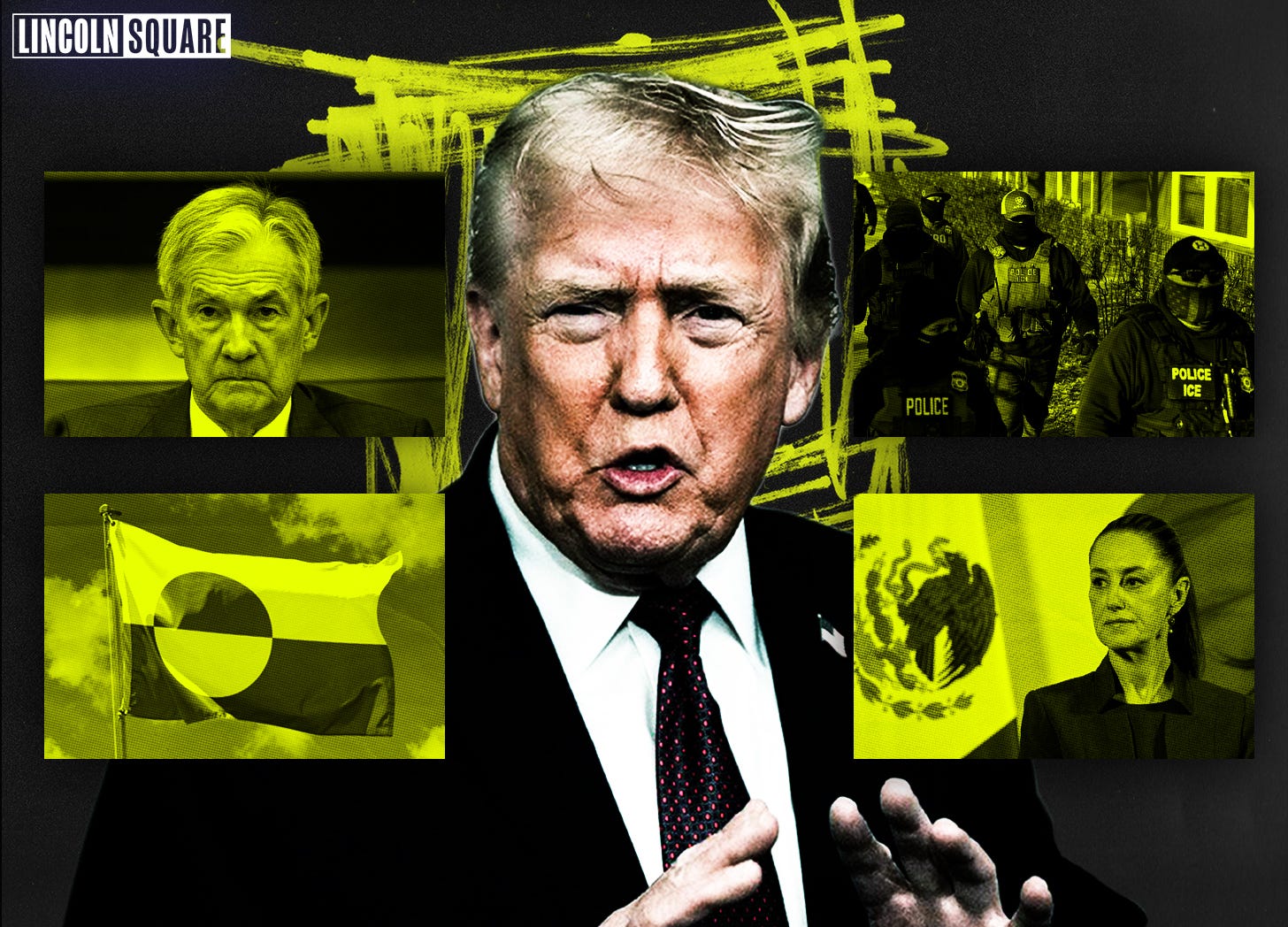
This is how complex systems collapse. Not from a single failure, but when multiple stabilizing institutions are pressured at the same time. The president has threatened allies, undermined courts, pressured the Federal Reserve, destabilized markets, and eroded trust at home and abroad—simultaneously. In such systems, failure does not require everything to break. One critical stabilizer giving way is enough. And the most dangerous signal is that none are now treated as off-limits.
The most dangerous moment in a complex system is not collapse itself, but the loss of restraint—the point at which mechanisms designed to absorb shock instead begin to generate it. That is the moment the United States has entered.
This is not a story about one policy failure or one shocking statement. It is about simultaneity.
In a matter of weeks, the president has threatened allies, undermined judicial authority, pressured the central bank, inflamed domestic law-enforcement controversies, and shaken global confidence in American commitments. These events are not isolated. They are overlapping stresses applied to the institutions meant to prevent cascading failure.
By simultaneity, this essay does not mean coincidence or a crowded news cycle. It refers to a specific systems condition: multiple stabilizing institutions placed under acute stress at the same time, without recovery intervals, such that stress in one domain amplifies stress in others before correction can occur. Sequential crises can be absorbed. Simultaneous ones overwhelm. When courts, markets, alliances, and enforcement norms are all pressured concurrently, risk stops accumulating linearly and begins compounding.
The clearest illustration of this loss of restraint is the episode involving the Federal Reserve—not because it is the most dramatic act, but because it demonstrates that no stabilizing institution is now treated as untouchable. When Federal Reserve Chair Jerome Powell says that Department of Justice actions were used as pressure on interest-rate policy, the significance is structural, not personal.
Central-bank independence is not a courtesy. It is financial infrastructure—the shared assumption that the price of money will not be set by executive impulse. Undermine that assumption and uncertainty propagates instantly through bond markets, mortgages, pensions, currencies, and sovereign debt. There is no redundancy for the Federal Reserve.
The Fed exists because the United States learned, painfully, what happens when monetary policy is subordinated to politics. After the Panic of 1907, Congress created a central bank insulated from short-term power to prevent recurring crises. Its mandate—price stability and maximum employment—was designed to limit discretion, not empower it. Stability, not speed, is the objective.
That stabilizing role is now under strain. Tariffs function as regressive taxes, raising prices across supply chains and increasing inflationary pressure. Political demands for lower interest rates in such conditions create the risk of stagflation—high prices paired with low growth—one of the most destructive macroeconomic outcomes a society can face. The Fed’s ability to respond is further constrained by already-elevated rates, leaving less room to maneuver than in past crises.
What distinguishes monetary credibility from other institutions is transmission speed. Courts erode slowly. Alliances fray politically. Law-enforcement legitimacy degrades unevenly. Monetary trust reprices immediately. Markets do not wait for elections or investigations. Once confidence falters, feedback loops become global.
The consequences do not stop at U.S. borders. American financial markets anchor the global system. If investors begin to doubt U.S. monetary governance, they demand higher yields to compensate for political risk. Higher yields raise debt-financing costs. Higher costs force fiscal contraction or inflationary monetization. Either path lowers living standards. Falling living standards erode legitimacy. Legitimacy loss weakens alliances. Alliance weakness raises security risk. A localized shock becomes a generalized crisis.
