


Brian Daitzman is the Editor of The Intellectualist. Subscribe to his Substack.
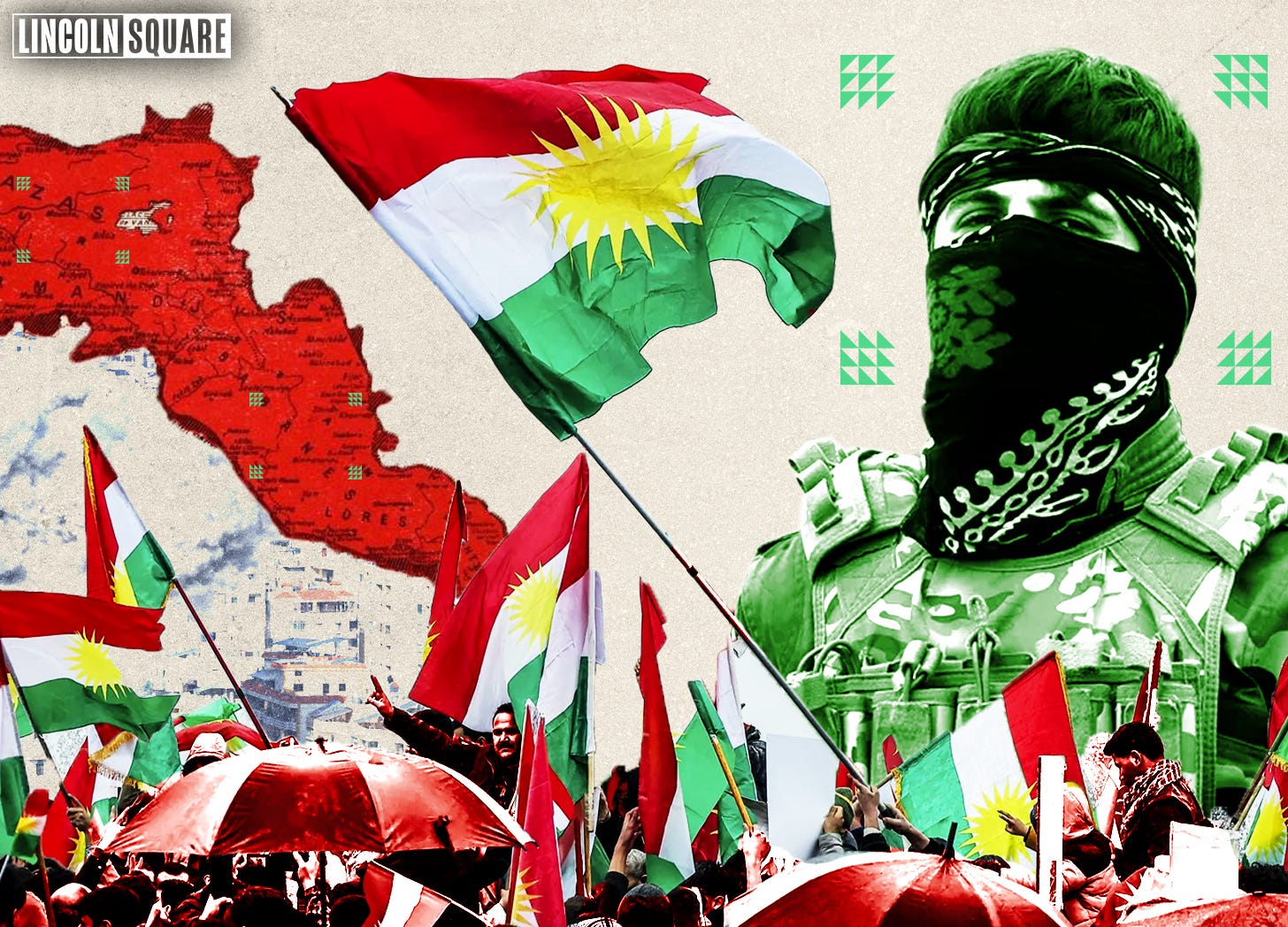
For a century, the borders drawn from the ruins of the Ottoman Empire have defined the Middle East’s political reality. They survived coups, wars, insurgencies, and revolutions. But under the pressure of conflict stretching from Gaza to Tehran and across northern Syria, those lines are no longer as fixed as they once seemed. Kurdish geography — long suppressed by treaties and power balances — is reappearing not as a declaration, but as leverage, shaped by arms, territory, and wartime calculation.
The airstrikes on Iran have dominated the headlines. The images are dramatic, the rhetoric sharper still: American and Israeli aircraft striking the Islamic Republic, the killing of Iran’s Supreme Leader, Tehran’s retaliation. It feels like a hinge in the long confrontation between Israel and Iran.
But the deeper shift may not be over Tehran at all. It may be unfolding along a belt of mountains and plains stretching from southeastern Turkey through northern Iraq into northeastern Syria. The visible war is with Iran. The structural shift runs through Kurdistan.
For a century, Kurdish statehood has been constrained less by internal division than by external coordination. The Kurds—roughly 30 to 35 million people spread across Turkey, Iran, Iraq, and Syria—are the largest stateless ethnic group in the Middle East. Their fortunes have risen and fallen with each regional upheaval: after the collapse of the Ottoman Empire, during the Cold War, after the U.S. invasion of Iraq, and in the fight against ISIS. Each time, autonomy expanded in crisis and contracted when neighboring states realigned.
That pattern was set in the aftermath of imperial collapse. When the Ottoman Empire disintegrated after World War I, its provinces were divided through wartime agreements and postwar treaties that reshaped the Middle East. The 1916 Sykes–Picot agreement mapped British and French spheres of influence across former Ottoman lands. The 1917 Balfour Declaration pledged support for a Jewish national home in Palestine. The 1920 Treaty of Sèvres included provisions for a possible Kurdish state. But three years later, the Treaty of Lausanne superseded it, fixing the borders of modern Turkey and abandoning Kurdish statehood. Kurdish-majority regions were partitioned among Turkey, Iraq, Syria, and Iran. The settlement did not eliminate Kurdish aspirations; it embedded them within four states whose leaders shared an interest in preventing secession.
The operating rule was simple. Turkey, Iran, Iraq, and Syria did not need to agree on much. They needed to agree on one thing: Kurdish independence would not be allowed. As long as at least two acted in concert, a sovereign Kurdistan remained remote.
Today, that coordination is fractured.
Syria is no longer a consolidated state under Bashar al-Assad. Since his fall in late 2024, Damascus has been governed by a transitional leadership under Ahmed al-Sharaa, a former insurgent commander. His government is attempting to reassert authority, including over Kurdish-led institutions in the northeast. But reintegration is not control. Turkish forces remain active in northern Syria. Israel continues to strike military infrastructure under a preventive doctrine. Damascus governs, but it does not command uncontested sovereignty.
Iraq presents a different looseness. The Kurdistan Region of Iraq is constitutionally recognized as a federal entity, with its own parliament and peshmerga forces. It flies its own flag and conducts its own diplomacy. Yet it remains embedded within the Iraqi state, dependent on oil exports and fiscal transfers from Baghdad. The memory of 2017 lingers. Kurdish voters approved independence in a referendum that year. Within weeks, Baghdad retook disputed territories with backing from Turkey and Iran. The referendum collapsed not because Kurdish voters hesitated, but because neighboring states aligned quickly and decisively.
Iran was long one of the pillars of that alignment. It suppressed Kurdish activism within its borders and projected influence into Iraq and Syria through allied networks. The recent U.S.–Israeli strikes—and the reported killing of Ayatollah Ali Khamenei—have forced Tehran into leadership transition under pressure. A succession struggle does not erase Iran’s coercive capacity. But it introduces uncertainty into a system that functioned for decades as a steady counterweight to Kurdish ambitions.
