


Brian Daitzman is the Editor of The Intellectualist. Subscribe to his Substack.
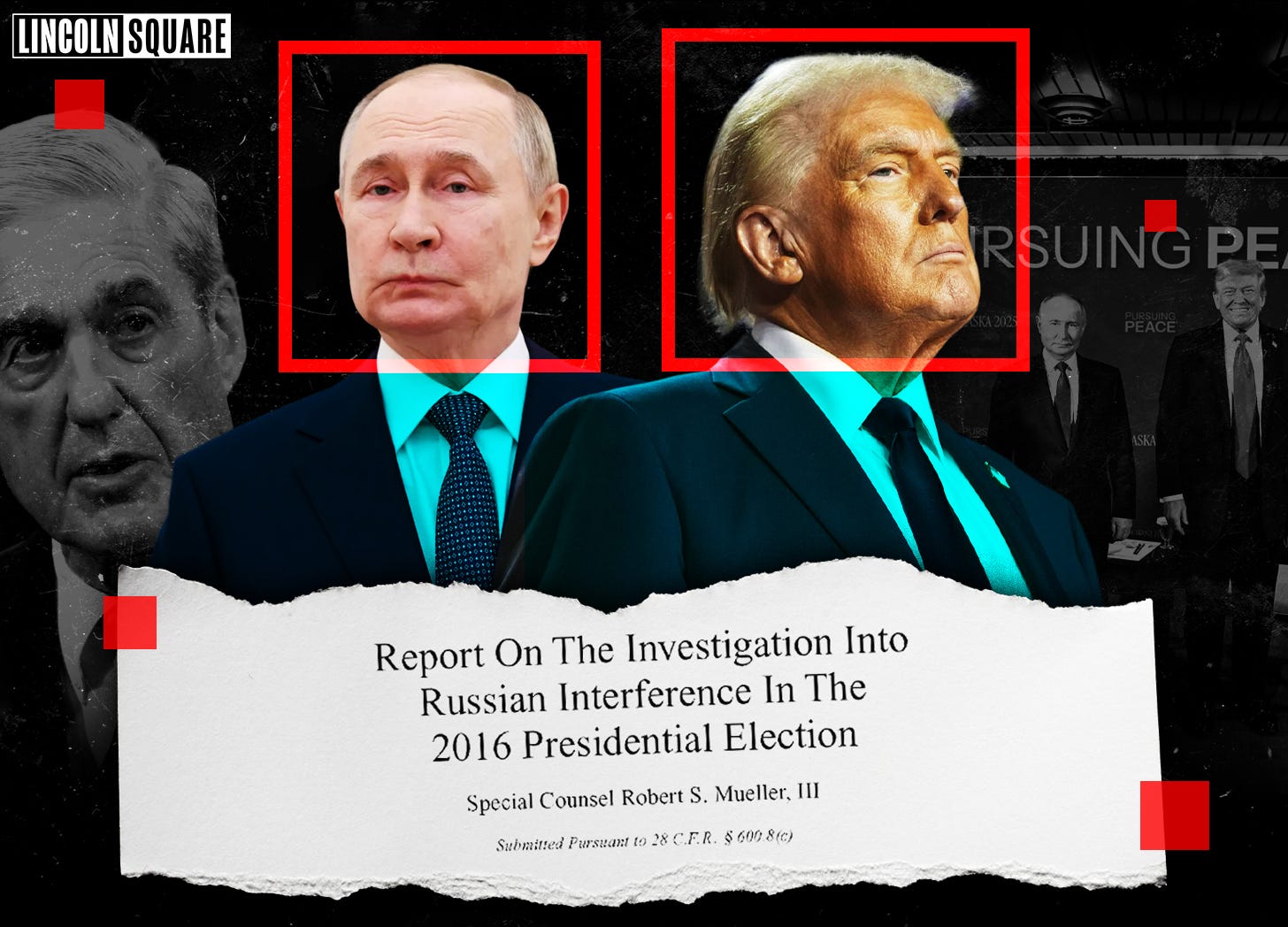
When Robert Mueller died, President Donald Trump did not mourn him. He celebrated instead, saying Mueller could no longer “hurt innocent people,” echoing a years-long effort to discredit the Mueller Report.
Mueller, the former FBI director, had been appointed in 2017 to investigate Russian interference in the 2016 election and any links to the Trump campaign. His report was not a hoax. It documented a sweeping Russian interference operation, repeated campaign contacts, the sharing of internal polling data with a Russia-linked intermediary, and identified counterintelligence risks—evidence of a pattern that predates 2016 and continues into the present.
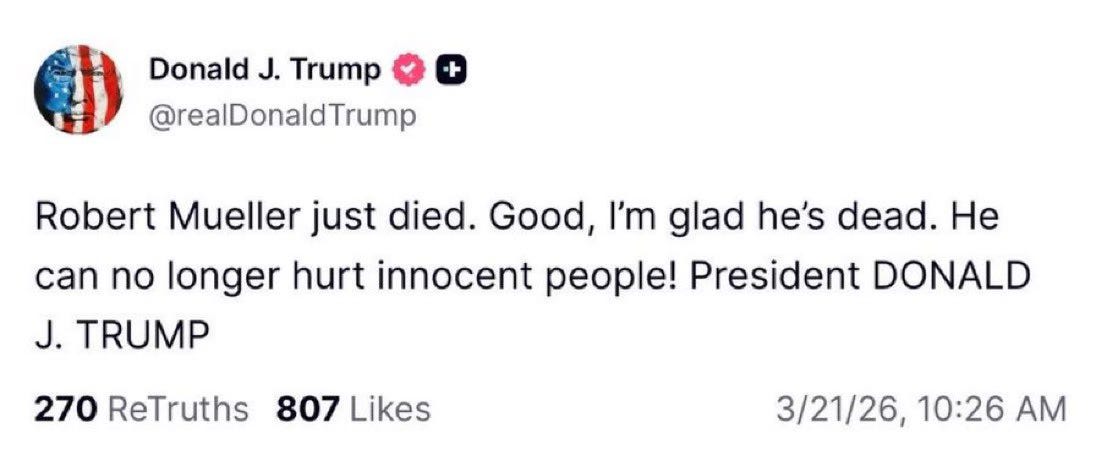
On March 20, 2026, former FBI Director Robert Mueller died, and President Donald Trump responded as if the moment settled a score rather than closed a life. He offered no restraint. He celebrated.
He said Mueller could no longer “hurt innocent people,” returning to a claim he had made for years—that the investigation itself was illegitimate, something that never should have happened—as if the disappearance of the man might dissolve the record he left behind. It was an attempt at narrative finality: if the investigator is gone, the investigation can be buried with him.
But the record does not depend on the man who assembled it. It depends on what it contains, and what it connects to.
Donald Trump spent years calling Special Counsel Robert Mueller’s investigation a “hoax.” He did not use that word when Mueller died. He did not need to. The meaning is the same. Saying Mueller “hurt innocent people” restates the claim in different language: that the investigation itself was illegitimate.
The claim that the Mueller Report was a “hoax” depends on treating its central figures and findings as disconnected fragments rather than parts of a single documented sequence.
Paul Manafort, Trump’s campaign chairman, was not just a consultant; he was financially and operationally linked to Konstantin Kilimnik, whom the Senate later identified as tied to Russian intelligence. Their interactions included the transfer of internal polling data. That exchange was not an isolated detail, just as the Trump Tower meeting was not a curiosity. Both sit within the same evidentiary record compiled by the Mueller Report and later reinforced by bipartisan Senate findings.
These are not separate stories. They are components of a single account of Russian interference and campaign-linked contacts. Read together—as the report itself presents them—they form a continuous pattern. Only by breaking that continuity apart can the label “hoax” be sustained.
The problem with “hoax” is not only that it is false. It compresses a long, documented sequence into a claim of emptiness. That compression only works if each part is isolated—Manafort reduced to a consultant, Kilimnik to an associate, polling data to a detail, a meeting to a curiosity, the Mueller Report to overreach, a bipartisan Senate finding to an afterthought, later policy to something unrelated. Restore continuity, and the word collapses.
