


Kristoffer Ealy is a political scientist, political analyst, and professor in Southern California. He teaches American Government and political behavior, with a focus on political psychology, voting behavior, and political socialization. Subscribe to his Substack, The Thinking Class with Professor Ealy.
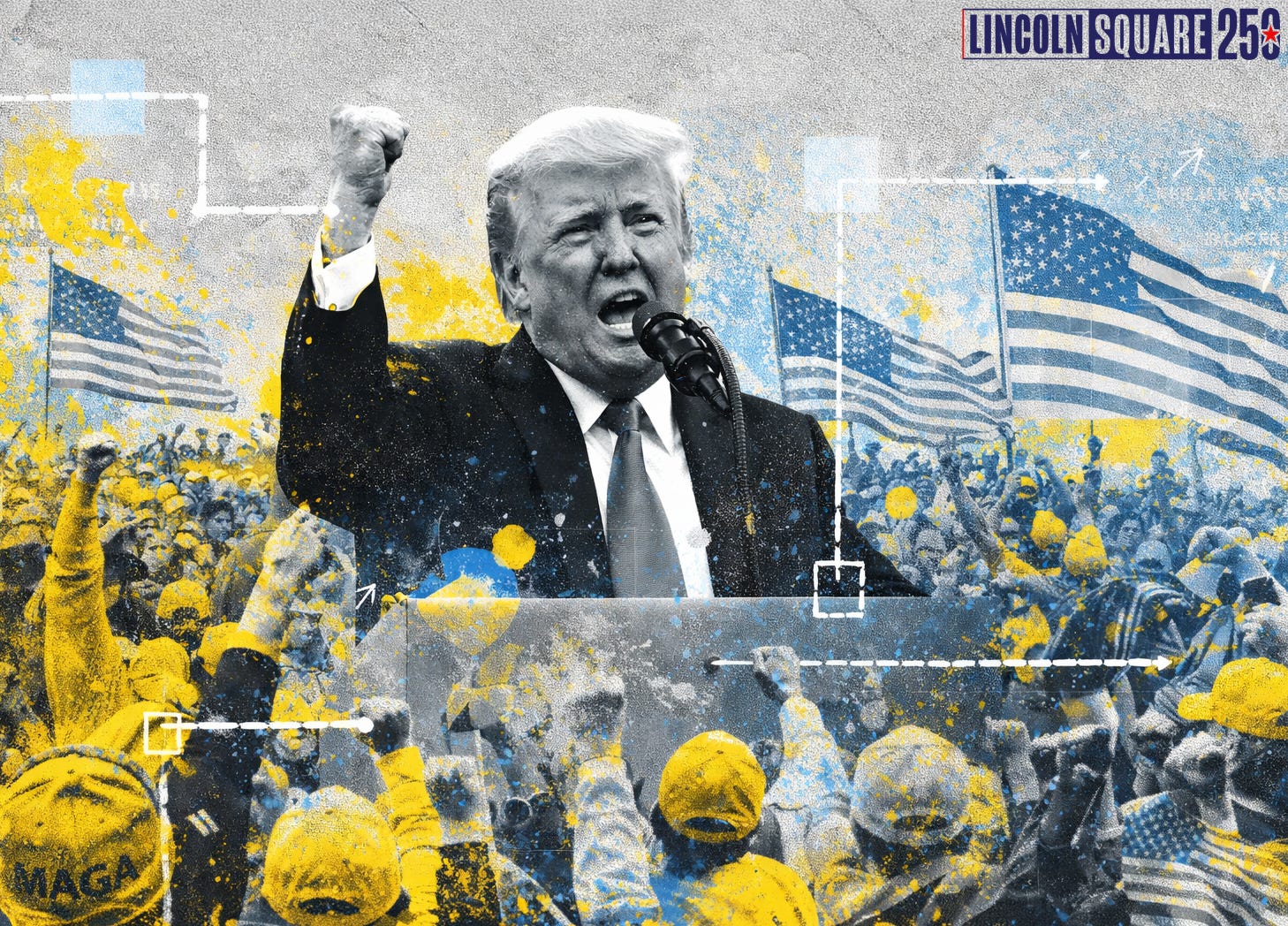
In Part I, we traced how Donald Trump spent four decades as a man most of the country had the luxury of ignoring — a tabloid character, then a reality-TV boss, then, once he came down that golden escalator, someone the whole country was forced to reckon with. We defined audience capture: the process by which a public figure’s incentives flip, so that the crowd stops being who he leads and starts being who he performs for.
We saw it happen to Trump himself, booed by his own rally crowd for recommending the COVID vaccine and for hesitating to go after Dr. Fauci on command. And we saw it happen to the people who built careers assuring an audience that its worst impulses were reasonable — Brandon Tatum, Vivek Ramaswamy, and Megyn Kelly, each of whom hit a fork in the road and chose the crowd over the harder, more honest path.
Part II picks up with the clearest, ugliest example yet: one night in Nassau County that captured the whole mechanism in real time — an FBI director who forgot who he actually works for, a president who won’t apologize for gas prices, and a room that cheered exactly the wrong things. From there we follow the same dynamic downstream, to a podcaster who can’t seem to remember what he believed three weeks ago.
Then there was the night of Aug. 14 in Nassau County—a night that somehow managed to combine partisan campaigning, institutional degradation, economic gaslighting, and an 80-year-old man repeatedly talking about “young, beautiful girls” before an audience full of cops. So, basically, another completely normal evening in the second Trump administration.
On August 14, 2026, Trump traveled to the Nassau County Police Academy on Long Island, ostensibly to tout new FBI statistics showing a substantial decline in violent crime. That was the official reason. In practice, the event quickly became an overwhelmingly political rally aimed at boosting Republicans in New York, including Bruce Blakeman’s campaign for governor against Kathy Hochul. FBI Director Kash Patel and Todd Blanche—who had been sworn in as attorney general only four days earlier—served as warm-up acts before Trump. America’s two most powerful federal law-enforcement officials apparently looked at the longstanding norm against using their offices as partisan campaign props and decided norms were more of a suggested serving size.
Patel then stood before the crowd and announced, “I’ve spent 10 years working for President Trump.”
Ten years.
Patel did not become part of the Trump administration until years after Trump first took office, so this was generous arithmetic even by the standards of a movement where crowd sizes occasionally require their own branch of mathematics. But the number is almost beside the point. The phrase “working for President Trump” is the real problem.
Kash Patel is the Director of the Federal Bureau of Investigation. He does not work for Donald Trump in the sense that Trump owns a landscaping company and Kash is trying to make assistant manager. He leads a federal law-enforcement institution whose obligations are to the Constitution, federal law, and the American public. The entire post-Watergate concern around FBI independence grew out of exactly this danger: federal law enforcement becoming too pliable to White House political demands.
Think of it like a sheriff’s deputy pulling over the sheriff for drunk driving. Yes, organizationally, the sheriff sits above the deputy. But once the lights come on, the deputy’s obligation is to the law. He does not walk up to the window, see the sheriff fumbling with his registration, and say, Boss, ordinarily this would be a DUI, but I really appreciate the leadership.
