The Hot-Take Economy and the Death of Informed Opinion
How Charlamagne tha God, Joe Rogan, and the “just asking questions” crowd turned misinformation into a business model—and why the rest of us can’t afford to play along.
There’s been a great deal of media noise since the Democrats decided it was a good idea to reopen the government. And I’ll be honest—I’m tired. When it comes to politics, my philosophy has always been simple: mourn the loss, learn from it, and move on to the next fight. When Kamala Harris lost to Trump, I gave myself three days to sulk and then went right back to dissecting what went wrong and how to fix it. But the postmortem tour has been nothing but a loop of “Democrats suck” takes with no conversation about what comes next. That’s not a chorus I care to join. Still, in the middle of all that noise, this so-called beef between Roland Martin and Charlamagne Tha God caught my attention—not because I love political drama, but because it says something deeper about the difference between opinion and information.
Charlamagne Tha God gave his audience yet another half-informed hot take about Democrats, and Roland Martin wasn’t having it. After hearing Charlamagne’s comments, Roland flatly told senators and listeners to his show, “Don’t listen to what the hell he just said,” and then calmly explained why Charlamagne was wrong. That should’ve been the end of it. Instead, Charlamagne took it personally and launched into a string of juvenile insults that I won’t bother repeating—not because they were offensive, but because they were so spectacularly stupid. At one point, he called Roland a “hater,” which, let’s be honest, is usually what people say when they’ve run out of facts but still want to sound like they’re winning. When Roland saw the clip, he could’ve easily fired back in kind, but to his credit, he didn’t. Instead, he took the high road and broke down the difference between misinformation and disinformation, and why credibility matters when you have a microphone that powerful. It was the kind of dignified response Charlamagne didn’t deserve but the audience desperately needed—proof that Roland’s in the journalism business, and Charlamagne’s in the hot-take business.
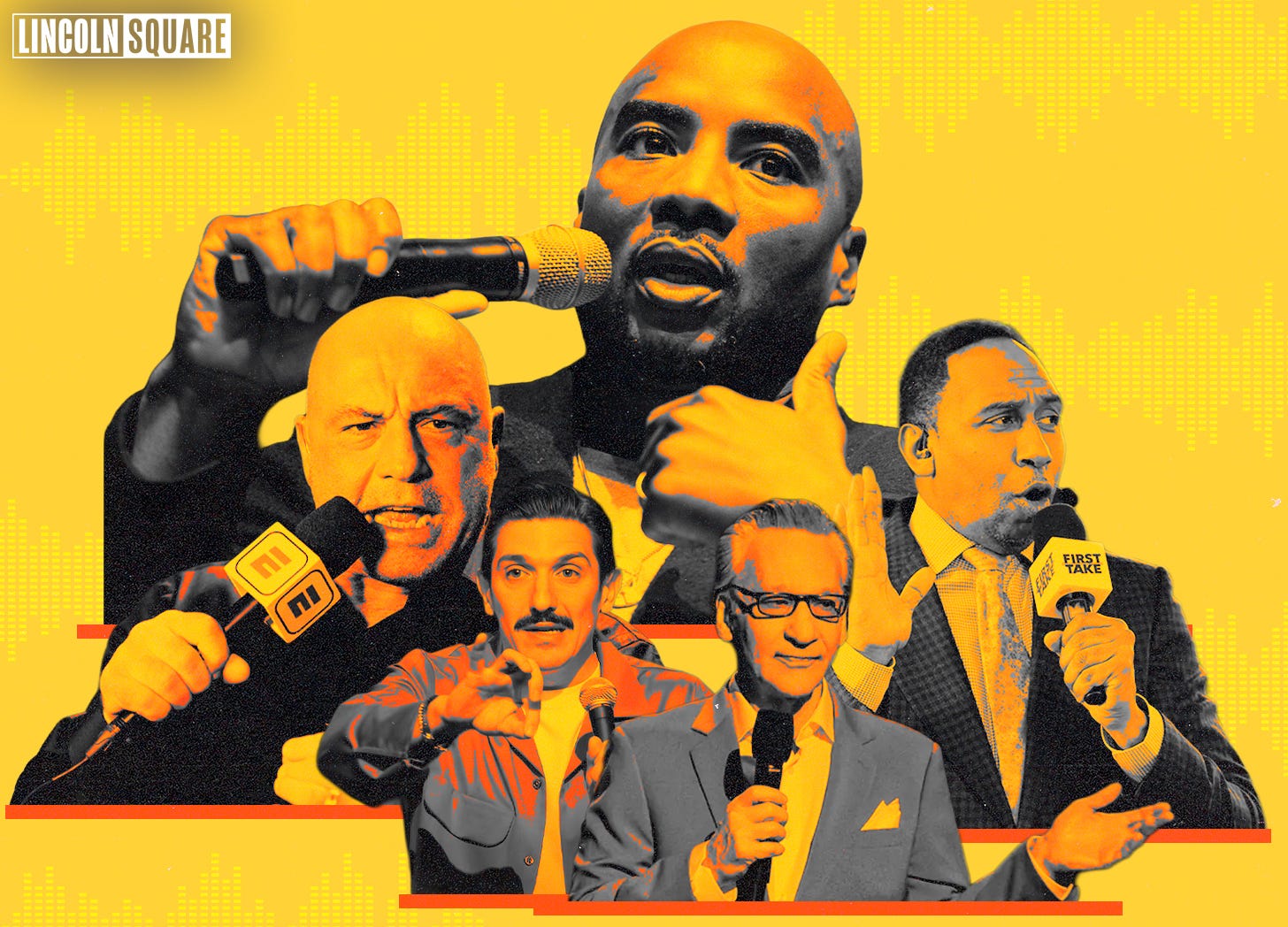
Watching Roland’s measured response got me thinking about how this whole topic is bigger than one personality. It’s bigger than Charlamagne and bigger than Roland. It’s about informed opinions—and how little we seem to value them anymore. My issue with Charlamagne isn’t that he has opinions; it’s that too many of them are built on bad information. He’s become part of the “I’m just asking questions” crowd, the pseudo-intellectual Avengers made up of Charlamagne, Joe Rogan, Stephen A. Smith, Andrew Schulz, Bill Maher and other twits—the hot-take crew that believes objectivity means trashing Democrats twice before breakfast. Trust me, as a Democrat, I get it. Democrats get on my nerves regularly. But there’s a vast difference between criticizing a policy you understand and talking shit based on a premise that’s flat-out wrong.
The problem with that crew, as Roland hinted, is that they’re now treated as equals to journalists or actual experts. In the nineties, Howard Stern was the reigning shock jock: lowbrow, often misogynist, sometimes racist, occasionally hilarious. But people knew exactly what he was. He wasn’t pretending to be Cronkite with a fart button. He wasn’t interviewing senators and pretending to arbitrate truth. The “just asking questions” guys don’t move like that. They book politicians, conspiracy influencers, and “doctors” who validate whatever anti-science talking point they’re peddling that week. Rogan spent most of 2021 turning vaccine denial into a wellness brand, saying he didn’t “believe in” the vaccine like it was Santa Claus, and that bullshit spread for months. He even challenged an actual infectious-disease expert, Dr. Peter Hotez, to a public “debate,” as if epidemiology were a bar argument. The absurdity, of course, is that when Hotez declined—because serious scientists don’t dignify pseudoscience with spectacle—Rogan ran back to his audience and treated the refusal like a victory lap. “See? The expert won’t debate me!” he crowed, as though years of medical training are nullified by a guy with a microphone and a sauna. You don’t see Hotez demanding a cage match on stand-up comedy beats or MMA holds. Expertise doesn’t have to perform for clicks. Bullshit is now a billion-dollar industry, and the “just asking questions” crew are its venture capitalists.
A journalist’s only obligation is to the truth. Not to ratings, not to donors, not to whatever demographic the algorithm thinks is under-served. The truth isn’t Democrat or Republican—it’s just the truth. It just so happens that we live in an era where one party believes in the truth only when it benefits them or can be twisted into a grievance meme. There was a time when Republicans at least had a baseline level of reality they accepted. They didn’t deny that climate change existed; they denied its seriousness, which at least left an opening for problem-solving. Now we have elected officials denying the efficacy of proven vaccines, and corporate executives like David Zaslav openly telling CNN to “cater to Republicans, too,” as if truth were a brand segment. Journalism isn’t supposed to cater. Truth doesn’t need seasoning; it just needs telling.
The truth isn’t random hot takes. It’s not something that needs to be explained into existence. It can be debated, sure, but the debate should be about deepening understanding or adjusting to new evidence—not about whose ego survives Twitter. In the days since the Democrats decided to give Republicans the supermajority they needed, I’ve actually heard some reasonable arguments about why reopening the government might be the right move. I still disagree with them, but at least those opinions were rooted in reality and based on evidence, not in the lazy “Democrats didn’t stop the big, beautiful bill, so it’s their fault” kind of nonsense that passes for analysis on some of these shows. Charlamagne’s opinion that the government should reopen wasn’t the issue. The issue was that his reasoning rested on false information, and when corrected by political journalists, he didn’t refine his argument—he doubled and tripled down on the wrongness. That’s not discourse; that’s defiance dressed as confidence. Psychologists call it cognitive dissonance reduction—the brain’s way of protecting self-image when facts threaten it. Credible scholars embrace correction; performers treat it like an attack. It’s ego-maintenance, not enlightenment.
No Reset Button
“Thirty-five-year-olds sitting at home playing video games, they’re gonna now have to go get a job — and by the way, that’s a good thing for them. Their mom doesn’t want them sitting in the basement playing video games anyway.”
I’ve been asked more times than I can count to claim expertise on things I know nothing about. I’ve had people dangle thousands of dollars in front of me to be a charlatan—to parrot a talking point so some lobbyist could say, “See, even a professor agrees.” You’ve seen the type: the TV doctors who pop up on these shows, weaponizing their degrees for a check. I imagine once you cash one of those checks, it gets easier to cash the next. And it’s not like I turned down the money because I’m some extra-moral person. Please. I just have enough critical-thinking skills to know that sure, it might keep me fed for a few months, but in the long run it’d starve my credibility. You can’t be the professor who lectures on ethics at noon and sell snake oil by five. That’s not brand management—it’s career suicide with benefits.
In both the professor space and the journalism space, I get things wrong all the time. I also get things right all the time. The trick is knowing which is which. When a student corrects me and they’re right, I tell them they’re right. Unlike when I write for Lincoln Square, my Substack is a one-man operation. It can take me days to finish a piece because before I hit publish, I have to make sure I’m being factual. When I’m writing for Lincoln Square, it can still take me days to file a draft—but I know those extra eyes will catch the little things I miss, so I try to make the editor’s job as easy as possible. With Substack, there’s no safety net. It’s easy to miss a data point or a name. If a reader points out an error and they’re right, I thank them and fix it immediately. That’s not ego; that’s maintenance. That’s how credibility survives.
After the Democrats caved to Republicans in that bogus Senate agreement—where Democrats got nothing but a promise from a known liar like John Thune—I went off. I recorded an expletive-filled rant. I was angry, and a lot of people appreciated the candor. A lot didn’t. Thirteen subscribers unsubscribed on the spot. I was genuinely sad about that. When a colleague asked if I’d delete the video, I told him I couldn’t. Because none of the critics pointed out any factual errors—they just didn’t like my tone. Deleting it would’ve meant catering to feelings instead of truth, and the truth was that I was furious at seven Democrats and one independent who sided with Republicans when the evidence showed they didn’t have to. People have every right not to like my tone. They’re also free to leave. But I have the right to my opinion, foul-mouthed or not. Honesty is messy; misinformation is neat.
Charlamagne wasn’t wrong for having an opinion or even being rude. What was wrong was the misinformation he kept spreading after being corrected. Psychologically, that’s ego preservation through confirmation bias—seeking out new justification for old errors. These guys will keep doing it until they learn the truth and then, eventually, start monetizing disinformation once the facts threaten the brand. When Stephen A. Smith apologized to Jasmine Crockett, he apologized for everything except falsely implying what her actual job as a congresswoman was. That’s not accountability; that’s crisis PR with better lighting.
And whether it’s Charlamagne spreading misinformation or his partner-in-crime DJ Envy cosplaying as a real-estate mogul, it’s the same brand of expert theater. Envy claimed he learned real estate from an ex-con, which is like saying you learned cybersecurity from the guy who hacked your bank account. The only reason people believed he and his buddy Caesar were legitimate is because The Breakfast Club gave them a megaphone. Real estate is hard work—it’s late-night paperwork, continuing-education classes, and agents grinding through rejections. Envy skipped straight to the seminar circuit. Influence without expertise is performance art for people who don’t know the difference.
Independent journalism exists to fill the gaps mainstream outlets leave, and lately there’s been no shortage of gaps. CNN and MSNBC love to treat Charlamagne and Envy like political analysts when neither has ever produced an original thought about public policy. The same networks platform the “just asking questions” guys because controversy gets clicks and truth gets homework. But journalism’s job is not to trend; it’s to clarify. And the audience’s job is to demand that clarity, not to treat truth like an elective course we can drop when it gets hard.
I’m not saying I have it all figured out. I get things wrong, I learn, I recalibrate. But there’s a difference between evolving and refusing. Truth isn’t an accessory; it’s oxygen. When people with million-person platforms treat misinformation as entertainment, the rest of us suffocate a little faster. The democracy we keep trying to fix can survive disagreement; it can’t survive disbelief. If truth becomes optional, democracy becomes negotiable. And once that happens, everything else is just content.
Kristoffer Ealy is a political science professor who teaches at California State University Fullerton. He is the author of the upcoming book, Political Illiteracy: Learning the Wrong Lessons. Read the original column here.


I dislike down to my bone marrow the chorus of "the Democrats suck" as if that is the answer and never say, as you pointed out, what comes next. I still stew (aka. rant) about this a little when they basically say Harris wasn't authentic or she wasn't change. Well, they got change alright! They and we got Trump. And they almost say, she is why we now have Trump and his goons. I want to ask what does authentic mean? What's the plan?
I really find you thoughts and insights helpful. I like how you put it: "Truth isn't an accessory; it's oxygen." The more truth, the better we breath. The better we breath, the better we can think. Friends often say to me, "Hey, take a breath."😔 Thanks again for all you do. I look forward to all your articles, Professor. Good job! and take care.
This is wise to say: "He’s become part of the “I’m just asking questions” crowd, the pseudo-intellectual Avengers made up of Charlamagne, Joe Rogan, Stephen A. Smith, Andrew Schulz, Bill Maher and other twits—the hot-take crew that believes objectivity means trashing Democrats twice before breakfast."