The Epstein Files Don’t Blink
Trump’s attempt to govern the country like a loyalty-based cult is hitting a wall of reality.
Kristoffer Ealy is a political scientist, political analyst, and professor in Southern California. He teaches American Government and political behavior, with a focus on political psychology, voting behavior, and political socialization. Subscribe to his Substack, The Thinking Class with Professor Ealy.
The first thing a cult leader learns is that rules aren’t moral standards. Rules are loyalty tests. They are not designed to govern you. They are designed to govern them. A cult leader’s followers don’t follow the rule because it’s fair. They follow it because the act of following becomes proof that they belong.
Which is why cult rules can be humiliating. Contradictory. Pointless. Even self-destructive. It doesn’t matter. In fact, the more irrational the rule is, the better it works—because nobody makes sacrifices like someone trying to prove they’re still in the inner circle.
This is how you get the classic arrangement where the leader can do the kind of thing that would get a normal person fired, divorced, indicted, or laughed out of town—then turn around and demand strict purity from everyone else. The hypocrisy isn’t a bug. It’s a feature. The point isn’t “rules.” The point is hierarchy. The point is demonstrating there is one set of consequences for the faithful and another set for the sovereign.
In a functioning cult, people learn not to question that out loud.
Not because everyone is stupid. Not because everyone is hypnotized like a movie extra. It’s because cults are engineered environments where speaking plainly comes with penalties. Followers learn that even gentle criticism can trigger exile, retaliation, or humiliation. Ask the wrong question and you’re suddenly “negative,” “disloyal,” “divisive,” “working for the enemy,” “trying to sabotage the mission.” The leader doesn’t need to censor everyone directly. After a while, the followers do it for him. They start editing their own thoughts in real time. They don’t ask, “Is this true?” They ask, “Is this safe?”
And the leader thrives on that silence. Silence is a blank check. Silence is a permission slip. Silence is the raw material of power.
Because once the room is trained to protect the leader’s feelings, the leader’s feelings become law.
This is the part people miss when they try to analyze cult leaders like they’re just unusually persuasive. A cult leader isn’t simply “charismatic.” A cult leader is someone who turns emotional weather into governance. If he can make his approval feel like oxygen and his disapproval feel like exile, he doesn’t need policy. He doesn’t need evidence. He doesn’t even need coherence. He just needs followers tuned to his moods the way sailors stay tuned to the sky.
So everything becomes personal. Every critique is treated as an attack. Every investigation is framed as persecution. Every consequence is recast as betrayal.
And if you live inside that bubble long enough—if you are constantly surrounded by people who clap on cue, defend the indefensible, and treat your name like a holy object—you start believing the cult is reality. You start believing admiration is the default setting of the world. You start confusing silence with agreement. You start thinking your base is not a base; it’s the country.
That’s when the cult leader’s worldview hardens into something darker: leverage becomes the only language he trusts.
When threatened, he doesn’t ask, “Did I do it?” He asks, “How do I make them stop?” He reaches for shame, fear, punishment, exile—because those are the tools that always worked inside his ecosystem. And here’s the crucial psychological mistake: after living in a loyalty-based world for long enough, the cult leader assumes every other world is loyalty-based too.
So he steps outside the cult and looks at outsiders—critics, journalists, investigators, the opposition—and he can’t process a simple possibility: these people might not be organized around worship the way his followers are. He can’t imagine a political tribe that doesn’t have a sacred figure whose protection overrides all principles. He can’t picture a coalition where people argue with each other openly and survive it. Because in his world, disagreement is disintegration.
Which leads to the projection.
If he is a Supreme Leader, they must have a Supreme Leader too. If he is an untouchable figure at the center, they must have one as well. And once he believes that, the move becomes obvious. When outside forces threaten him with accountability, he tries to change the subject by dragging someone else into the blast radius:
If you come for me, your leader is going down too.
It’s hostage logic. It’s the cult leader’s version of mutual accountability: not “we should all be judged by the same standard,” but “if I’m judged, I’m taking somebody with me.”
And that—right there—is where Donald Trump is living right now.
Because no matter what he tries to distract the public with, the Epstein files are not going away.
He can start an unnecessary tariff fight and dominate the headlines for a day—trade war cosplay, tough-guy posturing, a new chart on every cable network—and the Epstein files are still there. (Even his latest trade drama comes with the usual whiplash: big tariff threats, frantic bargaining, and a flurry of “deal” headlines.)
He can send federal law enforcement into cities to produce the kind of footage that plays well in an authoritarian highlight reel—and the Epstein files are still there.
He can pick a fight with Disney until Jimmy Kimmel gets benched—because nothing says “stable leadership” like treating the federal government like a personal complaint department—and the Epstein files are still there.
He can even try to intimidate the press into shutting up, and the Epstein files are still there.
Pam Bondi had Don Lemon arrested by federal agents on civil rights charges tied to that Minnesota church protest he says he was covering as a journalist. According to the Associated Press, Lemon said he’d offered to surrender voluntarily, and yet about a dozen agents still came for him in a public, heavy-handed display. PBS likewise reports the Trump administration charged Lemon with federal civil rights crimes related to that protest.
And if you need the perfect illustration of how distraction politics works, it’s this: you can generate a week of shouting about whether Don Lemon is a criminal or a martyr. You can throw gasoline on every culture-war nerve ending. You can produce the spectacle.
But when the smoke clears, the files are still there.
The files are not just “a story.” They are the kind of problem that doesn’t obey spin. They sit there like a weight on the chest. They don’t respond to press conferences. They don’t care about trending topics. They are, in the worst way, durable.
That durability is precisely why the Epstein files have become one of the biggest rifts inside MAGA itself.
For years, Trump’s ecosystem sold a storyline: the big reveal is coming. The ring will be exposed. The names will drop. The “deep state” will panic. This entire cinematic mythology—Epstein plus conspiracies plus “we’re about to blow this wide open”—was a promise made to people who want the world to be simple enough to fit into a villain plot.
So when the same leader who promised the reveal starts acting like the documents are radioactive, a lot of his own people feel duped.
That’s not speculation. It’s visible in the fractures. Even Marjorie Taylor Greene—someone who has built her entire political identity around MAGA devotion—publicly broke with Trump over the Epstein files drama, and her split became a symbol of something bigger: this issue was messing with the base’s sense of narrative.
You can distract a movement from policy failures. You can distract them from hypocrisy. You can distract them from incompetence. But it’s harder to distract people from a broken prophecy.
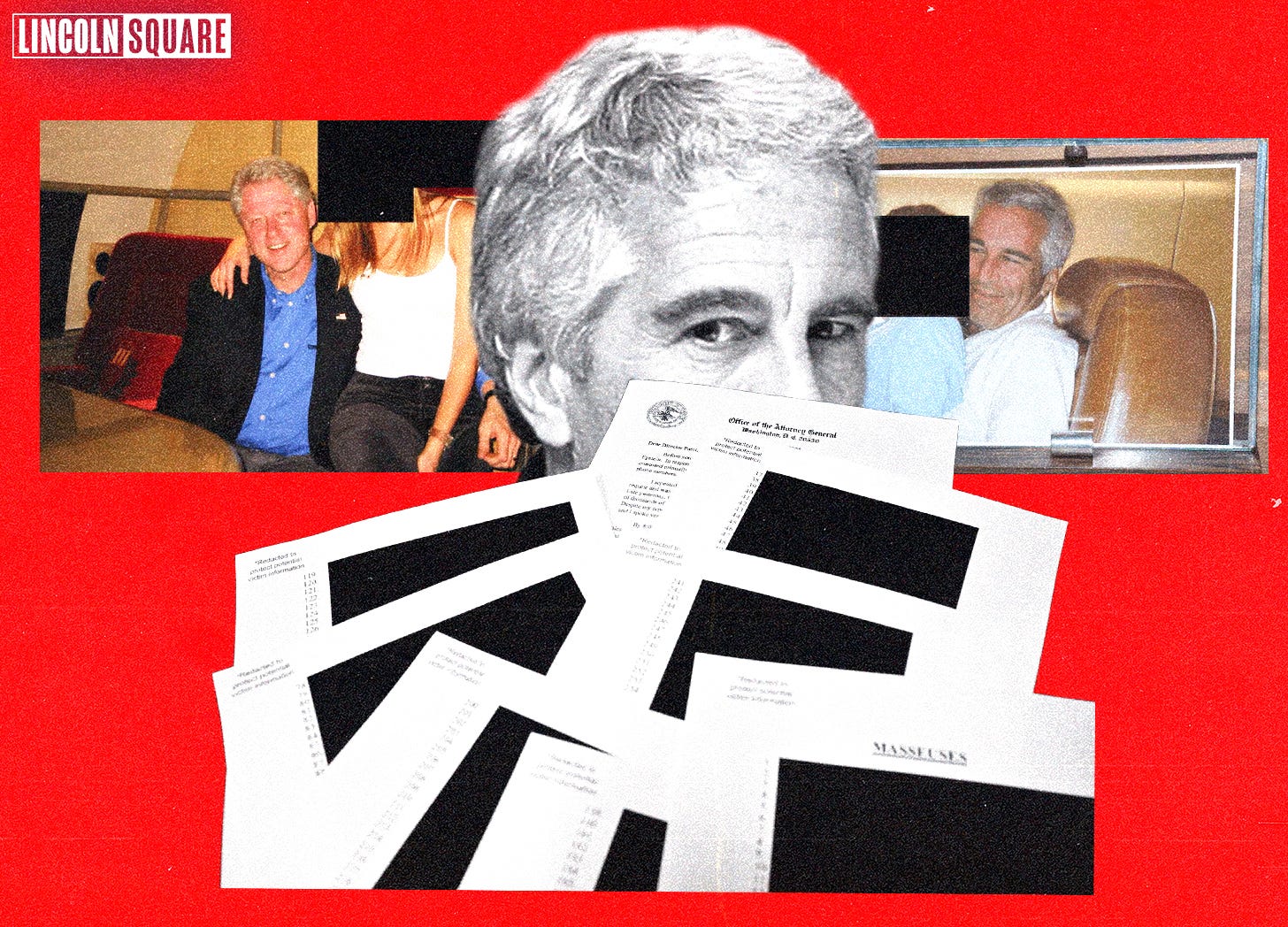
And the DOJ’s releases have turned this into something that keeps reappearing. The Department of Justice announced it published more than 3 million additional pages responsive to the Epstein Files Transparency Act, with more than 2,000 videos and 180,000 images included in the publication—and that, combined with prior releases, totals nearly 3.5 million pages.
That scale matters. It means the story is not a one-night scandal. It’s a drip-feed that keeps crawling back onto the timeline with fresh names, fresh details, fresh discomfort.
And that brings us to the part where Trump does what cult leaders do when the heat won’t go away: he reaches for hostage logic.
When the distractions work for only a moment, the posture shifts into projection: Your side has a sacred figure too. Your side has dirt too. Your side has a leader you’ll protect no matter what.
So now we get the line: Bill Clinton is the only one who went to Epstein’s island. Investigate him.
And the response from outside the MAGA bubble has been… okay.
Not “How dare you.” Not “Don’t you ever.” Not the cult-leader reaction Trump is used to. More like: sure—bring evidence. Subpoena whoever needs to be subpoenaed. If Bill Clinton committed crimes, investigate him too. Just don’t pretend investigating him replaces investigating you.
This is the moment the cult leader’s brain short-circuits.
Because in Trump’s world, the threat “your leader will get hurt too” is supposed to cause panic. It’s supposed to make people back off. It’s supposed to force the other tribe to protect their idol the way his tribe protects him.
But Democrats are not organized around a single sacred figure in that way. They are a coalition that can barely agree on lunch, and that is exactly why this move doesn’t land the way Trump expects.
The Democratic Party houses people like Alexandria Ocasio-Cortez and Maxine Waters on one end and Joe Manchin and John Fetterman on the other. That’s not a cult. That’s an argument with a voter file.
And yes, people admire leaders. People defend leaders. People get weird about leaders. But the party is not structurally built around worshiping Bill Clinton, Barack Obama, or Hillary Clinton as if their reputations are the foundation of existence. The response Trump keeps running into is brutally simple:
If there’s evidence, bring it.
Which is why that “whatabout” posture keeps dying in conversation. If a MAGA supporter says, “You have to investigate the Clintons too,” and you respond, “I agree,” there’s no next move. Because the whole point of the posture was to create tribal paralysis. It fails when you refuse to panic.
This is what Trump has successfully done to his own supporters: he has convinced them the world outside the MAGA bubble is a cult too. That everyone else operates on fealty the way they do.
Unfortunately for them, it’s not true.
And the tragedy here isn’t just political. It’s moral. Because the Epstein story—beneath all the names, beyond all the gossip, under every document and redaction—is about horrific exploitation and systemic protection. It’s about who got shielded and who didn’t. It’s about power.
That’s why this remains radioactive. Not because it’s “salacious.” Because it’s a stain.
And the latest releases keep illustrating how wide Epstein’s orbit was. CBS News reports that big names like Bill Gates and Elon Musk appear in the Epstein files, including documents and communications that show how Epstein moved through elite circles.
On Elon Musk specifically: the newly released emails read less like “I kept my distance” and more like a guy trying to RSVP to the wrong apocalypse. According to reporting on the messages, Musk discussed plans with Jeffrey Epstein involving a Caribbean island visit and even asked about the “wildest party” on an island—because nothing says “serious innovator saving humanity” like shopping for nightlife recommendations from a convicted sex offender.
And now you’ve got Melinda French Gates publicly sounding like someone who is done playing polite about it. Reporting on her remarks has highlighted that she believes Bill Gates needs to answer questions about his connection to Epstein, which is the kind of statement that lands differently when it comes from the person who knows where the bodies are buried—metaphorically, legally, relationally.
So let’s be honest about what this looks like: the files keep expanding the circle of discomfort. They keep dragging the “untouchables” into daylight. And every time that happens, Trump tries to throw another smoke bomb, another spectacle, another “look over there.”
Even the Fulton County raid fits the pattern.
And if the Epstein distraction tour needed a “we’re not even pretending anymore” intermission, Federal Bureau of Investigation delivered it in **Fulton County—serving a warrant at the county’s election hub over the 2020 election Trump lost, litigated, and still can’t emotionally process. Then **Kash Patel popped up to “defend” the raid like he’s the bouncer at the world’s pettiest nightclub: nothing to see here, folks, just a totally normal federal search for ballots from an election we already finished arguing about in court. And because the vibe apparently wasn’t unhinged enough, **Tulsi Gabbard shows up at the scene because Trump personally asked her to be there—then “facilitates” a brief phone call between Trump and the agents executing the search, like the FBI is a customer service line and he’s calling to check the status of his grievance.
That’s not an effort to secure democracy. That’s a performance designed to keep a grievance alive.
And it’s the same pattern: generate heat, dominate attention, force everyone to argue about the spectacle.
But when the spectacle ends, the files are still there.
This is why the Epstein files have the energy of a horror-movie villain. You can run, scream, set the house on fire, swear you killed it, and the next scene opens with it standing right behind you, perfectly calm, holding a clipboard.
If Bill Clinton is as guilty as Trump implies, why not release the files and let the receipts speak?
If the story is as simple as “the Democrats did it,” why not publish everything and let the public see it?
If you’re innocent, transparency is a flex.
If you’re hiding something, transparency is a threat.
And that’s the part Trump can’t stop telling on himself about—because the behavior is not “someone who can’t wait to clear this up.” The behavior is “someone who needs the conversation to move faster than the documents.”
That’s why the Clinton posture is so revealing. It’s not an argument. It’s an escape hatch.
It’s not “let’s hold everyone accountable.” It’s “please, for the love of God, make this a team sport.”
But the response outside MAGA keeps ruining the plan: fine. Investigate everybody. Bring charges where there’s evidence. Subpoena whoever needs to be subpoenaed. Don’t protect anyone just because they used to be important.
That answer is intolerable to cult logic, because cult logic depends on the idea that everyone is lying and everyone is protecting their own sacred idols. It depends on the idea that accountability is fake. It depends on the idea that loyalty is the only thing that’s real.
Which is why Trump keeps trying to govern like a cult leader who thinks the whole country is a cult.
And that’s why it keeps failing.
Because the Epstein files don’t belong to the news cycle. They belong to the record. The Justice Department’s releases exist. The documents exist. The questions exist.
Trump can throw tariffs like smoke bombs, sic federal agencies on cities, stage petty culture-war stunts, and dare the country to look anywhere else—but the files don’t blink. They don’t argue back. They don’t need spin. They just sit there, waiting.
And when he says, “Investigate Bill Clinton, too,” the answer isn’t outrage. It’s agreement. Because outside the MAGA bubble, accountability isn’t a threat—it’s the point.
If Epstein taught the country anything, it’s that power thrives in darkness. So if everyone is innocent, transparency is easy.
And if someone keeps trying to change the subject, it’s worth asking why.


