


Don Moynihan is the J. Ira and Nicki Harris Family Professor of Public Policy at the University of Michigan Ford School of Public Policy Subscribe to his Can We Still Govern? Substack.
DOGE wielded extraordinary power during the first months of the Trump administration. It was more important than any Cabinet official. The fact it has been completely memory-holed by this administration says much about its purpose and impact, and the politics of non-accountability under Trump.
One version of DOGE formally ended this summer, though even its conclusion is shrouded in ambiguity. The original Executive Order establishing DOGE created two entities (see, Section 3(b)): temporary organization ending on July 4th, and and a permanent organization that should still be in place, with representatives in every agency. The temp organization is formally gone and it seems that the permanent DOGE is inactive.
It is sort of crazy that “Does DOGE still exist?” is a question there is ambiguity about. Formally they do, and are supposed to have reps in every agency. They still have a website, but do not list employees. A good chunk of their projects are Biden era U.S. Digital Service projects. Former DOGErs are have moved to other agencies.
Even if it is no longer operational, the shadow of DOGE very much remains. When asked the type of new tech hire the he is looking for, Trump’s top HR officer said, “I wanna see people like ‘Big Balls…We need people like that.” You may dimly remember Big Balls as a DOGEr. He remains in government, slapping AI on government services as the administration launches America.gov.
The White House has declined to release any sort of after action report about DOGE. Which again, is sort of amazing. There is no official nonpartisan government accounting for the most unaccountable of organizations. Dems in Congress have released their own reports, mostly based on media coverage rather than first hand investigations.
There have been some Government Accountability Office reports, documenting:
Claimed DOGE savings were unsubstantiated (something the New York Times has already documented superbly).
Ambiguities of hiring and the tendency of DOGE to hide personnel information.
DOGE eliminated the records needed to verify if it had accessed sensitive systems (but included this bombshell finding in a footnote).
And so we are left with more ad-hoc assessments (mine below, and this one from Mother Jones for example). Some are around specific policies. For example, an Inspector General report recently confirmed what was widely predicted: DOGE cuts to IRS reduced tax revenues from wealthy tax cheats.
And yet, we are starting to see the first wave of DOGE revisionism, with news outlets owned by Jeff Bezos and Rupert Murdoch leading the charge by promoting the claims of Tyler Hassan, a DOGEr with a book to sell about his experiences.
Before this revisionism becomes a plutocratic conventional wisdom:
We need a credible Congressional commission to thoroughly review what DOGE did.
If the consensus is that it failed, I would like to see some real discussion as to why DOGE failed. There was a lot of interest in what DOGE could do. So it feels like a good Rorschach test test for people’s theories of governmental change. You had the richest man in the world, an extraordinary entrepreneur, given unprecedented power to change government. So, why did he fail? And what does this tell us about prescriptions for the future? Should we be enabling or constraining operations like DOGE?
Comparison with Civic Tech
I have my opinions, and feel happy with my predictions about the nature of DOGE when Trump took office.
But just criticizing DOGE does not seem like enough to imagine the future of tech in government. While it falls far short of the type of accounting and explanation that is needed to understand DOGE, I do think its worth framing DOGE in the context of the movement it displaced, which was the civic tech.
In a new article in Public Administration I make this comparison.1 I interviewed a group of civic tech leaders both before and after DOGE took power. It could be that civic tech becomes perceived as a compelling alternative to DOGE, an antithesis that fuels a synthesis between the two approaches, or an afterthought. But it represents a different movement that also started from the premise that tech in government needed to be fixed.
What do I mean by civic tech? When I started studying this topic, I found multiple definitions. So this will be contested but I think of civic tech as a movement of a loosely affiliated technology and design experts, traditionally coming from outside government but engaged in remaking government services through digital innovations. Civic tech for government applies technology, data and human centered design to improve policy implementation, fueled by prosocial motivation.
Inside of the federal government, the US Digital Service (USDS) and 18F are the two federal government units that most visibly represented civic tech. President Trump’s return to office in 2025 both elevated the use of technologists in crucial governance decisions, while eliminating USDS and 18F, and tech units in large agencies like Social Security and IRS. Ironically, these organizations gained the most public attention when they were eliminated from government.
What does civic tech care about? The broadest value, and one that might feel most surprising to non-technologists, is the emphasis on people, specifically in improving the experiences of the “users” of technology. The users might be members of the public who use public services, but can also include the government employees affected by new technology. This “unwavering focus on people first” was a recurring theme among interviewees:
• “Some of those powerful things that we can do, and the most powerful changes that we can bring are not necessarily what people - especially government people – think of as tech, but tools like plain language, better service design, or user research”.
• “If you’re building a truly civic component to it, you’re making it accessible and usable for everyone”.
As civic tech actors spent more time in government, they gained an ability to see how their work could make a difference and a greater sense of how to manage change:
• “We have a much clearer understanding of the public and gaps in delivery for the public that also was missing earlier. And so, I think that also allows us to have this sort of action orientation…now there’s a clearer direction and orientation towards the north star, which is outcomes for the public”.
• “We have a lot better idea of what it takes to actually make change. How long, how much work, what kind of institutional engagement. It’s grown by orders of magnitude”.
• “What we learned over time at the federal level was that what worked in private sector tech development couldn’t be imported wholesale into government. Instead, the real breakthrough came from applying technology-driven methods — human-centered design, product management, rapid iteration, and continuous improvement — to policy and program implementation. This shift from a “tech-first” to a “delivery-first” produced significant wins.”
Part of learning how to use power was learning how to work with public employees, and within government systems. One persistent risk was that civic technologists with limited experience of government or a specific policy domain could easily present themselves as saviors, failing to understand why existing processes worked the way they did. As part of “the movement’s gradual shift from operating outside government to inside, it’s become far less solutionist, far more understanding and supportive of public servants, and somewhat more interested in the underlying causes of poor service delivery”.
In some respects, DOGE looked like civic tech: a group of tech outsiders promising to modernize government. The reality is that these two movements offered competing visions and practices for how tech could reshape government, summarized below.
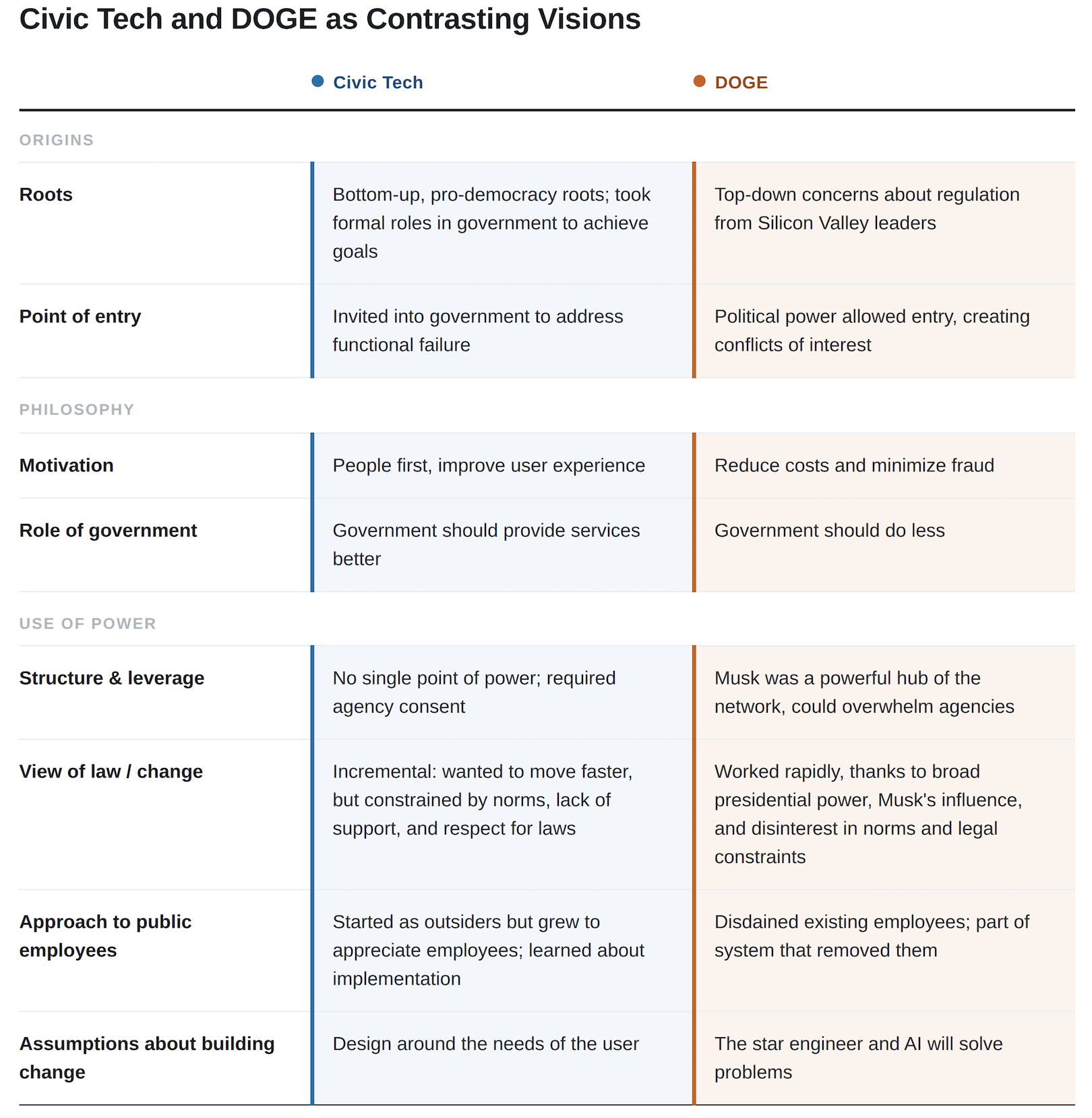
While both DOGE and civic tech reflected the growing political influence of Silicon Valley, they offered different philosophies for how to use that influence. Silicon Valley elites are not a homogenous group, nor do they fit a distinct political profile.
Civic tech grew out of more bottom-up engagements about the relationship between tech and democracy, reflecting the evolution of a spirit of volunteerism to be found in hackathons and volunteer brigades. DOGE represented the concerns of the owner class of Silicon Valley. Complaints of excessive regulation under President Biden, opportunities to win or expand contracts with government, and attraction to the culture war narratives offered by President Trump, or some combination of all three, saw many Silicon Valley leaders support Trump.
One interviewee said: “it’s also useful to note much of the new activity is VC [venture capital] driven. If DOGE in 2025 is like HealthCare.gov in 2013, then I think you can trace back DOGE to milestones like the Palantir IPO [2020] the way you’d look at Personal Democracy forum or Hack for Democracy [for civic tech].”
The entry point of civic tech and DOGE into the federal government was also different. The HealthCare.gov failure saw a presidential administration inviting tech help to solve long-festering problems with state capacity. By contrast, Elon Musk leveraged his position as Trump’s largest political donor and conversion of Twitter into a right-wing platform to persuade Trump to pursue DOGE, with the support of others in the owner and VC community.
In a way that was markedly different from civic tech, DOGE reflected the conversion of money into political power and direct access to government systems. For those in civic tech, this raised obvious conflict of interest problems, and the risk of state capture. One said: “This is not about efficiency of government. This is about looting the government for valuable assets like personal data and using it for private sector gain.” Another pointed out that “corporate vendors have seen an opening…They aren’t just looking for contracts. They’re also looking for data and other materials that will give them a leg up elsewhere.”
Members of the civic tech movement saw themselves as pursuing prosocial goals of making government services work better. One said:
Civic tech has always focused on making government work for people: understanding community needs, delivering outcomes over outputs, prioritizing effectiveness over efficiency. DOGE and the U.S. Digital Service start from the same premise — government is failing to deliver — but diverge completely in their response. DOGE’s focus is efficiency, cost-cutting, and software modernization…It may seem pedantic, but it’s foundational. Focusing on technology centers the systems and institutions. Focusing on service centers the outcome and the people.
The prosocial focus of the civic tech community runs at odds with the embrace of “reactionary politics” among the technologists that Trump has turned to, who emphasize cutting government spending and regulation, rather than increasing access to public services, and establishing private tech company control of digital spaces.
One interviewee said they believed both individuals who went to work for civic tech and DOGE were interested in making government work better, but “how the two groups perceive the problems and the solutions is quite different. DOGE was established to be adversarial to incumbent public servants and the way services are designed and delivered.”
That suspicion extended to how the two groups viewed the public: while civic tech was broadly associated with efforts to improve customer experience, Elon Musk and others in DOGE expressed false beliefs that fraud was systemic among major government programs such as Social Security, and made eliminating fraud a primary goal. These beliefs, often driven by conspiracy theories, shaped DOGE’s actions, most obviously in the elimination of USAID.
Civic tech’s theory of power centered on moving from informal and voluntary influence outside of government to holding a role in government. Over time, they learned the constraints of working in a public setting. In this respect, those who stayed adapted to a model of incremental change, becoming more skillful at the practices of implementation, such as gaining buy-in from federal employees and other stakeholders. One interviewee said: “The classic civic tech arc was to make a lot of assumptions about how quickly and easily some government function could be fixed, spend at least a year with government, learn why the quick and easy assumption was wrong, reassess, and re-engage in deeper work with a longer timescale.”
The civic tech evolution toward incrementalism also reflected its limited power. Civic tech units never held much independent power, depending upon Presidential directives and agency invitations to fix specific problems, resulting mostly in piecemeal engagements. They also, sometimes begrudgingly, accepted that legal constraints had to be followed.
The context for DOGE was fundamentally different. Trump’s first year in office saw a broader embrace of a philosophy, the unitary executive, that claimed extraordinary new powers for the Presidency, often in ways that clashed with existing norms and statutes. DOGE operated within a framework of an empowered presidency combined with extraordinary delegation to Musk, whose money and influence created his own power base.
DOGE made momentous changes even before Cabinet officials were in place and claimed the right to fire or put on administrative leave any public employees who resisted. In such a context, DOGE focused on controlling the technology systems that drive core government functions: personnel, contracts, data and payment systems, with the goal of unified control. One member of the civic tech community pointed to this factor:
[T]echnology has become the spinal cord of government, and technical infrastructure is now the infrastructure of everything, able to accelerate or obstruct any policy goal. The policy establishment still doesn’t seem to get this. DOGE does. They understand how deeply technology, government, and power are entangled. Just look at DOGE’s approach: they didn’t go to policy offices or executive suites first, but straight to IT systems and operations.
Another contrasted their early experience in civic tech with DOGE:
We — the first cohort of the U.S. Digital Service — wanted access to systems and data but learned pretty quickly that access was restricted for (mostly) good reasons. DOGE bullied and threatened people to get access to systems and data. And if anyone resisted, they were fired.
While most in the civic tech community dislike DOGE’s actions “you will find people who envy the pace that DOGE has set or the things that they’ve been able to accomplish.” Another said:
I think we could define ourselves in relation to what DOGE could have and should have been…The thing that we should take from DOGE is the boldness. We can be much more bold, and I think that we can be responsibly bold. We could take all of that ambition and in some sense, slightly less respect for the status quo and wield that with far greater responsibility and empathy for people.
It is fair to say this is a point of contention within civic tech. Many who might have previously bemoaned safeguards on, for example, data privacy saw DOGE’s actions as a confirmation for why those safeguards were needed:
I see some civic tech people excited that DOGE “just did things” and energized by the idea that if they can “just do” horrible things, we could “just do” good things when our turn comes. I’m less sure that benevolent fiat is a realistic possibility.
If DOGE learned about how to accumulate power, their pace of change, combined with a lack of knowledge or indifference about public services, saw them fail to learn about implementation. DOGE officials had little background in government, joined for short assignments, and so might have learned much from fellow technologists who had been exposed to government’s problems up close. But this potential for collaboration was never realized, reflecting deep tensions in worldviews. One member of the civic tech community said:
Every person who comes to government with no experience inside has a dawning as they start to figure out how things work (or don’t, depending on your perspective). That naiveté can be useful. It lets you ask questions that someone with more knowledge might not. But naiveté, in combination with a complete lack of moral compass, disrespect for incumbent public servants and the expertise they hold, along with being empowered to maliciously and indiscriminately cut the funds and resources needed to deliver public services will only lead to harm.
The downsizing agenda of DOGE included closing 18F, and pushing out most of the original USDS employees, plus closing other units of civic tech innovation, like the IRS team that built Direct File. In a mass resignation, about one-third of USDS employees wrote:
[W]e will not use our skills as technologists to compromise core government systems, jeopardize American’s sensitive data, or dismantle critical public services. We will not lend our expertise to carry out or legitimize DOGE’s actions.
If civic tech members were frustrated that they did not achieve more, they generally viewed DOGE as creating negative value. One said: “DOGE’s biggest impact was making life so intolerable for civil servants that they quit fighting to ensure that their part of the organization continued to thrive.” The National Design Studio, the closest thing to a replacement for 18F, has been mocked by members of the civic tech community for its limited ambitions.
From the civic tech perspective, this difference flowed partly from the different contexts they operated under, but also their different visions of public service. One said:
The civic tech movement has always viewed government as essential to delivering public services. We recognized the deep flaws in bureaucracy that made progress difficult, but we believed reform – not destruction – was the answer. DOGE began from the premise that government was both broken and bad, aiming to dismantle it entirely.
Of course, all of this might sound self-serving from disgruntled civic tech members. But DOGE really did fail,. And it really is the case that people who worked in civic tech have been engaged in some pretty self-critical post-mortems about their time in power. See this piece by Merici Vinton for example, which is a pretty insightful contrast to how former DOGErs describe their work:
For members of civic tech, the DOGE disdain for public employees also extends to the public:
[T]hey clearly do not care about the experience of people inside government who could be their partners, nor do they even think about what it is like for the public to interact with the government. The adversarial nature of the DOGE assignment means that there is no interest in designing with users, nor for them.
And again, much of this disagreement seems to center around views about how a government in a democracy ought to work. DOGE promised to deliver big results to the elected President quickly, even if it meant violating some norms. They failed to deliver the results, but did violate the norms and possibly some rules.
Civic tech brought tools of human-centered design, rapid iteration, and ongoing improvement to managing government even as they were unable to broadly implement these practices across government. They viewed DOGE as abandoning those practices, in favor of a simplified understanding of government service delivery that relies more on AI and engineering (which indeed, seems to be the approach of the National Design Studio, an offshoot of DOGE). One noted that in this respect, DOGE mirrored some of the broader changing practices in tech:
Since about 2015, UX [user experience] has been systematically disempowered in the tech industry, with the innately brilliant engineer dominating as the staff type who always matters more than every other. You see this in Musk’s actions at Twitter, mirrored in DOGE’s focus on recruiting young engineering talent with little effort to understand the technical or cultural systems they’re changing.
At this point, the DOGE brand has been so discredited that Governors who once boasted of their own DOGEs have moved on. A year ago, I used to get occasional calls from government reformers in other countries to explain the potential for a DOGE in their settings. Those calls have stopped.
At the same time, it is increasingly impossible to separate any serious government reform effort from tech. The future of modernizing government may not be DOGE but it will involve tech. So its important to get our prescriptions of the role of technologists in a democratic system right. Contracting out this role is tempting for policymakers, but misses the point that they need to invest in internal capacity if they want the reform to work.
The exodus of civic tech from federal government has some potential benefits. One is the type of soul-searching that can lead to a more muscular vision for the future. Another is that some members of civic tech are migrating to government roles elsewhere, sometimes in private or non-profit companies sometimes in state and local government (e.g. New York Mayor Zohran Mamdani’s PIT Crew, the new Virginia Digital Service or Colorado’s revamped tech office). This can fuel innovation, and the needs at other levels of government are real. As they do so, the comparison with DOGE should inform what we want, and what we don’t want, the next chapter of tech innovation in American government to look like.
1 For my fellow academics, this paper was a lesson in perseverance. I thought the civic tech movement was important in its own right. I wrote a short commentary for a journal that advertised that it accepted commentaries about three years ago. The reviewers asked for interviews of civic tech actors. So I did the interviews. But the reviewers still found the piece too opinion-driven, so it got rejected. It was also rejected by the next journal for the same reason. In both cases, the journal advertised that it welcomed short commentary pieces, but the problem is, reviewers still want commentary articles to be more like traditional social science, or commentary that better aligns with their opinions. I finally submitted to Public Administration as a regular article, and got some demanding but quite useful reviewer requests, including that I go back to the original interviewees now that the Trump administration was in place. I did, and the results really improved the analytic aspects of the article. The questions reviewers asked me also pushed me to do a more thorough version of the study, and so the Better Government Lab started interviewing civic tech people who left government. More on that research in a future post, but hopefully it won’t take three years!

Thank you for the article, Don. I guess Elon Musk will be working in the defense department ordering weapons.
I saw DOGE in action. We lost a lot of experienced, hard-working employees who took pride in doing their jobs and doing them well. Not coincidentally, I think it could was designed to eviscerate the jobs of many African American men and women so they would no longer be earning good money, and it played into Trump’s and Muskrat’s racism. I am not African American, I’m white, but it was fairly obvious to me what was happening. Russell Vought also deserves a substantial amount of discredit for the DOGE scam. He thinks Federal employees waste time, but I can tell you from firsthand experience they don’t. Trump illegally allowed Thiel and Muskrat access to people’s personal data in violation of a number of statutes. The people I worked with were very patient and willing to educate new employees and answer questions. DOGE caused the mass exodus of many employees with substantial amounts of institutional experience, and it wasn’t just in the IRS, where I worked with truck excise tax returns.