

The Democratic Party Elizabeth Warren Wanted Doesn’t Exist
The 2026 Democratic primary season is a battle between the establishment vs. insurgency. And the Michigan Senate race proves there's no significant space in between.


I want to say something I know many people who agree with me about almost everything else are going to hate.
But first, let me tell you about June 2019, when I watched Elizabeth Warren work a crowd at Lansing Community College after she was introduced by a charismatic, first-term state senator, Mallory McMorrow.
Warren spent hours taking selfies and actually talking to people — which is, if you’ve covered presidential campaigns, not how candidates at this level usually spend their time. She told stories about her working-class upbringing in Oklahoma. She talked about juggling teaching and parenthood. She had a plan for everything and could explain every one of them. At the time, I wrote that she struck me as “the proverbial girl in the front row who patiently raises her hand, but the teacher keeps calling on the bored boys in the back.” (Yes, this was incredibly relatable to me.)
When Warren dropped out of the presidential race on March 5, 2020, I wrote (and I will own this forever) that I was crying while I typed. She was a fighter, I wrote. She had the best plans. She had “the promise of uniting the Democratic base with progressive insurgents.” And in the end, none of it mattered.
I believed all of that. I still believe she had the best ideas in that race.
What I’ve reluctantly come to believe over the last six years is that I was wrong about the Democratic Party’s appetite for what she represented — certainly in Michigan, at least right now. And McMorrow’s exit from the Michigan U.S. Senate race on July 5 is the latest data point in that argument.
I know this won’t be a popular argument among the people who shared my 2020 grief. But I’m a journalist. It’s not my job to be popular. And so I’m making it anyway.
Elizabeth Warren endorsed McMorrow for the open Michigan U.S. Senate seat in March, calling her “the champion that working families in Michigan need.” McMorrow, for her part, was running a campaign built on a familiar premise: there’s a large, decisive bloc of Michigan Democrats who want someone genuinely progressive on policy but unwilling to stake the party’s future on maximalist positions that scare off swing voters. Someone who could get rave reviews from Joe Scarborough and Elizabeth Warren. Someone who was bold and electable, smart and practical, progressive and winning.
In other words: the kind of candidate I thought I was watching take selfies in Lansing back in 2019.
But Warren’s track record in Michigan should have been a warning. She suspended her campaign on March 5, 2020 — four days before the primary. She dropped out before she had to find out how the state felt. But we got a revealing data point: a Michigan Democratic primary in which the establishment candidate (Joe Biden) swept the state, and the insurgent (Bernie Sanders) finished second, and the practical progressive who could thread the needle between them (Warren) had already gone home.
That’s the Michigan Democratic Party. Establishment vs. insurgency. No significant space in between.
McMorrow was running for exactly that space in between. Her 2022 Senate floor speech — delivered in response to a Republican colleague who called her a “groomer” for supporting LGBTQ kids — went viral, generated millions of views and made her a national figure. She wrote a book. She spoke at the last Democratic National Convention. She ran a professional campaign with serious backing and a message about affordability and fighting Trump that should have translated to voters.
But Haley Stevens — a congresswoman from Southeast Michigan who ran Barack Obama’s auto task force and flipped a Republican congressional seat in 2018 — had already claimed the “moderate who will fight Trump.” lane. And Abdul El-Sayed had claimed the insurgent left — endorsed by Sanders, the UAW, and Alexandria Ocasio-Cortez, and is running a campaign that treats the Democratic establishment as the problem (at times, a bigger one than Trump himself).
McMorrow was competing for a slice of the electorate that isn’t large enough to anchor a primary in Michigan in 2026. Recent polling before her exit showed her in single digits, with El-Sayed and Stevens having consolidated the party’s two gravitational centers. The state senator suspended her campaign rather than wait for the Aug. 4 primary to confirm what the numbers were already saying.
I want to be honest about why I’m making this argument, because it’s not the one I want to make.
When I wrote that Warren had the best plans and was a fighter and in the end none of it mattered, I was also making a broader point about what happens to eminently qualified women in politics. They’re told over and over that it’s never their time, that their moment keeps getting deferred, that some other candidate always has a better claim on their supporters. I still believe that. The structural problem I was describing is real, especially at the highest level — just look at the fact that Kamala Harris lost in 2024, much in the same way that Hillary Clinton did eight years earlier. Look at the growing resistance to a 2028 AOC presidential bid — even from some of her DSA allies.
But the argument that Warren’s lane doesn’t exist is separate from the argument that it should exist. She and McMorrow should have been serious contenders. The Democratic Party should have room for those who are genuinely progressive and genuinely electable and don’t make you choose between them. But it doesn’t, in Michigan, in 2026.
The people who shared my 2020 angst — who saw Warren’s exit as proof that the party still isn’t ready for smart, policy-driven women who refuse to make themselves smaller — are not wrong about what should be. They are right about the injustice. I am just arguing about what is (which is a colder and less satisfying kind of right).
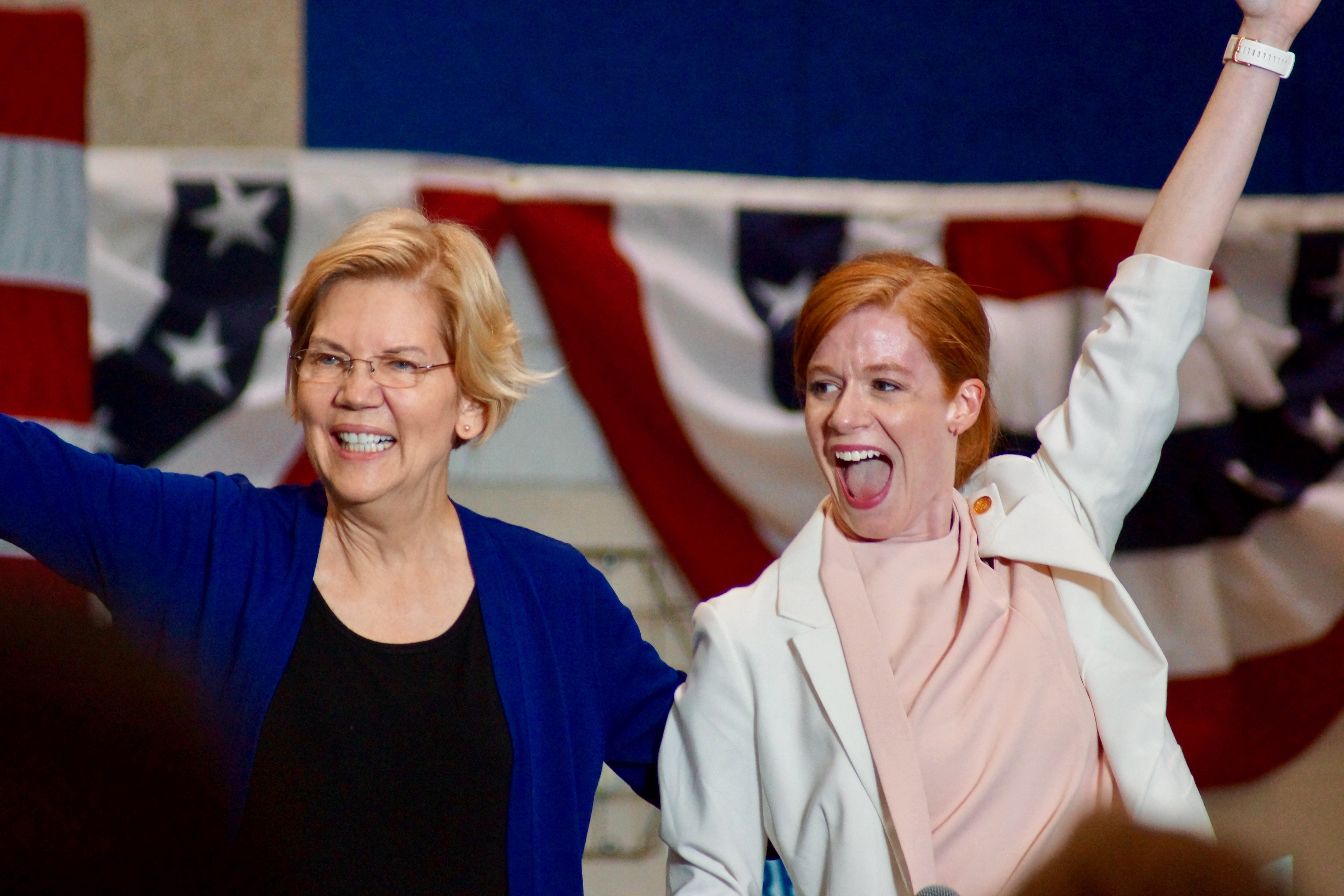
What Michigan Democrats are doing in 2026 is what they did in 2020: choosing between the establishment and the insurgency. But the terrain has shifted in significant ways.
In 2020, the establishment candidate was a 77-year-old man with a 50-year record that progressives had fought against for decades. In 2026, the establishment candidate is a 43-year-old congresswoman who flipped a Republican district. In 2020, the insurgent was a Vermont independent who had been making the same argument for thirty years. In 2026, the insurgent is a 40-year-old epidemiologist who lost his only previous race by double digits and campaigns with Twitch streamers.
In 2020, the establishment won. Biden took Michigan by 16 points in the primary. The state’s Democratic base — older, including substantial Black communities in Detroit and Flint, with a long relationship with organized labor — broke toward the recognizable name with institutional backing.
In 2026, El-Sayed appears to have the edge. A poll conducted the day before the first head-to-head debate showed the race statistically tied at 42-41, after El-Sayed had been leading by larger margins in earlier surveys.
Why is 2026 different from 2020? Because the man Michigan Democrats chose in 2020 lost the presidency four years later, after a catastrophic debate performance that forced him off the ticket. Because Harris succeeded him without any sort of firehouse primary or convention (which irked progressives) and then lost to Donald Trump anyway. Because Gov. Gretchen Whitmer ditched her “Big Gretch” persona to play nice with Trump and hide behind binders in the Oval Office last year. Because the establishment’s track record has given progressives cause to conclude that the familiar, institutional, practical path hasn’t been working.
When your argument for the mainstream lane is “trust the people who brought you here” — which amounts to a sea of Democrats who can’t seem to get it together to fight off fascism — the argument gets harder to make.
What McMorrow’s campaign represented — what Warren’s national brand represents — is a Democratic politics that says you can be bold on economics and win with swing voters. That you don’t have to choose between fighting the powerful and winning in November. That’s a coherent and appealing theory of the party.
But from where I sit today, that theory has been proven wrong.
The voters who want bold and electable split between two candidates who each offer one half of that equation. Stevens offers the electability. El-Sayed offers the boldness. McMorrow tried to offer both — and in doing so offered neither side what they really wanted. It’s somewhat telling that even after dropping out, McMorrow has declined to pick a side and endorse either rival.
What comes next on Aug. 4 will settle, at least for this cycle, which half of the party Michigan Democrats trust more. In 2020, they chose credibility. The lesson of 2024 may be that they’ve run out of patience with what credibility has delivered.
I say all of this knowing that plenty of progressives will disagree. They will say there is still a lane, that McMorrow was simply in the wrong race, that the Warren wing will find its moment. They might be right, but time is running out.
And right now, in Michigan, in 2026, the lane nobody could find is exactly where it has always been: just out of reach.
The Tradwife Trap: Sourdough, Silicon Valley, and the Far-Right War on Women's Independence

The Turning Point USA Women’s Leadership Summit this month featured selfie stations, magenta smoke machines, and free Pilates classes. A hype squad waved signs in the aisles to get the young female crowd pumped before speakers hit the stage. Vendors sold Christian lip tints and bracelet stacks. Between breakout sessions, attendees posed for photos against backdrops designed to make the whole thing look like a Coachella fever dream.
Do *voters* see it as "a battle between the establishment vs. insurgency"? Or is that mostly the way pundits frame it? As a Massachusetts voter, I supported Elizabeth Warren when she ran the first time, and I've supported her ever since -- though I was very disappointed when she endorsed Graham Platner right out of the gate. I'm neither "establishment" -- though I was for several years an officer in my local Democratic group, I'm usually unenrolled in any party -- nor "insurgent," which these days seems to overlap heavily with "Sanders supporter" (which I most definitely am not). I do count myself among those who wasn't wild about Biden but voted for Biden-Harris in the 2020 election, who actively supported the Harris-Walz ticket in 2024, and who was totally disgusted by how the advent of Trump II caught upper-level congressional Democrats completely unawares.
If I were in Michigan, I probably would have been backing Abdul el-Sayed in the primary because I listened regularly to his "America Dissected" podcast and think scientific expertise is valuable in Congress. I'd definitely be backing him against Haley Stevens. Other things being equal, I'll generally vote for the woman, but in this case they aren't equal at all.
I ❤️Elizabeth Warren too and I am still crying.