


Brian Daitzman is the Editor of The Intellectualist. Subscribe to his Substack.
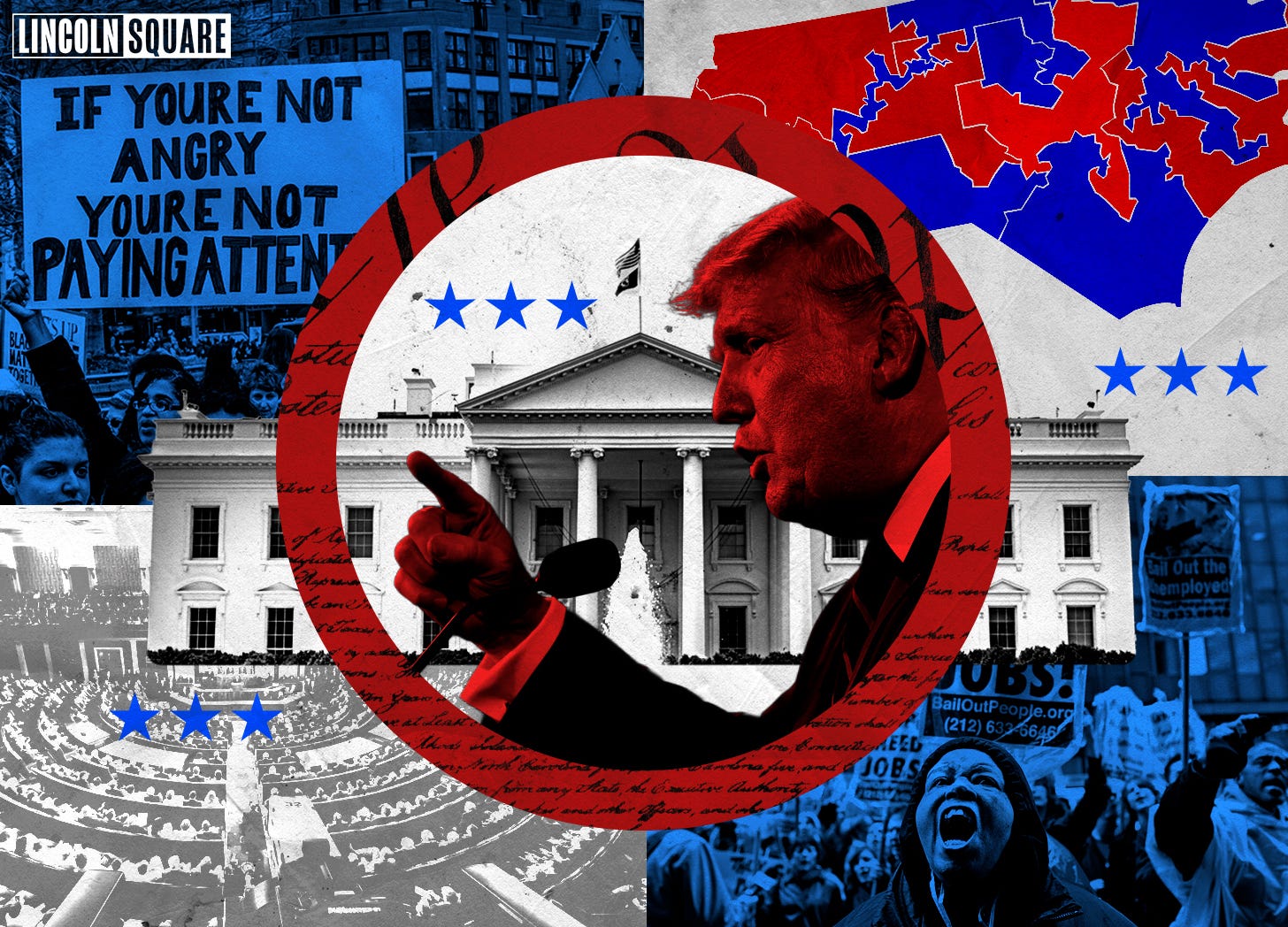
Taxation without representation. The most powerful political phrase in American history is resurfacing—because the condition it names was never fully resolved.
The United States began not as a true democracy, but as a sectional compromise—an agreement among regions with conflicting economic systems, political priorities, and moral commitments, embedded in institutions deliberately designed to limit direct popular rule.
The Civil War ended secession but not minority rule (institutional power exercised without majority support): the capacity of a smaller share of the population to control national power through institutional design. Reconstruction collapsed, and Plessy v. Ferguson—a Supreme Court ruling—legally sanctioned racial apartheid, enabling segregation, voter suppression, and political exclusion for nearly a century.
Those mechanisms were not dismantled. They were modernized.
Gerrymandering diluted representation without formally denying the vote. The House of Representatives was effectively locked at 435 members by the Permanent Apportionment Act of 1929, ensuring that representation would thin as the population grew. The Electoral College translated these distortions into governing authority, sometimes allowing fewer votes to yield national power. Together with Senate malapportionment and a dense lattice of federal veto points, these structures convert population minorities into durable governing leverage without requiring explicit disenfranchisement.
Under President Donald Trump, these long-standing imbalances have taken on an overtly operational form. Federal power has increasingly been exercised in ways that Democratic-led states argue function as pressure or punishment: the conditional provision of services, the withholding or delay of congressionally authorized funds, and the expanded use of federal law-enforcement and security authorities in American cities. In early 2026, for example, the administration temporarily froze billions of dollars in child-care and family-assistance funding while oversight disputes were litigated, prompting judicial intervention. State officials described the move as politically coercive; the administration characterized it as lawful oversight and antifraud enforcement. Similar disputes over disaster-relief allocations and immigration-related grants have reinforced the perception of conditional governance (services treated as leverage rather than guaranteed rights), even as supporters insist these actions fall squarely within executive authority.
When residents of those states continue to pay federal taxes while services are delayed, conditioned, or withdrawn, the resemblance to the original colonial grievance becomes difficult to ignore.
Today, these unresolved structures—minority rule, vote dilution, and conditional governance—are converging again. The result is not merely polarization, but a legitimacy crisis: the most serious institutional stress test of the American political system since the Civil War.
