Swipe Left on Reality: How the Purity Left Ended Up in a Situationship with Disaster.
A decade of protest votes, “principled” abstention, and asymmetric neutrality—and the people who could least afford it are the ones still paying the bill.
Kristoffer Ealy is a political scientist, political analyst, and professor in Southern California. He teaches American Government and political behavior, with a focus on political psychology, voting behavior, and political socialization. Subscribe to his Substack, The Thinking Class with Professor Ealy.
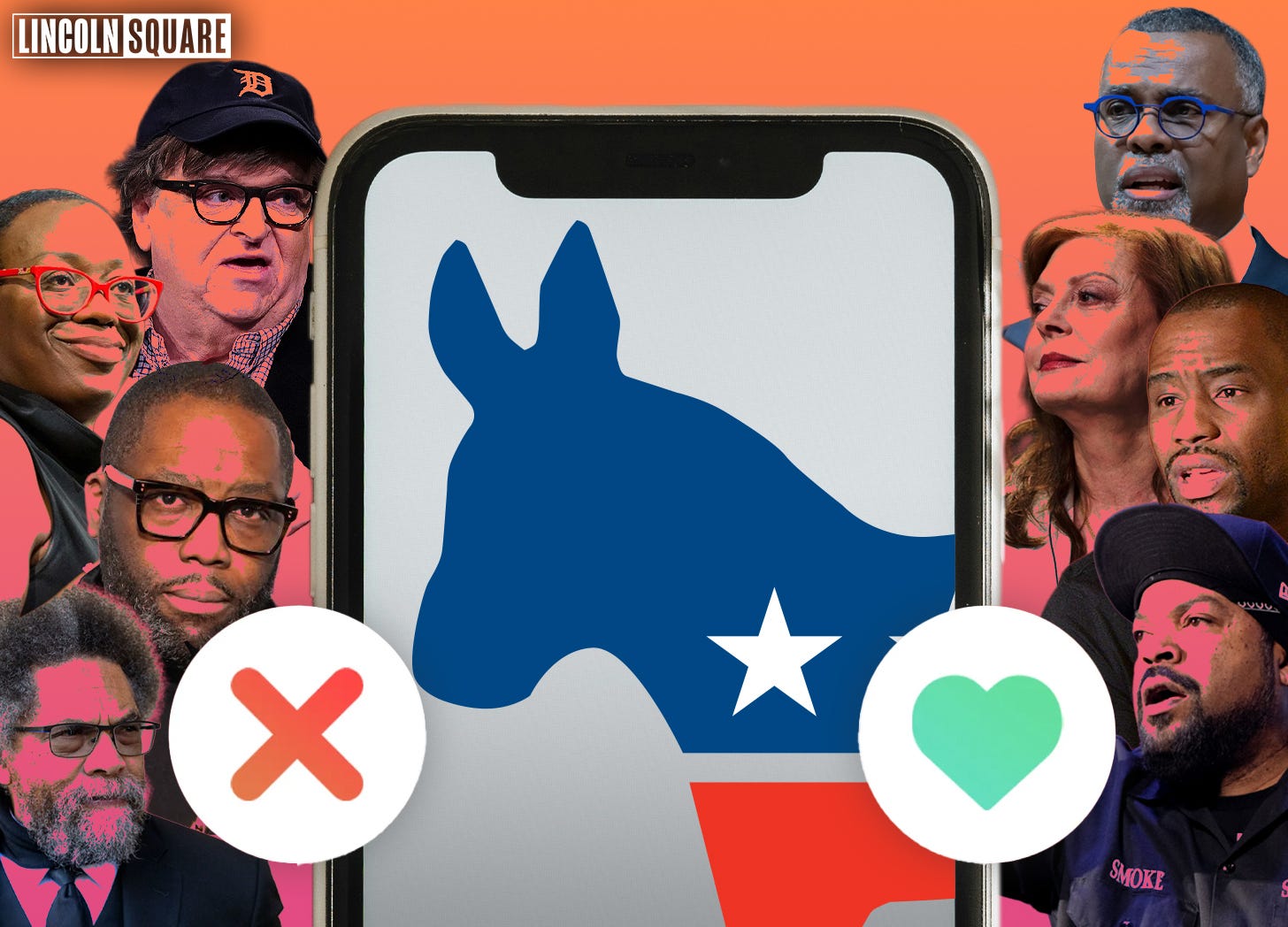
I want to say something that I’ve been sitting with for a while. And I want to say it with the full weight of a man who grew up on 7th Avenue in South Central Los Angeles, who moved to Knoxville, Tennessee and watched red state politics up close, and who came back to L.A. in 2005.
I want to say it as someone who has been teaching political science at the community college level since before some of these people discovered that voting mattered, and who has been watching this slow-motion disaster with his mouth open and his receipts organized.
Here it is: a significant portion of the so-called progressive left does not actually want elected officials to represent them. What they want is a prom date. They want a Tinder match. They want someone who checks every box, arrives with the right corsage, has the correct politics on Gaza and student debt and criminal justice reform and climate and reparations and police abolition and three other things they added to the list last Tuesday, and if the candidate doesn’t meet every criterion assembled in their imagination, they will stay home, vote third party, leave the ballot blank, tweet about their principles, collect a speaking fee for explaining their principles, and then act genuinely confused when the consequences arrive.
Except staying home from prom in real life doesn’t mean you miss a dance. It means Brett Kavanaugh gets confirmed. It means Amy Coney Barrett gets confirmed. It means Dobbs v. Jackson. It means the Voting Rights Act gets gutted. It means ICE is raiding churches in Los Angeles. Miss the prom all you want. The after-party is catastrophic and everyone who showed up is living in it.
What makes this even more baffling — and I use baffling as a clinical term because outrage is too dignified for what I’m feeling — is that these people treat electoral politics like a Choose Your Own Adventure book. Don’t like this candidate? Turn to page 47 and vote third party. Don’t like the third party? Turn to page 23 and leave the ballot blank. Don’t like the consequences of leaving the ballot blank? Turn to page 89 and start a revolution.
Here’s the problem with that plan: there is no page 89. This is not a book. When you turn to page 23 in the real world, page 24 is a Supreme Court that looks like a Federalist Society reunion, page 25 is Roe v. Wade in the trash, and by the time you’re ready to choose a different adventure the adventure has already chosen you — and it specifically chose the most vulnerable people in the country to absorb the consequences of your literary experiment while you were busy constructing your moral position on Twitter.
The Choose Your Own Adventure fantasy requires the assumption that there’s always another page to turn to, that the damage is always reversible, that the window for course correction never closes. That assumption is a luxury. And luxury, as we will discuss in detail, is something this entire roster has in common.
Which brings me to the video that started this piece. TabithaSpeaksPolitics posted a breakdown of Killer Mike — born Michael Render, Grammy winner, Run The Jewels architect, Atlanta barbershop owner, and a man who has apparently decided that 2026 is the year he cares deeply about Black voter mobilization. Tabitha’s thesis was that this is the right message from the wrong messenger.
I want to go further than Tabitha, because “wrong messenger” is too polite. Wrong messenger implies the problem is credibility. The actual problem is that Killer Mike has spent the better part of a decade doing everything in his considerable power to undermine the exact project he is now claiming to lead, and he is doing it with the casual confidence of a man who has either forgotten the receipts exist or has correctly calculated that enough people won’t go looking for them. I’m going looking for them. Pull up a chair.
Let’s start with what Killer Mike is actually saying in his 2026 mobilization push, because the vagueness is load-bearing. He’s calling for people to vote, to pressure local politicians, to show up for midterms, to — and I’m quoting — “plot, plan, strategize, organize, and mobilize.” That sounds righteous. It also doesn’t name a single candidate, a single party, a single opponent to vote against, or a single specific outcome to mobilize toward.
In Georgia, where the Republican apparatus has spent years systematically making it harder for Black people to vote, mobilizing people toward a vague inspirational concept is a strategy the same way “just do better” is a diet plan. It sounds great. It accomplishes nothing.
And the vagueness is not an accident, because specificity would require Killer Mike to reckon with the fact that in October 2022 — weeks before the Georgia gubernatorial election — he went on Charlamagne Tha God’s Comedy Central show and praised Brian Kemp for “running an effective campaign”. He said he “couldn’t have been more proud” of Kemp’s outreach to the Black community. For every compliment he handed Kemp, he had a critique for Stacey Abrams. Then he declined to officially endorse anyone and called it objectivity.
I’m going to give this a name it deserves: Asymmetric Neutrality Syndrome. The neutrality only cuts one direction. The praise flows exclusively toward the Republican. The criticism flows exclusively toward the Democrat. And the practitioner gets to call it independent thinking while functionally operating as a one-man voter suppression adjacent operation.
Brian Kemp was the man whose exact-match voter registration law flagged 53,000 registrations as pending — 70 percent of them Black — and who oversaw the purging of hundreds of thousands of voters from Georgia’s rolls. Stacey Abrams spent years building Fair Fight Action specifically to combat what Kemp was doing to Black voters. And Killer Mike went on television to praise the man doing the suppressing and critique the woman fighting it. Then he declined to officially endorse anyone. Just objectivity, folks.
It’s worth noting that this relationship started even earlier. In September 2020, Kemp posted photos of a friendly meeting with Killer Mike, captioning it “Today, Marty and I had a great meeting with @KillerMike.” Kemp used that photo op to soften his racist image. Mike allowed it. That’s the full arc.
And then there is the Tucker Carlson situation, which I am going to discuss with the specific authority of a man who grew up on 7th Avenue in South Central Los Angeles and watched another man from that same geography hand our neighborhood to one of the most cynical anti-Black media figures in America like it was a prop.
In July 2023, Ice Cube gave Tucker Carlson a guided tour of South Central on a special episode of Carlson’s Twitter show subtitled, I kid you not, “Stay in Your Lane.” The episode got six and a half million views. Tucker Carlson — a man who had defended the cop who killed George Floyd — rode through the streets of South Central while narrating over footage of derelict buildings and homeless encampments, blaming decades of Democratic governance.
The man who was born there pointed at his father’s house like it was a museum exhibit, said some things about failed Democratic policies, and went home to Encino. His father still lives in South Central. Ice Cube does not. Tucker Carlson got a hood pass he never earned, from a man who left the hood decades ago, to make a twelve-minute argument that will be recycled against Black Democratic voters for the next decade.
Nina Turner’s story is a masterclass in what happens when you confuse having a platform with having judgment, and I mean that with the clinical precision of someone who has graded undergraduate political science papers for a decade.
Turner was a Bernie Sanders surrogate, the president of Our Revolution, a former Ohio state senator, and a genuinely skilled orator who, in the closing days of the 2016 election, went on MSNBC and announced she was not backing anyone in the general election, then flirted with becoming Jill Stein’s running mate.
Then in July 2020, with a pandemic actively killing Black Americans at disproportionate rates, Turner told The Atlantic that choosing between Joe Biden and Donald Trump was “like saying to somebody, you have a bowl of shit in front of you, and all you’ve got to do is eat half of it instead of the whole thing. It’s still shit.” The people who voted for Biden — the overwhelming majority of Black Democrats — were the people she was calling shit-eaters.
Turner then decided to run for Congress. In Ohio’s 11th congressional district. Which is a majority-Black district. In Cleveland. Full of Black Biden voters. The exact people she had just told were shit-eaters. She ran in that district, against those people, and expected them to vote for her.
She lost by over four thousand votes. In her concession speech, she blamed “evil money.” The bowl of shit was not mentioned. Dark money didn’t invent that quote. Dark money just put it on television. The voters of Ohio’s 11th didn’t need outside groups to remind them they’d been called shit-eaters. They remembered. Voters are funny that way.
Six weeks after losing, Turner was hired by The Young Turks as a contributor. She ran again in 2022 and lost by thirty-three points. She is now appearing on Mark Halperin’s roundtable alongside right-wing commentators and describing it as intellectual diversity. The bowl of shit, it turns out, had a long shelf life.
Marc Lamont Hill has been running a more sophisticated operation, which is why I want to take a moment to appreciate the architecture before I burn it down.
Hill is a CUNY professor, a former CNN contributor, a former Fox News contributor, a bestselling author, and one of the most articulate political commentators of his generation. He is also, by his own documented admission, a Green Party member who voted Green in 2000, 2004, 2008, 2012, and 2016. Let that sink in. He didn’t vote for Gore when Bush took us to war in Iraq. He didn’t vote for Kerry while that war was being prosecuted. He didn’t vote for Obama. Either time.
He did, however, spend significant portions of all of those electoral cycles appearing on Fox News and CNN as the ostensible liberal voice in debates against people who were absolutely, unequivocally going to vote Republican. I noticed this years before I said anything about it publicly, and what I noticed was that the debate was never actually balanced. O’Reilly was always going to vote Republican. Hill was never going to vote Democrat. The viewer at home thought they were watching two people represent the actual binary choice in front of them. They were not.
They were watching a Republican advocate debate a professional abstainer in liberal clothing, and the network was calling it balance. It is not balance. It is a con. And the con has a name: Asymmetric Neutrality Syndrome, advanced stage, chronic, with Fox News complications.
In 2016 Hill went on The Breakfast Club — the most listened-to morning show in Black America — and said out loud what his voting record had been quietly saying for sixteen years: “I would rather have Trump be president for four years and build a real left-wing movement that can get us what we deserve as a people, than to let Hillary be president and we stay locked in the same space where we don’t get what we want.” He said this. To that audience. Weeks before an election that would determine the composition of the Supreme Court for a generation.
By 2020 he announced he was voting Democrat for the first time — presented as a historic personal sacrifice rather than a basic civic obligation — while simultaneously continuing to validate Green Party logic as a long-term investment strategy. By 2024, weeks before the election, he was on Democracy Now! explaining that anyone who opposed Biden’s Gaza policy had “absolutely no way” to justify voting for Kamala Harris if she chose Josh Shapiro as her running mate. In Pennsylvania. Where Shapiro was the governor. Where Arab American voters in Michigan were already being courted aggressively by Jill Stein.
He has also spent multiple cycles advocating what he calls strategic voting — the idea that people in blue states can vote third party while telling their friends in swing states to vote Democrat. And I want to pause here, because this argument is the perfect illustration of the central problem with nearly everyone in this piece. It sounds sophisticated. It is being presented by a smart man with real academic credentials and a genuine command of sociology. If you hear it quickly, without actually sitting down and critically thinking it through, you might nod along and believe you are in the presence of serious political analysis. You are not. You are in the presence of an idea that is dumb as fuck, dressed up in the language of someone who knows his field — just not this one.
And this is the throughline that connects every single person in this article. We are not dealing with stupid people. We are dealing with smart people who are politically illiterate — people who have mastered sociology, or music, or film, or philosophy, or whatever lane made them famous and credible, but who fundamentally cannot grasp how the science of politics actually works in practice. Electoral politics is not a sociology seminar. It is not a think piece. It is not a Choose Your Own Adventure book where you get to pick the outcome that best reflects your values and face no consequences for the chapters you skipped. It is a system with rules, structural incentives, institutional constraints, and real human beings absorbing the results of every decision made inside it. Marc Lamont Hill knows sociology. He does not know electoral politics. And the distance between those two things is exactly what has been costing communities like the ones I grew up in for the better part of three decades.
Back to the strategic voting argument, because it deserves to be buried properly. The idea only works if you have perfect real-time information about which states are actually safe — which nobody has. Wisconsin hadn’t voted Republican since 1984 before 2016. Michigan hadn’t gone red since 1988. Pennsylvania was considered a firewall. And in 2024, even New York — one of the bluest states in the country — took significantly longer to call than it had any business doing. There is no safe state. There is no consequence-free protest vote. What every person hears when a credentialed professor says “blue state voters can vote their conscience” is permission — regardless of their actual geography, regardless of the margin, regardless of who ends up paying the price.
Marc Lamont Hill has spent a quarter century constructing the intellectual infrastructure of Democratic electoral disengagement while collecting CNN paychecks, Fox News fees, Morehouse professorships, and CUNY chairs. He is now co-hosting the Joe Budden Podcast. The permission structure has a new address but the same landlord.
Eddie Glaude Jr. is the most complicated figure on this roster, which is not the same as the most innocent. Glaude is the James S. McDonnell Distinguished University Professor of African American Studies at Princeton — and yes, I’m going to keep saying Princeton, because the institution matters when we get to the class argument — a former department chair, an MSNBC contributor, and the author of a celebrated study of James Baldwin’s America.
He is also the man who in July 2016 published a piece in Time magazine called “My Democratic Problem with Voting for Hillary Clinton,” in which he announced he would not vote for her. He then went on Democracy Now! and called for people outside of battleground states to leave their presidential ballots blank. And here is the part that I keep coming back to: he brought his son.
Langston Glaude, then an undergraduate at Brown University, sat next to his father on national television and co-signed the leave-the-ballot-blank position. A Princeton professor and his Brown University son, sitting on Democracy Now!, telling working-class Black voters to leave their ballots blank, invoking the cost of the status quo to their lives. The irony of a Princeton professor and a Brown student invoking the cost of the status quo to the lives of people whose lives actually absorb that cost in ways Princeton and Brown do not is so thick you could spread it on toast.
Glaude has since admitted in writing that he was wrong about 2016 — tweeting “I was wrong about the 2016 election; I admit it and have admitted it (in writing), but I will NOT apologize for wanting better” — which is the political equivalent of a drunk driver saying they’re sorry the pedestrian got hurt but they refuse to apologize for the vodka. In 2025 and 2026 he has been consistently and clearly anti-Trump on MSNBC, calling the agenda a white nationalist project and describing the voting rights gutting as a five-alarm fire. He is saying the right things now. He is doing it with a salary. None of that cancels the tab.
Cornel West is easier to dispatch because his case requires less analysis and more documentation. West endorsed Jill Stein in 2016, called Trump “a neo-fascist catastrophe” and Clinton “a neo-liberal disaster,” served on the Democratic platform drafting committee, and then endorsed Stein anyway — which is the kind of move that earns you a gold medal in the Strategic Abstention Disorder Olympics.
Strategic Abstention Disorder — SAD, and I mean that in every possible sense of the word, because the acronym is intentional and the afflicted have earned it — is the condition in which the afflicted mistakes their principled refusal to vote for the Democrat as a form of political consciousness rather than political complicity, and repeats this mistake across multiple electoral cycles without meaningful reflection, while collecting half a million dollars a year in speaking fees to explain to people with far fewer resources why their vote is beneath the dignity of their values. The acronym is SAD because the disorder is SAD. And these mother fuckers are SAD.
Then in 2024 West ran for president himself as a third-party candidate, a campaign that received significant support from Trump allies who wanted him on swing-state ballots specifically to drain votes from Kamala Harris. The man who called Trump a neo-fascist catastrophe in 2016 was being used as a neo-fascist instrument in 2024. He does not appear to have registered this. Brother West is still Brother West.
Susan Sarandon. Sixty million dollars in net worth. Multiple Manhattan properties. Academy Award. And in March 2016, on MSNBC, she suggested that Donald Trump becoming president might “bring the revolution immediately” and that “things will really, you know, explode.” She voted for Jill Stein.
Things exploded. Three conservative Supreme Court justices got confirmed. Roe v. Wade was overturned. Affirmative action was gutted. The Voting Rights Act was hollowed out. ICE began raiding churches and schools in Los Angeles.
And in 2025, Sarandon told Vulture magazine that she finds “good news” in Trump because “he’s exposed all the cracks in our system.” She was also, in June 2025, on stage at the No Kings anti-Trump protest in New York City, which means the woman who wanted the revolution is now protesting the revolution she helped deliver while describing the carnage as good news because it exposed some cracks.
I want to introduce a term here: Belated Crack Awareness Syndrome. It is the condition of wealthy, credentialed progressives who mistake their own delayed discovery of systemic rot for insight, not understanding that the communities most harmed by that rot never had the luxury of not knowing it was there.
The people on 7th Avenue in South Central did not need Trump to expose the cracks. They were living in the cracks. They built furniture around the cracks. They raised children in the cracks. They buried people who fell through the cracks. The cracks were not a revelation. The cracks were their address.
Susan Sarandon needed sixty million dollars, a Jill Stein ballot, eight years of compounding consequences, and a protest in Bryant Park to discover what any working-class Black or brown person in America could have told her for free in 1987. That is not awakening. That is the most expensive political education in American history, paid for entirely by people who couldn’t afford the tuition, underwritten by a woman who absolutely could and chose not to.
Michael Moore is a more complicated case and deserves more nuance, which is a sentence I did not expect to type about the man who described a Trump victory as “the biggest fuck you ever recorded in human history” and Trump himself as “the human Molotov cocktail” that beaten-down working-class voters could “legally throw into the system.”
Moore did endorse Hillary Clinton in 2016. He voted Biden. He voted Harris. He is not Sarandon. But Moore spent the fall of 2016 delivering one of the most seductive pieces of political romanticization in modern American history — a speech so aesthetically satisfying in its description of working-class rage that Donald Trump Jr. retweeted the clip as a campaign asset. The fine print said vote Clinton. The clip didn’t include the fine print.
Today Moore calls Democratic leadership cowards on his Substack while also saying vote for them anyway, which is the correct political position delivered in the rhetorical packaging of someone who can’t quite bring himself to mean it without qualification. He clears the minimum bar. He clears it like a man who has decided the bar is beneath him but will step over it anyway on his way to complaining about the bar.
Ice Cube deserves his own sustained attention because his trajectory is the most complete arc of self-inflicted irrelevance on this entire roster and because it is personal to me in a way I need to name explicitly.
O’Shea Jackson grew up in South Central Los Angeles. I grew up in South Central Los Angeles — the first twelve years of my life on 7th Avenue — before my family moved to Knoxville, Tennessee and before I came back to LA in 2005. We come from the same geography.
In July 2020, three weeks before the presidential election, Cube quietly slipped into Washington D.C. and met with Jared Kushner for three hours to discuss his Contract with Black America — a document that started as a potentially serious policy proposal and ended as a Trump campaign photo opportunity. His intellectual collaborator for the contract included Dr. Boyce Watkins, who, when criticized about the Cube-Trump collaboration, responded on Twitter: “And Black people haven’t been getting played by the Democrats in every election? Learn how to negotiate. Stop giving your fucking loyalty away for nothing.” That is the Boyce Watkins special: both-sides nihilism in a Black empowerment costume, handed a national platform right before a consequential election.
Then in 2022 Cube went on Charlamagne’s show and praised Brian Kemp. Then in 2023 he gave Tucker Carlson a guided tour of South Central. Then in 2025, with ICE raiding churches and schools in Los Angeles — in our city, in the neighborhoods adjacent to the one we both grew up in — Ice Cube went on LA radio and said: “y’all just overdoing it.”
Y’all just overdoing it. ICE is grabbing people out of churches and schools in South Central and the man who used to rap “Fuck tha Police” and made a song called “Arrest the President” looked at that and said y’all just overdoing it. That is not remorse. That is a man who gave Tucker Carlson a tour of the neighborhood, praised the voter suppressor, handed Jared Kushner a policy document as a campaign prop, and is now mildly inconvenienced by the fire he helped pour gasoline on.
And now, a few months before the 2026 midterms, suddenly Cube cares deeply about all of this. This is not a political awakening. This is a man who only goes to the gym in December because his New Year’s resolution starts January 1st, except the thing he’s been skipping isn’t leg day — it’s the democratic participation of the community he claims to represent.
Charlamagne Tha God occupies a slightly different lane, and credit where it’s due: in 2020 he said explicitly that he was voting for Kamala Harris — not Biden, Harris specifically — and he did it. He voted correctly. But Charlamagne’s function in this ecosystem across multiple cycles has been to serve as the respectable middleman between the purity left and the apathy right, generating chronic institutional erosion of Democratic enthusiasm between elections and then showing up in October with the political equivalent of a hostage video endorsement. By 2023 he was telling Politico he felt “burned” by the 2020 ticket and had no plans to endorse Biden-Harris in 2024. That is not neutrality. That is the drip-drip-drip of disengagement, monetized.
I need to tell you something about myself here, because this piece requires it.
I was nineteen years old when I voted for Ralph Nader. A kid from South Central and Inglewood who had been listening to people like Michael Moore and Bill Maher make the case that Gore and Bush were essentially the same, that a protest vote was a form of political consciousness, that voting your conscience was more sophisticated than voting your interests. So I voted Nader. Al Gore lost Florida by 537 votes. Nader pulled 97,421 in that state. A few years later George W. Bush started a war in Iraq on manufactured intelligence, and a generation of mostly poor and working-class kids — kids from neighborhoods like mine — went to die for a lie.
I did not need a PhD to eventually understand what had happened to me. I needed to watch the news. The PhD came later. The consequences came first.
I tell this story not as confession but as prosecution. The con works. It worked on me. It works on smart people, politically engaged people, people who genuinely care about justice and are looking for someone credentialed and articulate to confirm that their instinct toward principled abstention is actually a form of sophistication. And when the people running the con have the platform of a Breakfast Club appearance or a Democracy Now! segment or a Princeton appointment, the reach of the permission structure is vast enough to change the outcome of elections.
By 2016 I was a second-year political science professor at Ventura College. I understood Hillary Clinton’s unpopularity as well as anyone on this roster. I also understood something they either couldn’t or wouldn’t say: she would come to the negotiating table. She was a politician who understood leverage, who responded to organized pressure, who had spent her career in the actual machinery of democratic governance. Whatever you didn’t like about her — and there was a list, and it was real — you could make that list very clear to her once she was elected, and she would hear it, because that is how politics actually works when the person in office is not a malignant narcissist who has never done anything for people he considers beneath him and never will.
Donald Trump has never had a negotiation with a poor person that ended in the poor person’s favor. His entire operating system runs on transactional loyalty among people who had leverage over him, and the communities I grew up in had none. I said this publicly, in my classroom, on panels, on my podcast, wherever I had access. I had no CNN contract. I had no Princeton appointment. I had a classroom at a community college in Ventura and the lived experience of having already survived one cycle of this exact argument.
Allan Lichtman, the American University historian who developed the 13 Keys to the White House, called the 2016 election for Trump in September of that year and did it the way a serious person does: soberly, methodically, without one molecule of aesthetic satisfaction in the prediction. He was not romanticizing. He was not building a brand. I heard that call and I knew we were in trouble.
The contrast between Lichtman’s posture and the posture of this entire roster is the difference between honest forecasting and weaponized prediction. Lichtman said Trump might win: here’s the warning. Moore said Trump might win: isn’t that kind of beautiful. Hill said Trump might win: I prefer Jill Stein. West said Trump might win: and Clinton is a neo-liberal disaster. Turner said Trump might win: the Democrats are a bowl of shit.
Lichtman’s model missed in 2024 — he predicted a Harris win — and he said so directly, without spin, without a narrative about evil money. What his model was not designed to account for were Russian-linked hoax bomb threats hitting at least fifty polling sites across Georgia, Pennsylvania, Arizona, Wisconsin, and Michigan on Election Day — Fulton County alone received thirty-two bomb threats that forced evacuations and extended hours. The model forecasts governance conditions. It does not forecast election day sabotage coordinated from foreign email domains. Lichtman got one wrong after decades of getting them right, owned it immediately, and went back to work. The people on this roster got 2016 wrong and spent eight years explaining why it wasn’t their fault.
Here is the class argument, stated plainly, because it deserves plainness.
Susan Sarandon was worth sixty million dollars when she voted for Jill Stein. Marc Lamont Hill had a Presidential Professorship, CNN contracts, book deals, and speaking fees when he told Black listeners he’d rather have Trump than Clinton. Cornel West was pulling half a million dollars a year in speaking fees when he told working people their vote was beneath their principles. Eddie Glaude held a named chair at Princeton and brought his Brown University son to co-sign ballot abstention on national television. Killer Mike had Grammy money, Run The Jewels money, a barbershop empire, and an Adidas deal when he was praising Brian Kemp.
Not one of them was going to lose their health insurance. Not one of them had a family member whose affirmative action admission to a state school was about to evaporate. Not one of them was going to have ICE show up at their church. They were playing revolution chess with other people’s lives as the pieces, and the people whose lives were the pieces never got to vote on the opening gambit. Purity politics is a luxury product. The people selling it have always been able to afford it. The people absorbing its consequences never could.
Let’s be honest about what accountability looks like from this crowd, because I’ve been doing this long enough to know that demanding tearful public apologies from people this credentialed and this proud is not a political strategy. It’s a fantasy.
Glaude is the closest to functional — he is saying on MSNBC that Trump’s project is a white nationalist agenda, he admitted in writing he was wrong in 2016, and he is pointing at the fire clearly if not completely. He gets partial credit. Moore calls Democrats cowards and says vote for them anyway, which is rhetorically messy and functionally correct. He clears the bar. Sarandon is still finding good news in the disaster. Ice Cube said y’all overdoing it about ICE raids in the city we grew up in and is now suddenly mobilized a few months before the midterms. Killer Mike is mobilizing toward a vague inspirational concept with no named candidate and no reckoning with his Kemp praise. Nina Turner is on Halperin’s roundtable. Marc Lamont Hill is on the Joe Budden Podcast building the next permission structure. Cornel West is Cornel West.
The standard this piece is setting is not high. It is embarrassingly, almost insultingly low given the size of these platforms and the scale of the damage.
Name the candidate. Name the party. Name what you’re voting against and what you’re voting for. Stop treating political neutrality as sophistication when the neutrality only cuts in one direction. Stop practicing purity politics with other people’s lives as the laboratory. Stop showing up a few months before the election with a mobilization initiative that has no address and calling it leadership.
And understand — this is the part that seems to genuinely escape this entire roster — that the communities most harmed by a Trump presidency did not need it to expose the cracks. They knew about the cracks. They have always known about the cracks. The cracks were their neighborhood, their school district, their hospital waiting room, their grandmother’s Medicare, their cousin’s Medicaid, their daughter’s reproductive rights, their brother’s encounter with a system that was never designed to see him fairly.
What they needed from people with your platforms was not a tour of the damage. They needed someone with your reach to help stop the people making it worse.
Tabitha said Killer Mike is the right message from the wrong messenger. I’ll go further. The message is incomplete from any of these people until it has a name on it, a party behind it, and a reckoning in front of it. Everything else — the mobilization initiatives, the MSNBC appearances, the protest stages, the podcast platforms, the Substack essays, the Tucker Carlson tours of neighborhoods you no longer live in — is just noise with a beat.
And the community has been dancing to noise for long enough.


I respect your writing and your intent, especially as someone who grew up 20 miles from you and who likes psychology and politics quite a bit.
But you kinda lost me in this screed.
I wish you would have taken the time to illustrate how Dems can be successful in November, and that an anti-corruption message is probably more important than any particular identity, and certainly more important than ideological purity, progressive bona fides, or political correctness.
Democratic mobilization and enthusiasm can trump Trump's chicanery and cheating in the midterms, but we do all need to be on the same page.
If Killer Mike or Ken Martin or Kamala Harris are not right-minded then forget them. We are facing a mountain of skullduggery now and on election day, and a unifying message such as pro-economic reform, pro-legal-justice-for-the-fascists, and pro-affordability can paper over the Left's widely-differing viewpoints and identity issues.
I believe politics serves people, is not inflexible, and is a personal expression as much as a public statement. People need to play by the rules but rules are often arbitrary even as they allow the game to be played with ferocious energy, emotions, and a constant testing of their power. We need to set the rules even while we know they could change. Just like in, say, baseball. Tired of bad hitting from a a pitcher? Let another go to bat for the pitcher. And so on.
Don’t like a candidate for office? Pick another or don’t choose another or don’t play. But politics isn’t baseball. The DH doesn’t play in the field and can’t affect the game’s play until the next turn at bat. A position player can affect the game throughout, not just at certain moments.
So a voter choosing another candidate from the ‘bench’, even from the other team or league, weakens the game writ large by adding a new rule or candidate that could upend the outcome, the season, the whole concept of electoral politics. One may not like a player or candidate but that’s the way it is. There’s always next year. There’s always next season.
Years ago, Trump was not allowed to play in the NFL, so he organized a new league. His right, his loss. The NFL prospered. Trump prospered, elsewhere.
My point, if I can get to it, is there’s little reward and much damage when a voter picks an alternate to the chosen candidate. One less vote for the one candidate who can legitimately affect the government lessens the chance for having a government that’s acceptable. Work to change the rules instead.