


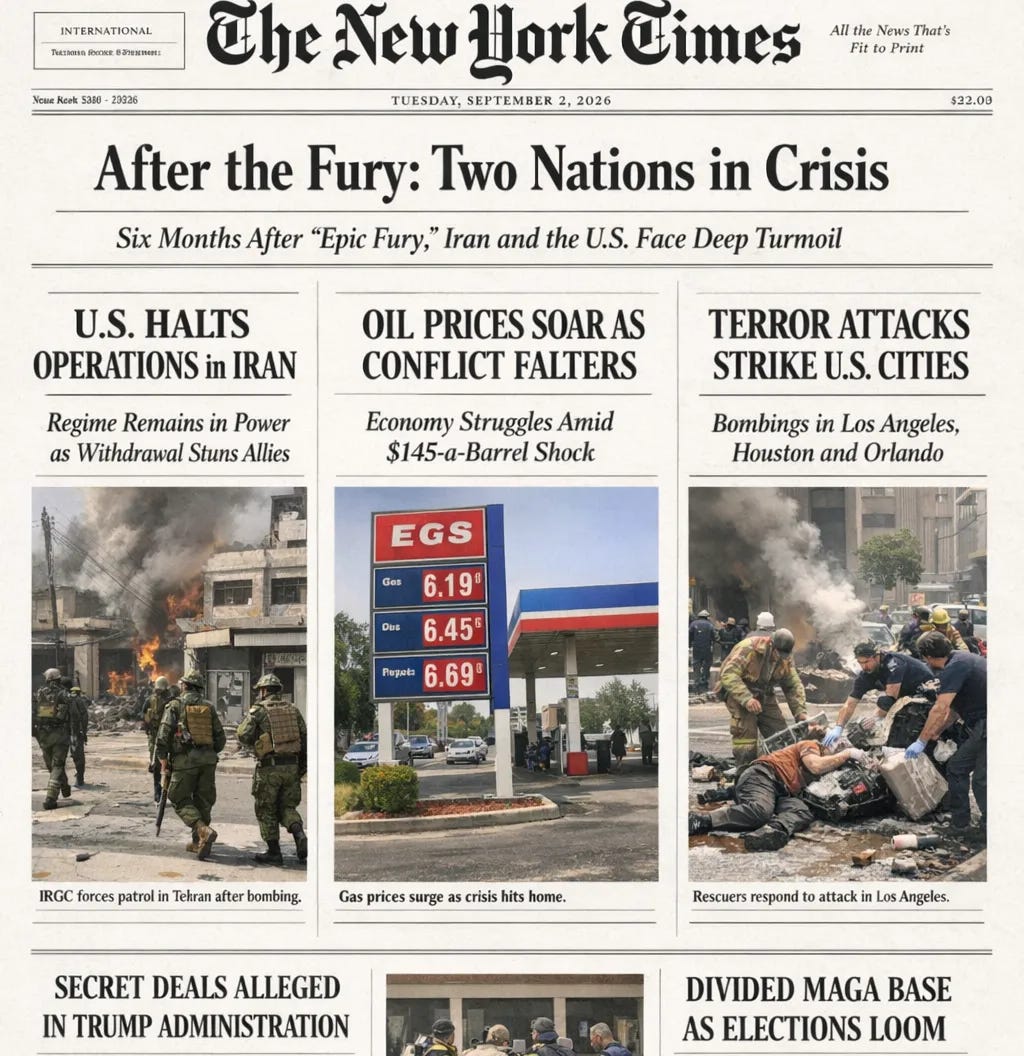
Author’s Note: I wrote in the style and tone of the New York Times as a future history of Operation Epic Fury and its aftermath. Let’s hope I’m wrong…but I’m likely to be right.
After the Fury: Two Nations In Crisis
September 2, 2026
WASHINGTON — Six months ago, the Biden-era caution that had defined American policy toward Iran was incinerated in a single night of “closeness and precision.”
President Trump, who campaigned as “The Peace President” in his 2024 campaign, launched Operation Epic Fury with a promise that the “monsters in Tehran” would be replaced by a “beautiful, free democracy.” The imagery was indelible: Tomahawk missiles streaking over the Alborz Mountains, American and Israeli strikes in Tehran and beyond, and the President declaring from Mar-a-Lago that the Iranian people were finally “taking their country back.”
“Our objective is to defend the American people by eliminating imminent threats from the Iranian regime, a vicious group of very hard, terrible people,” Mr. Trump said in an eight-minute video posted to Truth Social on the morning of the attack. He vowed to “raze their missile industry to the ground” and “annihilate their navy,” calling the operation a “noble mission” for the “future of our children.”
Six months in, the smoke has cleared to reveal a landscape that looks hauntingly familiar, yet infinitely more fractured. The “regime change” once promised by the White House has morphed into a strategic withdrawal, leaving a decimated Iranian populace at the mercy of a wounded, but vengeful, security state.
In a stunning reversal that has alienated traditional hawks and left Middle Eastern allies in a state of vertigo, the Trump administration has effectively declared the mission over, leaving the Islamic Revolutionary Guard Corps (IRGC) and the surviving elements of Iran’s theocratic government to pick up the pieces of its shattered authority.
The Survival of the Iranian Deep State
While the initial strikes successfully dismantled Iran’s nuclear infrastructure and its conventional air defenses, they failed to uproot the asymmetric power of the IRGC and its domestic enforcement arm, the Basij. In the power vacuum that followed the bombardment, these groups did not crumble; they burrowed in.
In the suburbs of Tehran and the restive provinces of Sistan and Baluchestan, the “liberation” has been replaced by a grim reality of door-to-door purges. Intelligence reports reaching the West describe a “reign of terror” as the regime hunts down dissidents who cheered the initial bombings. Yet, the moral clarity once voiced by the White House has been replaced by a pragmatic — some say cynical — indifference.
“We did our job. We hit them hard; nobody hits harder than us,” Mr. Trump told reporters yesterday. “But look, at some point, Iran has to handle Iran. It’s an Iranian domestic matter. We aren’t the world’s policemen.”
This stands in stark contrast to his rhetoric in February, when he urged the Iranian people: “When we are finished, take over your government. It will be yours to take. This will be, probably, your only chance for generations.”