Seven Signs that Donald Trump Has Transformed the US Government into a Personalist Regime
Trump has put his name—and face—all over our government. And he's taken corruption to a new level.
Don Moynihan is the J. Ira and Nicki Harris Family Professor of Public Policy at the University of Michigan Ford School of Public Policy. Subscribe to his Substack, Can We Still Govern?
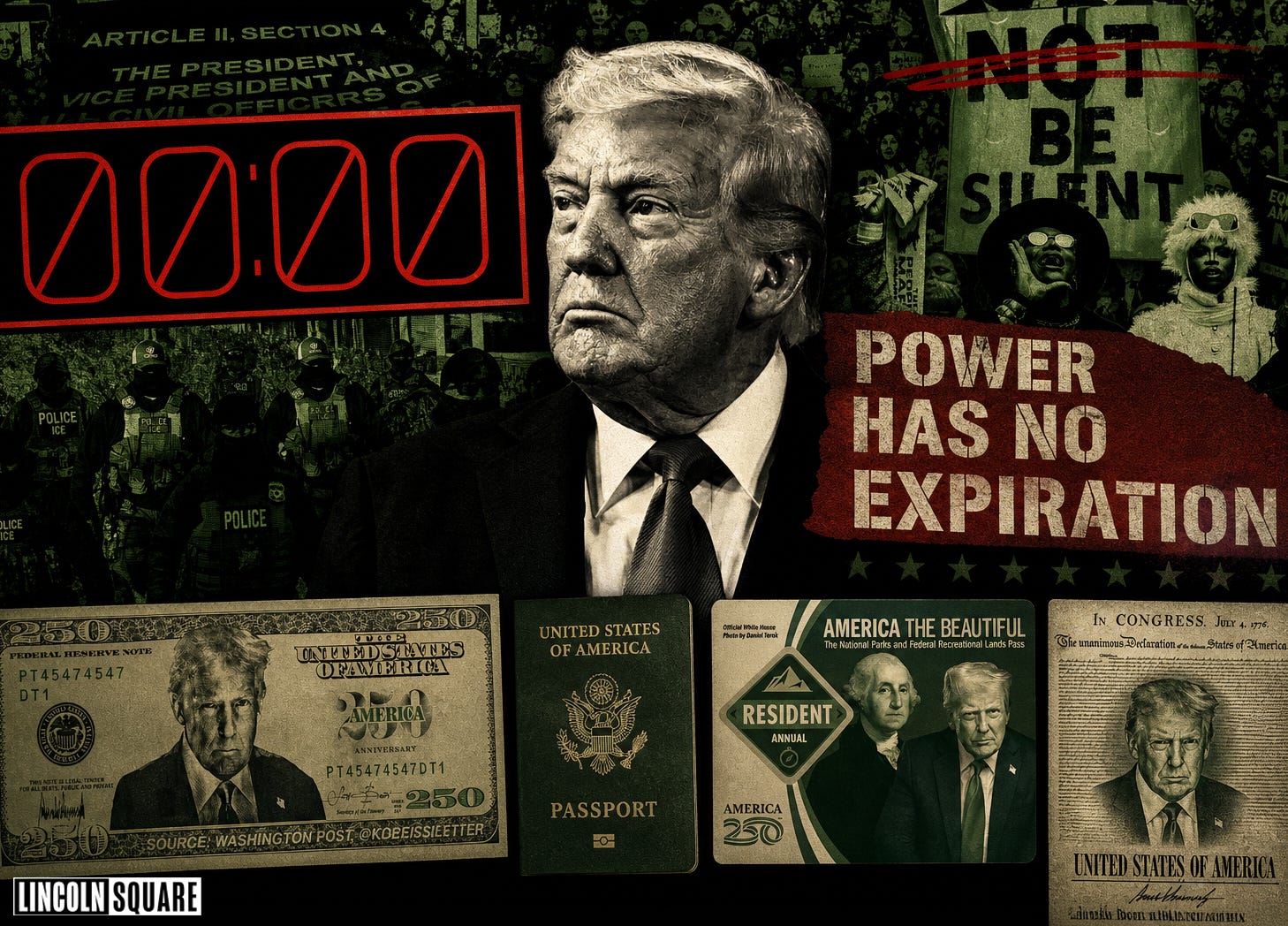
When asked about constraints on his power, President Trump replied: “There is one thing. My own morality.” Not Congress. Not courts. Not the Constitution. Not law, domestic or international. Not allies. “My own mind. It’s the only thing that can stop me.”
His party can’t stop him. The party of Lincoln is now “the party of Donald Trump,” acknowledged Lindsey Graham when discussing the primary loss of Senator Bill Cassidy, who voted to impeach Trump. Cassidy was one of a string of Republican incumbents that Trump pushed out of the party, alongside critic Thomas Massie, and Republican Indiana state legislators who opposed redistricting.
A variety of different terms exist to give meaning to the current moment in American governance, some old, some new. Fights over specific terms seem mostly pointless to me, academic in the worst way. What matters is if the language and underlying concepts helps to deepen our understanding of what is going on.
For me personalism has played that role. Drawn from comparative politics studies, personalism centers on parties and systems that serve a single individual. Trump was able to grab the Grand Old Party and purge it of dissent. I don’t think there is a comparable example where a mature and strong political party was so captured.
It is an extraordinary thing, but the Republican Party became more personalist after January 6. The assault on the Capitol served as the ultimate loyalty test. In the aftermath, his critics were purged. Trump didn’t bother appearing in a primary contest, so firm was his hold on the party.
Trump’s second term has been an exercise in embedding the logic of personalism into American government. Mechanically, he has done this via a series of reasonably predictable actions: hiring loyalists who are dependent upon him, weakening the job protections of the career civil service, capturing the justice system to threaten friends and reward enemies, threatening civil society. The loyalist is elevated, the critic disempowered. The process has been aided immeasurably by a Supreme Court who obligingly discovered a constitutional license for a Presidency of extraordinary power precisely at a moment when an authoritarian asked them for it.
The underlying logic of American governance is clear to all: Don’t cross Trump.
In this post I want to focus both on the symbols and substance of personalism, both the theater of toadyism and how personalism is reshaping our government and country.
Here are seven indicators for how Trump has gone from a personalist party to a personalist governing regime.
1. The Leader Is Everywhere
While Republicans made “Obamacare” an epithet, Trump sees the power of putting his names on things, and so we now have TrumpRx. Trump’s name, image and signature are everywhere, draped on government buildings, national park passes, visas, savings accounts, currency, monuments, battleships and passports.
Trump’s followers are free to erect gold statues on private property, but the use of public spaces and resources for the worship of individuals should reflect some collective agreement. Not for Trump. While Presidents have things named after them all the time, this is different in a number of respects.
Trump is breaking norms intended to convey a republican government, such as the idea that current Presidents are not Kings, and would not have their image or signatures on currency. The Washington Post reported that a federal employee was reassigned after she pointed out it was illegal to put living figures on currency to Trump appointees who wanted to put him on a $250 bill.
Trump is using his power as President to coerce others to adopt his likeness. In the past, champions of former Presidents might raise campaigns to rename public places. While President, Trump is suggesting that various stadiums, airports, or train stations be named after him — with the implication that he might make life difficult for those who oppose him.
History is literally being rewritten in public spaces. For example, the National Portrait Gallery removed text alongside Trump’s portrait that mentioned January 6.
The sheer volume and gaudiness of this campaign. Trump’s personal aesthetic defines public spaces in the nation’s capital, with no meaningful public input. He decides to tear down the East Wing and what should replace it. He decides to turn the reflecting pool into some garish swimming pool color. He decides if DC needs a massive arch. Others might sue, but Trump treats public property as personal property. While the tacky gold decorations in the Oval Office can be removed by a successor, remaking DC into an outdoor Trump casino will be much harder to reverse.
Whether Trump likes or is welcomed by the institution is irrelevant. Trump is trying to close the Institute of Peace, even as it was renamed the Trump Institute of Peace.
Trump imposed his name on the Kennedy Center, a beloved DC institution. When artists and audiences stopped coming, Trump closed it in a fit of pique, announcing a remodel for an institution that had just been remodeled. The unwelcome nature of the institutional assault underlines that the renaming are displays of power and coercion.
Trump’s face now dominates government buildings. “These are my buildings, my departments,” he seems to say. Most chilling is the unfurling of such a banner at the Department of Justice, ending any pretense of a maintaining the separation between the justice system and a wildly corrupt president.
2. The Rule of Law Is Secondary to the Leader’s Whims
Not so long ago, John Adams principle “A government of laws, not of men” was a staple of political discourse, a piece of unassailable rhetoric so undeniable that it could be used to to win neutrals to your argument. We hear this a bit less from the Republican side now.
Trump’s personal defense lawyers run the Department of Justice, and take pains to advertise we are now a government of men — well one man — and not laws that are equally applied. The Acting Attorney General Todd Blanche has been personally intervening in the Epstein case to protect Trump. He also recently boasted that every Department of Justice prosecutor and FBI agent who was involved in investigations of Trump were no longer in government, having been fired or pushed out.
The Department of Justice is now Trump’s law firm, used to target his enemies on Trumped-up charges, or those he wants to neutralize or get on his side, such as broad swaths of civil society like law firms or universities. Under this environment, crossing the leader, in the smallest way, means risking the full force of the federal government upon you. Because Trump owns the DOJ, he can tie you up in court forever, at no cost to him.
3. The Inner Circle Has Free Rein to Pillage
In a personalist regime, the government will never investigate Trump, even as he orchestrates unprecedented conflicts of interest and opportunities for corruption. The Trump family has branched out from real estate to crypto, arms manufacturing, and prediction markets — profitable opportunities that remain profitable because other people assume their proximity to power can be used to leverage favored treatment. For example, regulators who raise questions about these businesses can expect to be pushed out of their jobs.
Trump trades stocks for companies he boosts on social media, or who have business with the administration, because conflict of interest policies don’t exist anymore.
It is a free-for-all if you are on Trump’s side. Pardons can be purchased, investigations can be dropped, if you grease the hand of Trump’s inner circle. Appointees who might worry they are breaking the law for Trump can be won over with the promise of a pardon, or a threat of retribution.
Most recently, Trump converted a $10 billion shakedown of the IRS into a proposed $1.776 billion slush fund for Trump supporters who feel insufficiently rewarded for their loyalty, as well as a guarantee that the IRS will not audit him and his family despite deep concerns about Trump’s growing wealth. Imagine if Nixon had demanded that the Watergate burglars receive a massive taxpayer reward and that all future investigations into him and the whole cabal be blocked forever. That is where we are.
I think about the January 6th attacker and child sex offender who promised his victims that he would pay them for their silence once his January 6 reparations money came through. That man understood the logic of Trump’s mode of governing better than those of us who still think we live in a functioning democracy.
4. The Routine Debasement of Other Public Leaders
It’s not just that Trump posts demeaning AI slop of opposition leaders, or insults them like labeling Hakeem Jeffries as a “low IQ…THUG.” No-one in his own party is exempt. All must participate in their own humiliation.
One through line between Trump’s first and second terms is watching Cabinet meetings devolve into each official trying to top the other in their slathering hyperbolic praise of Trump. Trump enjoys the praise, but such “public displays of personal fealty” also has a purpose, as James Comey wrote:
While the entire world is watching, you do what everyone else around the table does — you talk about how amazing the leader is and what an honor it is to be associated with him….Of course, to stay, you must be seen as on his team, so you make further compromises. You use his language, praise his leadership, tout his commitment to values. And then you are lost. He has eaten your soul.
An analysis by the New York Times shows one in every six sentences uttered at a Cabinet meeting was devoting to flattering Trump or attacking his opponents. And in his second term, the flattery is getting more frequent and more slavish, reflecting Trump’s own claims about his historical greatness.
There are too many examples to list, but when the former Labor Secretary Lori Chavez-DeRemer said: “Mr President, I invite you see your big beautiful face on a banner in front of the Department of Labor because you are really the transformational president of the American worker” this set the stage for Trump imposing his image on a government building for the first time.
While it is easy to mock the Cabinet officials involved, this routines of debasement are a pattern we see in authoritarian countries, done to establish the point that there is only one true leader that all must serve.
5. Presidential Vibes, Not Facts, Determine Our New Reality
One downside of a personalist regime is that it creates information bubbles, where the whims of a 79-year old man cannot be questioned, and so becomes the operational reality for our government.
America is at war with Iran. A broadly unpopular war that was pursued with no discussion during the election. Sometimes Trump calls it a war, sometimes he insists its not. Sometimes he says the war is over, and the enemy has surrendered, sometimes he rages at them for their ongoing hostilities. He presents what sounds like extraordinary concessions to Iran as some sort of victory. It depends on the day or the hour, his moods, or considerations such as the need to temporarily juice the stock market.
Cabinet officials and spokespersons routinely engage in nonsense to accommodate these whims, but so too is the entire machinery of the most expensive and sophisticated military force in world history.
How strong is the ethos of Trumpian infallibility? Even retiring Senators, those who disagreed with Trump, refuse to directly criticize his judgment. Retiring GOP Senator Tom Tillis seems to have nothing to lose, but when objecting to Trump’s hare-brained scheme to take over Greenland he clarified: “To be clear — I’m not critical of the President. I’m critical of the bad advice he’s getting on Greenland.” The King may be all powerful, the smartest man ever, but he cannot be wrong — and so, it is his courtiers who are to blame.
The last thing Republicans want to be seen as is anti-Trump. This intolerance of dissent is familiar to authoritarian regimes, where members of the controlling class can lose their status if another accuses them of not being sufficiently communist or revolutionary enough. For example, if Trump loyalists like John Cornyn are deemed insufficiently loyal to the new generation, they are vulnerable. Here, Representative Anna Paulina Luna offers no specifics in her criticism of Cornyn, which is how these things work in personalist regimes: the accusation of insufficient enthusiasm is a sufficient threat. Trump later chose not to endorse Cornyn in his Senate race, saying “he was not supportive of me when times were tough.” Only absolute loyalty is enough.
6. Conspiratorial Ravings Become a Loyalty Test
Its not just military policy that is unchecked by anything other than Trump’s own. mind. It is executive action in multiple other areas. For example, the federal government is now acting as if Trump really won the 2020 election, and was cheated by some shadowy conspiracy theory that now must be investigated. As he auditions to take the job on a permanent basis, Acting Attorney General Todd Blanche says, “There’s a ton of evidence that the election was rigged. We’re very focused on finding out whether the right people voted.” The right people.
All of this is nonsense, of course, but having the FBI raid election centers and take their ballots not only mollifies Trump, it normalizes future federal attacks on election integrity.
Presidential nominees must publicly repudiate reality if they want to ascend in the world. This includes lifetime federal judges or members of the Federal Reserve, incredibly important jobs where integrity and judgement are crucial.
Imagine the King insisted the sky is green. People around him must also insist its green. Most know better. But when asked by skeptics “what color is the sky” they also insist its green, or find a dodge like “it’s a debated topic” or “I don’t want to talk about it” or “the weatherman says its blue.”
Every recent Trump judicial nominee before the Senate who was asked about the 2020 election came up with formulaic dodges, like saying not that Biden won, but was “certified” or “served.” They said it was a political issue they could not comment on — when the outcome was actually decided by courts via dozens of lawsuits. How will they judge future lawsuits from their patron?
Kevin Warsh, the new chair of the Federal Reserve was similarly unwilling to acknowledge that Trump lost. How much backbone will the nominally independent Federal Reserve have when Trump tells it what to do?
7. Only Loyalists Need Apply
It is not enough that evidence of loyalty to Trump has now been written into hiring and promotion policies for civil servants. New hires are getting the message. A couple of months ago, Liberty University Law School told students seeking internship opportunities and full-time opportunities that being “aligned politically with President Trump” was critical, more important than grades. In case there was any confusion, a follow-up email said: “only students who are interested in advancing the President’s initiatives and delivering wins for the American Worker should apply.”
The message — loyalty to one man matters more than anything — is seeping through the minds of anyone looking to work for your government. If you want to take some reason for optimism from the moment, it is that even with openly partisan recruitment pitches, the Department of Justice cannot find enough applicants to offset their purges.
The reality is that most people don’t want to work in, or live under, a personalist regime.


Trump's world? What an abysmal situation.
So so sad. 🙏🙏🙏💙