

Power without Accountability: Inside the Palantir Manifesto
The problem with our tech philosopher-kings.

Don Moynihan is the J. Ira and Nicki Harris Family Professor of Public Policy at the University of Michigan Ford School of Public Policy Subscribe to his Substack, Can We Still Govern?
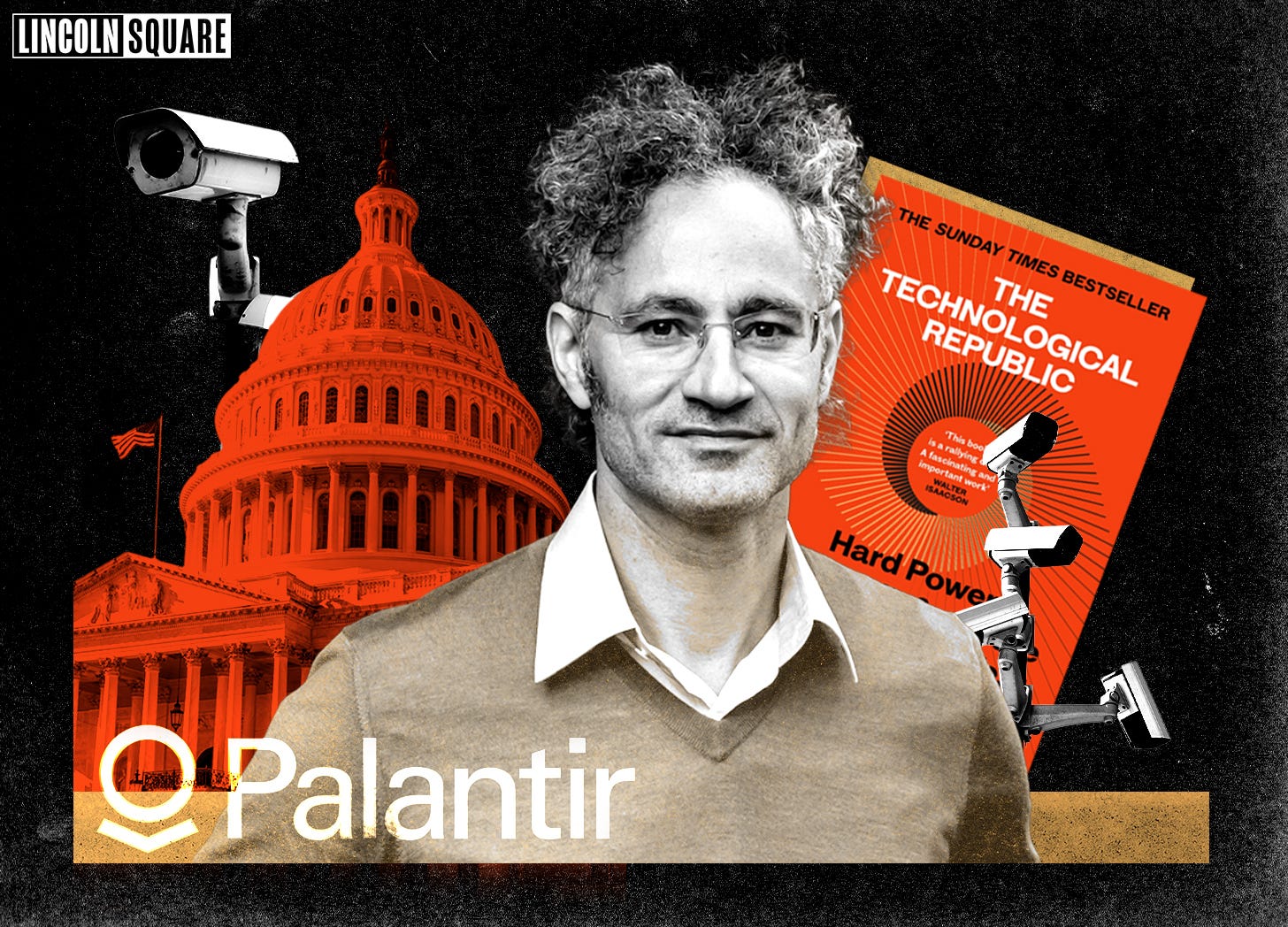
It’s not enough for the broligarchy to have untold wealth. They also wanted political power. Now they have that. And they want to be esteemed as philosopher kings, while simultaneously shielded from criticism. Well, that’s a taller order.
When they roll out their political manifestos, we should take them seriously, if not literally. Public statements by these actors, while often couched in statesmanlike or visionary terms, offer insights into a growing power elite: what they like, what they hate, their enemies, what they felt are entitled to.
These manifestos are relevant for governance, given Silicon Valley’s power via financial resources and platform control, and their embeddedness into government service delivery via grants, tax subsidies and contracts. They are no longer simply contractors, or one more donor class, but a powerful political class onto itself.
For example, when DOGE was announced, your best bet for understanding its purpose and impact was to pay attention to Elon Musk’s anti-government conspiracy ramblings on X, which fueled the elimination of entire agencies. Or Marc Andreessen’s manifesto, which predicted an attack on government services. These manifestos are, of course, riddled with unfounded claims, contradictions and blind spots. Andreessen bemoaned regulatory capture, while embarking on exactly such a program. But even, and perhaps especially, the blind spots are telling.
Some in the broligarchy see themselves as heroic historical figures, the kind of men (its always men) who are on a heroes journey that involves quashing some foes along the way. What if you are the foe? At some point this becomes a sovereignty problem, when the people empowered to manage your government have their own distinct values they are pursuing using the guise of public power and virtue.
How Palantir’s Guardrails Failed
And so we get to Palantir, a tech company that provides support for US government intelligence, immigration, policing, defense, tax preparation, health, revenue collection and logistical functions. Given that range of competencies, they are at the heart of concerns about tech surveillance under an increasingly authoritarian government.
A senior person in the Biden administration assured me that Palantir were seen competent deliverer of contracts. They got stuff done, including with pandemic-era logistics in health care. The company grew under Democratic and Republican administrations, but the billion-dollar contracts and eye-popping stock valuations did not start to arrive until the second Trump administration. They benefited from a fertile combination of massive increases in immigration and military spending, the rise of AI, and the downsizing of the federal government.
The way in which Palantir grew caused unease within its own ranks. A year ago, some former Palantir employees wrote an open letter about the violation of the company’s prior ethical guardrails.
A Code of Conduct was crafted to uphold democracy, preserve the spirit of free scientific inquiry, and ensure responsible AI development. Guardrails were set to prevent discrimination, disinformation, and abuses of power. These principles have now been violated, and are rapidly being dismantled at Palantir Technologies and across Silicon Valley
The company’s leader Alex Karp released a manifesto, which is actually just excerpts of the “The Technological Republic” written by Karp with help from Nicholas W. Zamiska. I’m not going to go through every point of the manifesto (some of which I am sympathetic to), but do want to focus on a couple of big points
Can an Anti-Fascist become a Techno-Fascist?
A takeaway point is that on the whole, the manifesto’s vision of Palantir is that of a U.S. government and its tech allies as dominant players, unconstrained by accountability. This has caused alarm bells to go off. For example, in a series of posts on Bluesky, Cas Mudde, one of the leading scholars of authoritarianism, was blunt:
The Palentir statement on its desired “Technological Republic” is one of the scariest things I have seen in a while. It is a call for a world dominated by an authoritarian U.S., generated by AI (both the statement and the world), run by tech-surveillance companies. Technofascism pure! Clearly, this disqualifies Palentir as a business partner for any other country than the U.S., not just in defense and security related sector but ANY sector — as information is power. European countries should not just start new collaboration with Palentir, they should divest it ASAP! Democrats should develop an actionable agenda of democratic reform in case they return to power. This cannot be limited to institutional refoms, but must include reigning in the power and wealth of technofascist companies and individuals.
Is it possible that the underlying book, with more room to caveat and explain, is less objectionable. Not so, according to John Ganz, who slogged through the whole thing:
The book is extremely creepy: It becomes clear in the course of reading this “Technological Republic” the authors propose is essentially some kind of merger or acquisition of the United States government by Silicon Valley, a state run by an engineering elite that would be empowered to “ruthlessly” pursue “outcomes.” It’s a proposal for a kind of tech oligarchy: “no public “oversight for me, surveillance for thee.” I contend it’s a work of reactionary modernism.
The manifesto makes a straightforward case that government and Silicon Valley power must be fused in order to defend a peaceful and prosperous way of life for Americans. If we pause with AI we are merely allowing our adversaries gain an upper hand:
The question is not whether A.I. weapons will be built; it is who will build them and for what purpose. Our adversaries will not pause to indulge in theatrical debates about the merits of developing technologies with critical military and national security applications. They will proceed.
The manifesto argues Silicon Valley has invested its efforts in frivolities rather than American military capacity — unlike Palantir! Western values, which are superior to others, must be defended with power:
Some cultures have produced vital advances; others remain dysfunctional and regressive. All cultures are now equal. Criticism and value judgments are forbidden. Yet this new dogma glosses over the fact that certain cultures and indeed subcultures … have produced wonders. Others have proven middling, and worse, regressive and harmful. We must resist the shallow temptation of a vacant and hollow pluralism. We, in America and more broadly the West, have for the past half century resisted defining national cultures in the name of inclusivity. But inclusion into what?
“Defending the West” is part of Palantir’s DNA. It was never a company that sought to please consumers, but viewed itself as aligning with U.S. military interests. It also works with Israeli military, extending “the West” to a political rather than geographical concept.
Since “The Technological Republic” was published, Karp has gone from being a partial critic of Trump, to a defender. He once declared his “biggest fear is fascism” and that “I always thought if fascism comes, I will be the first or second person on the wall.” So how is he now a Trump donor? How did an anti-fascist become someone seen as authoring a techno-fasicst manifesto?
One of Trump’s extraordinary skills is to recognize and recruit those whose greed and vanity outstrip their principles, and who are happy to shout righteously for a cause they once abhorred. Deregulation, praise and massive contracts are a powerful cocktail to help you forget your commitments, especially when your supposed allies in liberalism are now critical of you. “Being unpopular pays the bills” Karp told a biographer in response to liberal outrage.
Some speculators think Palantir is wildly overvalued due to a Trump bubble where earnings are way out of proportion with stock price, and have tried to short it. Trump praised Palantir when its stock tumbled recently. Right now, the company’s prospects, or at leasts its stock price and leader’s personal wealth, feel increasingly dependent on MAGA’s vision of the world.
But it is uncomfortable to label yourself a sellout, and so a billionaire anti-fascist write a manifesto about how, yes, they are still defending democracy, and no, they are not working for a fascist. In a thoughtful column, Michelle Goldberg noted that the German politician who was the primary subject of Karp’s dissertation went from being a fascist in the dissertation to a speaker of forbidden truths in “The Technological Republic.” Trump seems to have made the same transition for Karp.
As Palantir becomes engaged in domestic surveillance and immigration enforcement for a government that has repeatedly violated the law, “defending the West” starts to look indistinguishable from bog-standard, right-wing ethnonationalism. As part of a somewhat bizarre critique of his one-time mentor Jurgen Habermas, Karp argued that the structure of public discourse cannot be rational but “must be rooted in a more corporeal and traditional — and indeed national and cultural — source.”
His biographer said that Karp’s views on the West have changed:
Judging by his own words … he does not see multiracial, pluralistic democracy as the thing about the west that should be defended ... he sees it much more as just a collection of countries bound by a shared Judeo-Christian heritage, and, to varying degrees, by an attachment to free enterprise. That’s kind of where he is, I think. And it can lead you down some pretty dark paths.
Goldberg’s profile of Karp notes that at one point his reputation as a Democrat, avowed anti-fascist, and biracial student activist worked well to dampen Democratic hostility to Palantir when they were in power. Now they are not, Karp has more reason to embrace a different version of his identity. Goldberg concludes: “I was left suspecting that the best explanation for Karp’s journey — as for most of his right-wing billionaire compatriots — is the vulgar materialist one.”
Two Types of Public Servants
One striking element of the manifesto is its incoherence. At turns it is assertive and dominant, and at other points wheedling in its pleas for grace and tolerance. But if you make some simple assumptions about who the manifesto is talking about, it becomes clearer.
Let’s take the following points together since they touch on public service:
8. Public servants need not be our priests. Any business that compensated its employees in the way that the federal government compensates public servants would struggle to survive.
9. We should show far more grace towards those who have subjected themselves to public life. The eradication of any space for forgiveness—a jettisoning of any tolerance for the complexities and contradictions of the human psyche—may leave us with a cast of characters at the helm we will grow to regret.
11. Our society has grown too eager to hasten, and is often gleeful at, the demise of its enemies. The vanquishing of an opponent is a moment to pause, not rejoice.18. The ruthless exposure of the private lives of public figures drives far too much talent away from government service. The public arena—and the shallow and petty assaults against those who dare to do something other than enrich themselves—has become so unforgiving that the republic is left with a significant roster of ineffectual, empty vessels whose ambition one would forgive if there were any genuine belief structure lurking within.
19. The caution in public life that we unwittingly encourage is corrosive. Those who say nothing wrong often say nothing much at all.
Again, this is incoherent until you realize that Karp is presenting you with two types of public servants. Civil servants purged under Trump, and the tech elites who venture into government. The former deserve your scorn. The latter — the Alex Karps of the world, the Silicon Valley contractor class — merit your understanding and praise.
Few groups in American public life have suffered more material or reputational damage in the past year than federal civil servants. More than 400,000 employees have left the federal government. For many, they left a dream job, pushed out by people who knew less than they did. They worked under a government where the President declared them to be the deep state, government leaders promised to put them “in trauma” and the President’s supporters often exposed them to harassment campaigns. They were demeaned by bosses who opposed the mission of their organization.
Karp does not have much grace or understanding for this group of public servants. They are overpaid priests. The echo of “will no one rid me of this meddlesome priest?” may not be intended, but its there. As for the claim that government employees are overpaid, generally, white collar government workers are not overcompensated compared to the public sector, and in some cases forego a significant wage premium. We also spend much more money on contractors than employees, so if you wanted to save money ...
Another way to look at this is that billionaires have joined a war on professional administrative class of public servants precisely because of their proximity to formal mechanisms of accountability. Civil servants are sworn to uphold the constitution, report wrongdoing to officials, follow the rules. They are in most respects more accountable than our politicians to ethical and legal requirements, and more difficult to buy off. This makes government slower and more irritating for sure, and puts those officials at odds with the Musks, Andreessens, and Karps of the world, whose vision and interests benefits from reduced oversight and accountability.
I do have some sympathy for the point that procurement processes are unwieldy and political appointees are generally held to a very high standard of scrutiny that often discourages them from participating in government. But frankly, its Democrats who impose those standards, which Trump has abandoned. The Biden administration struggled to get tech elites to join government because of stringent ethical and conflict of interest barriers. The Trump administration has none. Elon Musk made clear that for the chosen few, conflicts of interest no longer exist. New tech hires can stay with their current companies that work with the government.
So the plea for grace for those who enter the public square is not about rules or formal constraints here, but public criticism of power. It has never been easier or potentially more lucrative from the Silicon Valley set to jump into government. The only penalty they face is a social one. While Karp is angry that certain cultures have not been harshly enough criticized, criticism of the consolidation of financial, technological and political power happening in America is off the table.
Public criticism offers one form of accountability. If people violate our laws and norms, should they held accountable? The manifesto’s answers is “yes…for some, not us.” Violent criminals? Yes. Civil servants? Yes. White collar criminals? Well, lets not be hasty? Tech billionaires working for government? That would be “corrosive” for the country.
I’m reminded of the Simpsons character Artie Ziff, Marge’s prom date who later becomes a billionaire. When he asks that Marge not share with others his unwelcome prom night groping, he puts his request for silence in the most virtuous terms possible:

We need to be nicer to the broligarchy …. or risk damaging the entire country.
More seriously, how will future Democratic administrations respond to an organization that might have genuinely valuable capacities, but who is not shy about pursuing a hostile ideological agenda and bristles at the slightest accountability.
National Military Service
Until relatively recently, Palantir was seen as secretive, criticized more for its connections to founder Peter Thiel than anything Karp said. However, the manifesto is presented as that of Palantir, hosted on their website, promoted by their social media. There is no meaningful distinction between the leader, Karp, and the company’s policies, which is an odd thing for a publicly-traded company.
Generally its healthy to separate our sometimes weird personal opinions from the organizations we work for. There is a reason that contractors give money to both party and try to limit their ideological stances. They don’t want their values to chase off business. Once those values go beyond internal guidance for employees, and instead become political manifestos, they demand allegiance or opposition.
For example, should a tech company have opinions on military and foreign policy? The manifesto talks about the need to rearm Germany and Japan. Why? Some at the company surely have opinions on this. Others might different opinions. Thats fine. But why should we care about what Palantir thinks?
Similarly, Palantir calls for national military service. This is a common and unfortunate affliction of middle-aged and older men, akin to an interest in the Roman Empire or World War II. Its simply not something you see many men in their 20s promote for obvious “I-would-prefer-not-to-die” reasons. Charitably, it reflects a sense of a desire for creating shared meaning among the young that the elderly perceive is lacking, or to coerce the elite into sharing the cost of military conflict. Uncharitably, it is the old telling the young how to live and risk their lives.
It is easy to mock Palantir on this. How many of them completed their military service? The may sincerely believe that they are part of the greater military effort via their defense work. Indeed, the Trump administration made some of their executives officers in the Army Reserve. But all of that is beside the point. Why should Palantir have an opinion on this and why should anyone take it seriously?
There are other examples:
The limits of soft power, of soaring rhetoric alone, have been exposed. The ability of free and democratic societies to prevail requires something more than moral appeal. It requires hard power, and hard power in this century will be built on software.
As a statement about foreign power, this seems pretty misguided. The U.S. has dissipated its soft power to an extraordinary degree in a rapid period of time. Are we better off for it? We are, as we speak, engaged in a period of hard power and the public does not seem to like its elements — needless wars and tariffs — or its outcomes — higher prices, weakening alliances.
The problem with the manifesto is that Palantir’s worldview and business model are impossible to separate. A world where soft power has real and lasting impact is simply less profitable for a company like Palantir relative to a world where we blow a lot of stuff up. A world featuring an AI arms race is more profitable than a world with AI regulation. A world where Silicon Valley polices domestic crime is more profitable than a world that constrains surveillance on the public. A world with fewer meddlesome government employees is a world where Palantir takes on the administrative reins of the state.
In each of these cases, Palantir takes a stand that is bravely consistent with its bottom line. In an interview with Wired, Karp says that Palantir has put principles before profits, by refusing to work with China and Russia. But I’m skeptical: how exactly can a tech security firm win contracts from the U.S. government while also working with its primary adversaries? When Palantir gets into a fight with the U.S. government akin to Anthropic’s current battle about the use of Claude for violent or unconstitutional ends, they will deserve them more credit.
When the Subtext Defeats the Text
The subtext of the manifesto here is so overwhelming that the text can barely stand up for itself. For example, when Karp says:
The pervasive intolerance of religious belief in certain circles must be resisted. The elite’s intolerance of religious belief is perhaps one of the most telling signs that its political project constitutes a less open intellectual movement than many within it would claim.
A purely textual interpretation might be that he is commenting on the most powerful man in the world attacking the most visible religious figure in the world. Thats in the news, right? Trump attacks the Pope! A pretty big deal!
But of course, no-one believes that is the intent. Palantir is operating on a series of shared assumptions: that religious intolerance is only a project of the left, despite increasingly open attacks on non-Christian religions from the right; that motivated erosion of individual rights, such as abortions, are not a form of intolerance worth commenting on.
A student who once engaged in Black campus politics now argues that wokeness is a “pagan religion view” inculcated by campuses: “a new religion with sacrifices. Who’s the sacrifice? Me, I’m the sacrifice.” Again, this mix of the powerful preening as victims while blaming woke campuses is bog-standard right-wing fare.
I don’t want to be too critical. Here is a piece of solid advice:
The psychologization of modern politics is leading us astray. Those who look to the political arena to nourish their soul and sense of self, who rely too heavily on their internal life finding expression in people they may never meet, will be left disappointed.
Yes. Yes! YES!
Small problem. Its hard to think of any segment of society that has been more guilty of engaging in this than the techbros. Elon Musk cooked his brain online. Marc Andreessen and others seemingly struggled with being in virtual spaces where their ideas and status were challenged, and rewired their political beliefs as a form of cope.
The Palantir manifesto reflects the worldview not of deep philosophical consideration but of a rotten information environment, one where pluralism and accountability are bad, and coercive power is the necessary and profitable price of freedom.
To what degree should our government endorse and support this worldview?
 | A guest post by
|
Heard Technocracy on it’s the end of the week/lincoln square. Love your contributions.
Palantir is a metastasizing nightmare, and these people in charge as well as their favorite pseudo philosopher and sociopath Curtis Yarvin need to be removed from power immediately. They have no authority or accountability to this nation or its citizens.