


Jill Lawrence is an award-winning reporter and columnist who has covered every presidential campaign since 1988. Subscribe to her Substack, History Keeps Happening.

We’ll never need to wonder whether the Declaration of Independence – or Project 2025, for that matter – had impact. But what about Occupy Wall Street, the Free Staters, Anonymous, and countless other movements with names we no longer remember?
What makes a manifesto take root, and stick around? If you wrote your own, what would it say? Is there a specific recipe for success? And must violence be part of that recipe?
These are questions at the heart of Dan Taberski’s Manifesto, a six-part Audible podcast released this summer. It sounds like a vague concept, but in fact it’s quite specific. It also sounds esoteric – but once you realize what we’re really talking about here, it’s as grounded and relevant as … well… the Declaration of Independence.
“Many creators have attempted, with mixed results, to make a podcast series for our troubled times. Taberski has delivered a masterclass,” reviewer Chloe Walker wrote. “Manifesto” might be Audible’s “best original podcast so far, she said.1
The T-word – Trump – is never mentioned, and the mood is often light, even laugh-out-loud funny, thanks to Taberski’s interviewing skills and sense of humor. But the subtext is unavoidable, especially when he judges absurdist manifestos by tech billionaires like Mark Zuckerberg, Elon Musk, and Mark Andreesen as “bullshit,” and makes the connection to On Bullshit – a 1986 essay by the late Princeton philosophy professor Harry G. Frankfurt, published in 2005 as a 4x6-inch, 67-page hardback.
Bullshit, Frankfurt contends, is worse than and different from lying – closer to bluffing than telling a lie, which involves sharp focus and an inescapable concern about truth and values. “A person who undertakes to bullshit his way through has much more freedom. His focus is panoramic rather than particular,” Frankfurt writes. A bullshitter “is neither on the side of the truth nor the side of the false. His eye is not on the facts at all … he just picks them out or makes them up to suit his purpose.”
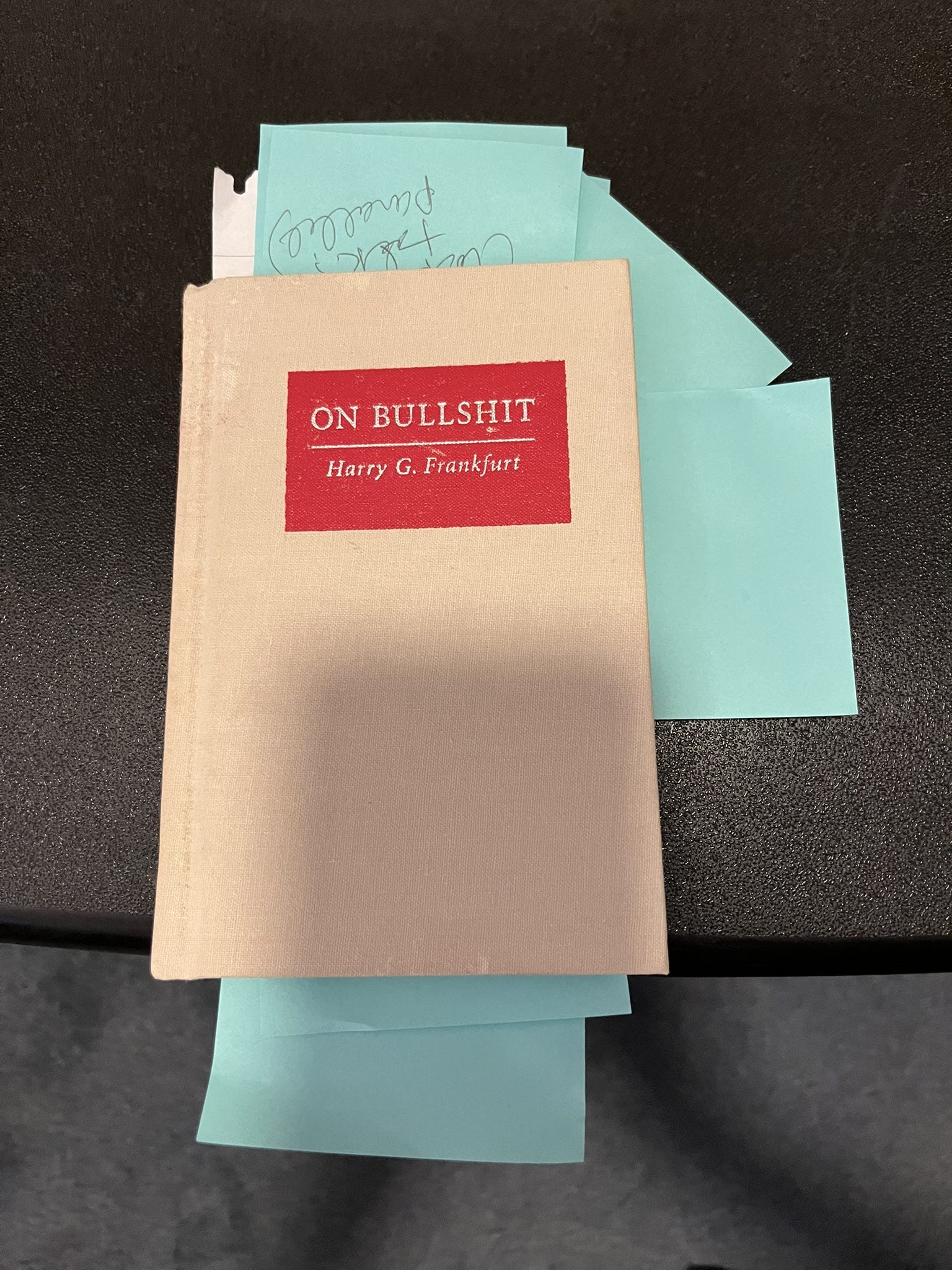
In a C-SPAN clip included in “Manifesto,” we hear Frankfurt discussing what he calls the endgame of the bullshitter: “He’s not engaged in the enterprise of conveying information or in deceiving people. He’s engaged in the enterprise of manipulating opinions, manipulating attitudes and feelings. And he will say whatever he thinks will be effective in that respect, regardless of whether it’s true or false.” He called bullshit “a more insidious threat to our culture, to our civilization, than lying is. Because bullshit encourages … indifference to the truth.”
Exactly. We’ve now reached heights of B.S. and indifference that Frankfurt never could have imagined 40 years ago, or even 20. Here’s a model of understatement straight from his book: “Bullshit is unavoidable whenever circumstances require someone to talk without knowing what he is talking about … This discrepancy is common in public life.”2
Kirby Smart Is a Liar. Does It Matter?

Kirby Smart is the head football coach of the University of Georgia. He’s very good. And he’s also a very public liar.
Free Staters and Unoccupied Wall Street
Most manifestos represent lost opportunities, and sometimes that’s all to the good. In one of the more amusing episodes, Taberski traces the libertarian “Free State” movement from its early 21st century origins in scattered states to its success in getting thousands of people to move to the state they decide they’ll take over and turn into a libertarian paradise: New Hampshire.
Now, it’s true that New Hampshire license plates say “Live Free or Die,” and that it has no state sales or income tax. But it’s not exactly Ayn Rand on the Merrimack. It has favored Democrats for president since 2004, it has elected two Democratic senators, its state House of Representatives is the largest in America (400 members, twice as large as second-place Pennsylvania), and each member represents a mere 3,300 people. That’s a lot of government.
Beyond that, as Taberski covers with admirable good humor, the Free Staters were trying to take over a place where people already lived. That includes emigres from Massachusetts, the liberal bastion to the south.
New Hampshire has a law stipulating that it holds the first primary in presidential years, which is ridiculous and unenforceable. But it did mean that as a presidential campaign reporter, I spent an inordinate amount of time studying the state’s habits and habitat. I found it hard to resist its quirks and beauty, and some of the thousands of free-state transplants from Texas and elsewhere had similar reactions.
Taberski captures that dynamic, as well as the libertarian presence in the state legislature. The Free Staters have representation and influence, but they have also triggered protests and opposition, and fallen short (so far) of the takeover they envisioned. For instance, they were smacked down 323-13 in a 2022 state House vote to secede from the United States.
Occupy Wall Street is another movement examined in “Manifesto.” Taberski looks at how and why it sputtered out – despite seeming destined to take off. Because who doesn’t hate Wall Street? There’s a whole genre of films and books dedicated to villainizing it.
That was especially true when Occupy Wall Street emerged in 2011 in lower Manhattan. The nation was still recovering from the Wall Street collapse and the Great Recession, with its evictions and foreclosures and, for the financial firms that precipitated the mortgage crisis, federal bailouts. And the Tea Party on the right provided a model of grassroots energy to emulate.
So what happened? The key is in an enduring yet futile precept the Occupy originators laid out at launch: Tell us your ideas and what you want to achieve. As Taberski makes clear, this question was still being asked years after the movement began. There was no leadership or direction, no specific demand or goal, and no willingness to work within the system with anyone who is part of it.
The scattershot nature of the movement and its potential for brand dilution, as I put it in a 2011 piece for The Atlantic, was obvious at the outset. Even so, when Taberski asks one of the founders about her ultimate ambition, her response hit me as a real WTF moment. Without giving too much away, let’s just say it was more flower child than wolf-of-Wall-Street tamer.
‘Mad as Hell’ and ‘Queers Read This’
We hear about manifestos associated with violence – Luigi Mangione’s screed against greedy health-care system “parasites,” and the virulently anti-technology Unabomber, Ted Kaczynski. There also are sales-pitch manifestos like Think Different, Apple’s 1997 “here’s to the crazy ones” ad campaign for computers that showed no computers, just a procession of world-changing geniuses.
We hear the classic “I’m as mad as hell and I’m not going to take this anymore” rant from about-to-be-fired anchorman Howard Beale (Peter Finch) in Network. The Anonymous collective that takes on the Church of Scientology (a prank-centric group that devolves into nuttiness and then tragedy). A punk-inspired Riot Grrrl manifesto to lift and protect women. An AIDS manifesto that Taberski describes as “full of fear and fury and exasperation,” blaring “Queers read this!” with an urgent warning that their lives were in danger.
And, of course, there’s that potentially treasonous 1776 declaration, illuminated in Manifesto by Taberski and his interview with Bill Barker, a Thomas Jefferson impersonator who has played the same role for nearly 50 years. “What we had written could be our death warrant,” Barker – in character as Jefferson at Monticello – told Taberski.
That document remains one of the most successful manifestos of all time. It was also terrifying, for the authors and for the colonists bitterly divided over whether, in fact, splitting from Britain was a good idea.
Centuries later, it is the reason we are here as a once and future role model, to struggle, celebrate, and all the rest. Despite our many troubles of the moment, that declaration is still a guiding force — right down to anticipating practically every complaint against today’s regime in its list of grievances against King George III.
As Taberski tours manifesto-ville, to use reviewer Lauren Passell’s coinage, full-blown success stories are rare. For anyone losing sleep over the new national platform from the Democratic Socialists of America — the one with planks like phasing out borders, abolishing the Senate, and replacing the president and Supreme Court with “an executive and judiciary chosen by and subordinate to Congress” — it’s probably safe to relax.
And for anyone planning their own manifesto, Taberski’s 11 bullet points – including get angry, take the leap, and write like you’re an army – are an excellent starting place. The rest is up to you. And us.
1 Full disclosure, this podcast came to my attention because my son, Greg Martin, composed and produced the music for it.
2 Yes, I digress, but what are the chances that my next-door neighbor would own a copy of On Bullshit? It came up in a casual backyard discussion and he immediately went inside, found it, and walked it over. (There is an ebook, as well, of course.)
Thank you for this wonderful article. It seems Mr. Musk is throwing good money after bad in the Texas race. As for the Data Center we have a big billboard here in town against this Data Center. It’s very well done. My neighbors and I are fighting against Data Center’s. It’s my belief once the November elections Trump will be a lame duck president.
Interesting and thought provoking article! I didn’t know about the book “Bullshit”. Somewhere in my random readings of the past, I remember coming across a quote “Bullshit baffling the mind!”.