

Is Trump OK? What He Isn’t Telling the American Public.
When a president boasts about cognitive tests but withholds the results, the question is why.

Brian Daitzman is the Editor of The Intellectualist. Subscribe to his Substack
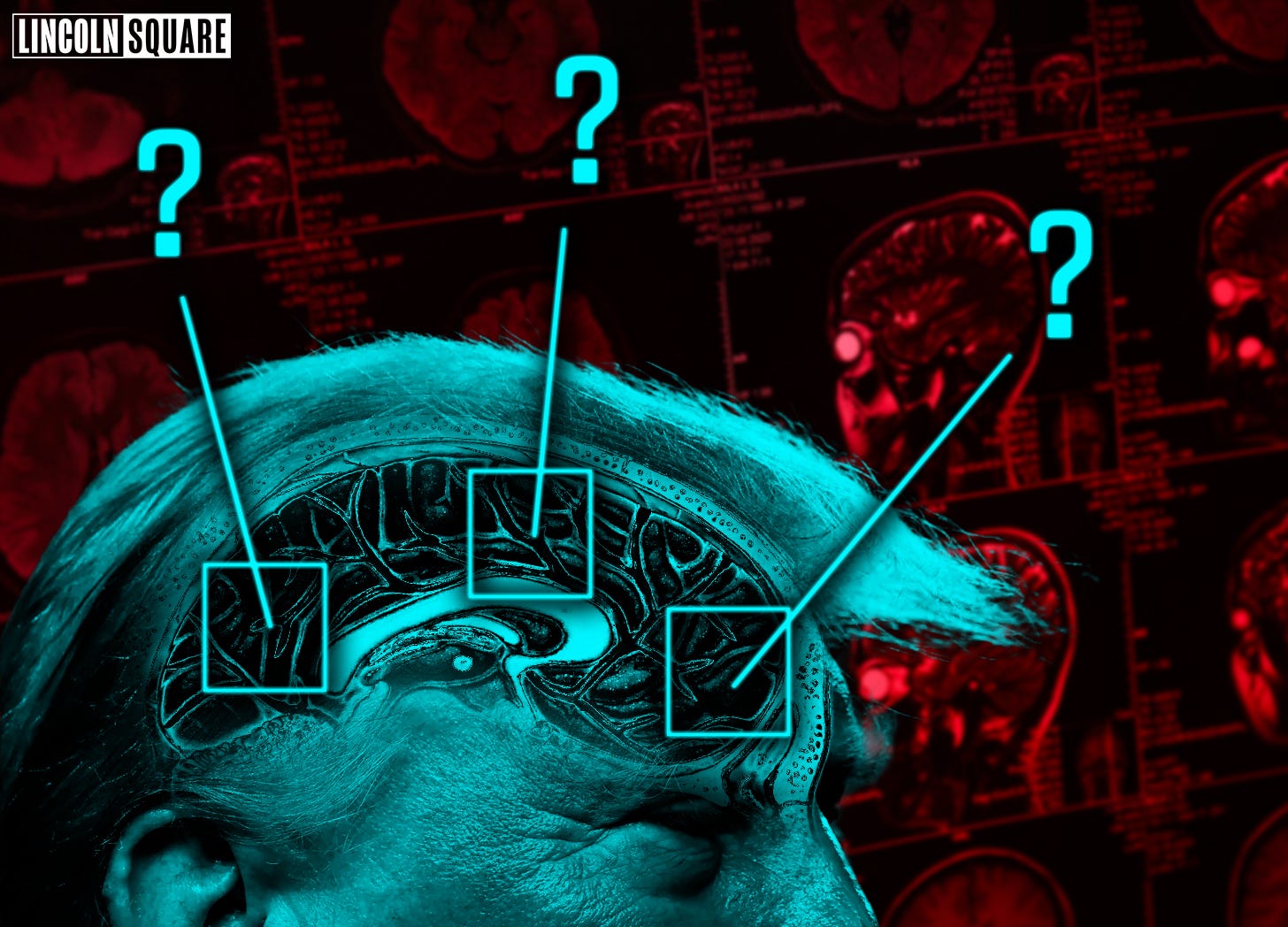
.President Donald Trump repeatedly tells Americans he has taken cognitive exams and passed them easily. He has not released the records. What remains available for public evaluation is observable behavior, a documented history of false self-reporting, and a growing body of expert warnings framed explicitly as risk rather than diagnosis. In the gap between assertion and evidence sits something unusual in modern American politics: a presidency asking for trust while declining the verification that trust ordinarily requires.
President Donald Trump was not asked about his mental fitness. He raised the subject himself.
In a recent Oval Office meeting captured on video, the president shifted from prepared remarks into an unsolicited account of cognitive testing. He said he had taken cognitive exams. He said he had taken them multiple times. He said he had passed them easily. He said he had “aced” them.
He did not identify the tests, the clinicians who administered them, or the dates involved. No medical documentation accompanied the claims. No underlying cognitive test records, serial scores, or clinician documentation have been released publicly at any point during his presidency.
The moment was notable not because cognitive testing would be unusual for a president in his late seventies, but because Trump returned to the subject repeatedly, without prompting and without corroboration. This was not a response to scrutiny. It was a preemptive assertion. It fit a pattern that has now extended across two presidential terms.
Since at least 2018, Trump has repeatedly claimed that he undergoes cognitive testing and emerges fully cleared. He has used these assertions as evidence of exceptional fitness and as a rebuttal to critics. What he has not done is provide the underlying records that would allow independent evaluation.
That absence would matter under any presidency. Under this one, it carries particular weight.
Presidential health disclosure has historically involved discretion and omission. Franklin Roosevelt concealed the severity of his illness during World War II. John F. Kennedy minimized chronic conditions. Ronald Reagan’s cognitive decline was not fully acknowledged until after he left office. In each case, historians continue to debate whether the public was denied information essential to democratic consent.
Trump’s case differs in structure. He has not remained silent. He has insisted. He has repeatedly placed his own cognitive fitness at issue while withholding the evidence that would allow verification.
The pattern began early in his first term. In January 2018, Trump’s White House physician reported that the president had taken the Montreal Cognitive Assessment, a brief screening tool designed to detect cognitive impairment, and had scored within the normal range. Trump immediately characterized the result as having “aced” the test.
 | A guest post by
|