


Brian Daitzman is the Editor of The Intellectualist. Subscribe to his Substack.
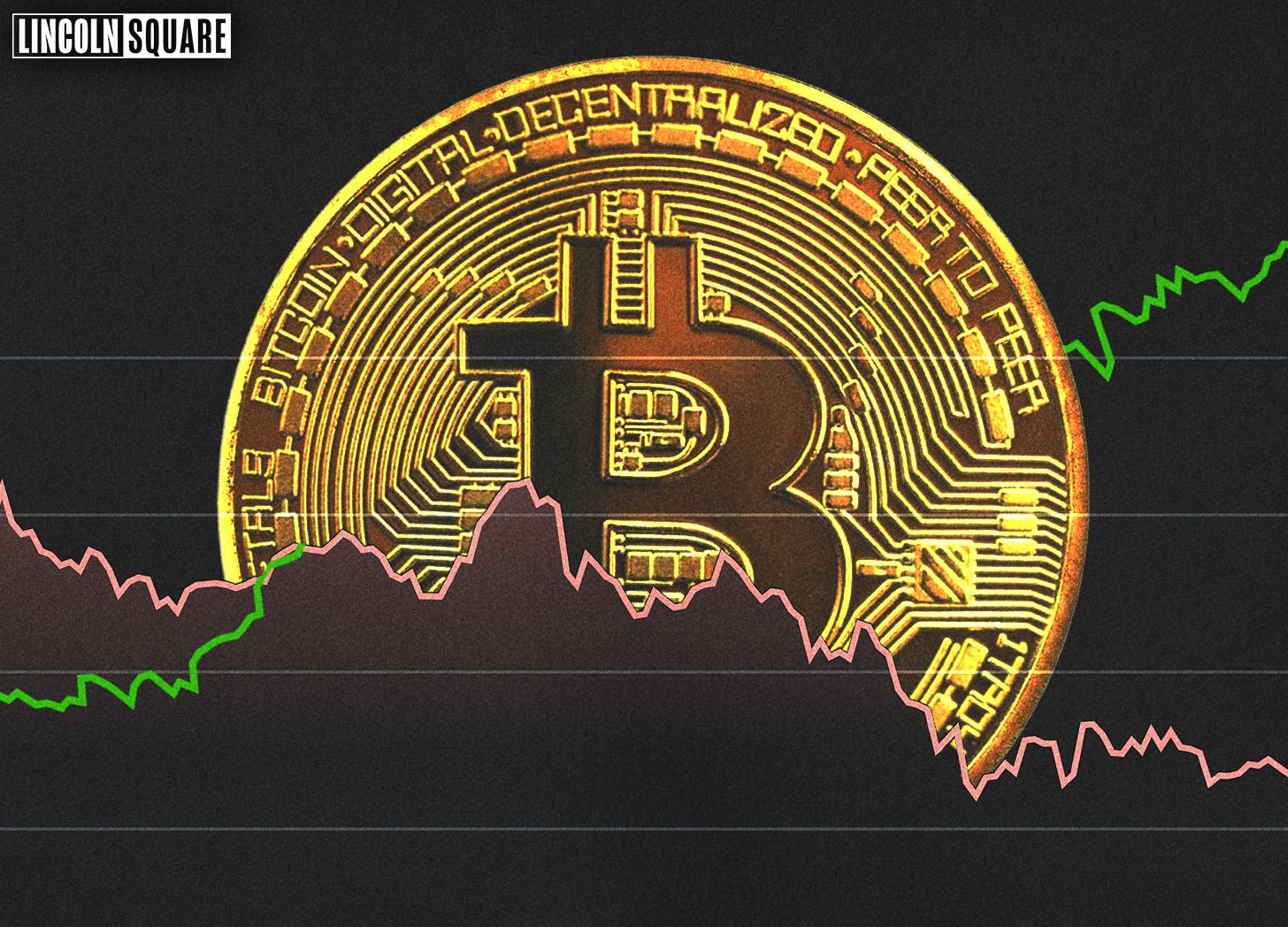
Bitcoin’s recurring crashes revive a question that refuses to die: not how low it might fall, but what it is actually worth. Stripped of price charts and ideology, Bitcoin emerges as an asset with no cash flows, no obligation, no compulsory use, and no anchor outside belief. Many of the critiques it once leveled at fiat currency—dependence on confidence, lack of backing, vulnerability to shifts in trust—apply more precisely to Bitcoin itself, exposing a structural fragility rather than a cyclical decline.
Bitcoin’s latest decline has revived a familiar claim: that it could ultimately go to zero. The statement is often dismissed as alarmist or ideological, but it persists because it is not really a price prediction. It is a structural argument. When Bitcoin falls, the question that surfaces is not how far it might drop, but what, exactly, it is supposed to be worth in the first place.
That question matters because Bitcoin was not introduced merely as a speculative instrument. It was promoted as digital gold, as a store of value, as an asset that would preserve purchasing power and behave independently of traditional financial systems. Those claims implied stability, durability, and some form of anchoring outside of sentiment. Yet in practice, Bitcoin has never traded that way. Each downturn therefore reopens the same unresolved issue: what is Bitcoin actually a claim on?
Recent price action has made this harder to ignore. Since its October 2025 peak above $120,000, Bitcoin has fallen back into the mid-$60,000 range, losing roughly half its value. This decline has not coincided with any widely cited step-change in Bitcoin’s utility, adoption, or underlying functionality. Instead, it has largely tracked broader shifts in financial conditions: tighter liquidity, risk-off sentiment, ETF outflows, and the unwinding of leverage. The price is moving less because Bitcoin itself has changed than because the environment that sustained speculative demand has.
This dynamic is especially visible in mining economics. Estimates of the cost to produce a new Bitcoin vary widely by operator, depending on energy prices, hardware efficiency, financing, and scale. Public estimates range from tens of thousands of dollars per coin to figures approaching or exceeding the high-$80,000 to mid-$90,000 range for some miners. At current prices, a meaningful portion of the mining industry appears to be operating near or below break-even. When prices fall below production cost, higher-cost miners shut down equipment, hash power consolidates, and network difficulty adjusts. None of this establishes a durable price floor. Instead, it introduces another feedback loop in which price weakness creates operational stress, reinforcing volatility rather than stabilizing it.
To understand why this matters, it helps to step back and consider how value normally works in modern finance. Most financial instruments fall along a spectrum defined by their distance from real-world economic activity.
