ICE Is Enforcing Fear because Trump Is Losing Control
U.S. Immigration and Customs Enforcement is not enforcing immigration law. It's enforcing fear.
Evan Fields is a veteran who writes the Fourth and Democracy and Weekly Wrap newsletters for Lincoln Square. Subscribe to his News from Underground Substack.
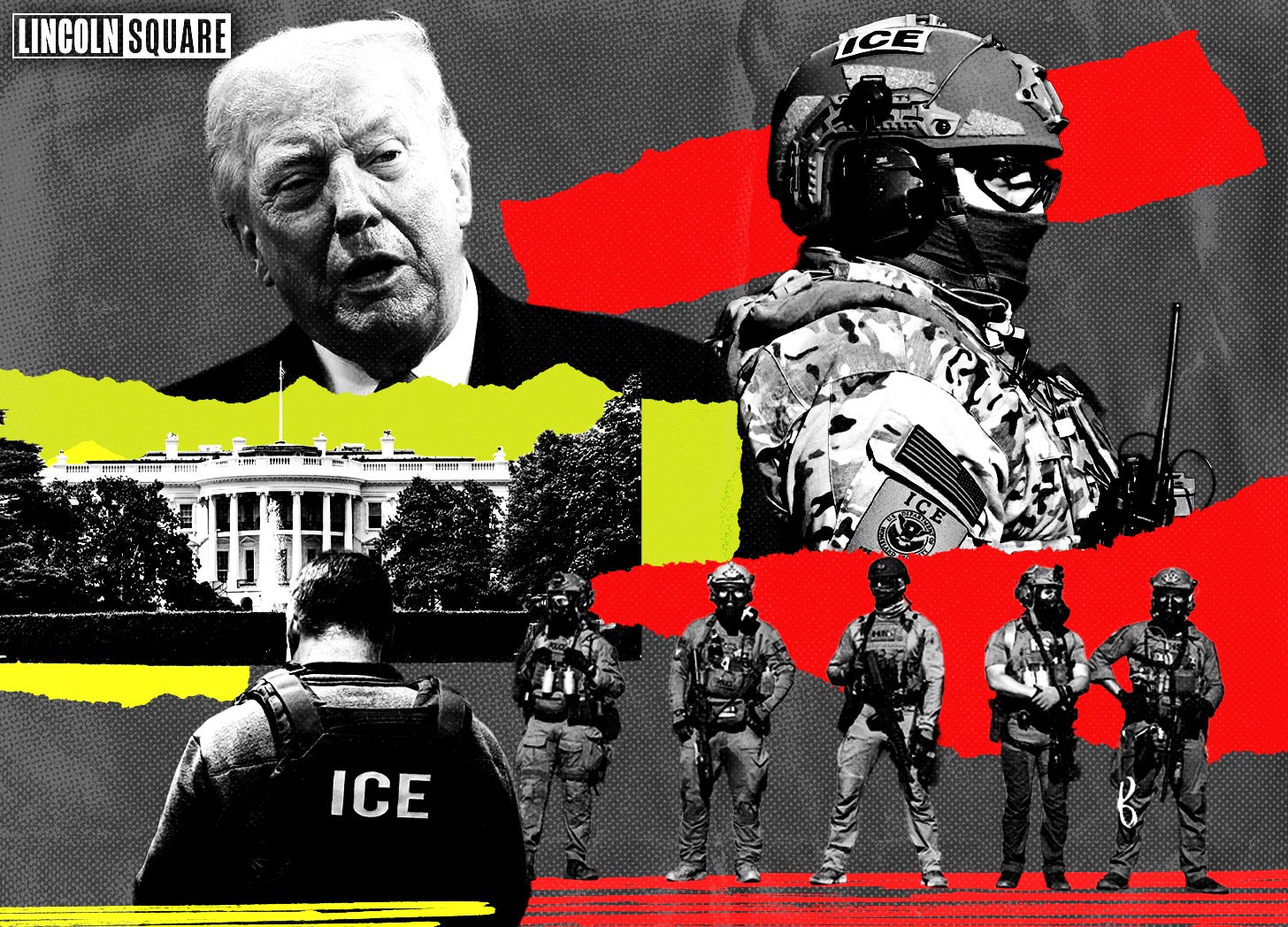
If ICE were a conventional law enforcement agency tasked with border security, it would operate quietly, precisely, and with discipline. It would prioritize warrants over raids, intelligence over spectacle, and accountability over secrecy. Its objective would be compliance with the law, not submission to power.
That is not how ICE operates.
Instead, ICE stages pre-dawn raids, deploys masked agents, resists identification requirements, shields itself from oversight, and treats civilian terror as an acceptable byproduct of its work. These are not incidental failures or rogue decisions made in the heat of the moment. They are structural choices with the intent to produce intimidation over order and enforcing uncertainty over the law.
That is not an agency that has lost its way. But one that has found its purpose — at precisely the moment the regime it serves is losing control.
The mainstream media narrative has insisted that ICE is simply “too aggressive” or “poorly supervised.” We’re told that law enforcement agencies need better training, clearer rules, or updated procedures. This framing becomes politically convenient because it suggests ICE’s violence is accidental — isolated incidents caused by a lack of guidance rather than intent.
You do not accidentally construct an institution that operates with military tactics against civilians, conceals the identities of officers, exercises sweeping discretion, and survives repeated scandals without consequence. Those aren’t glitches in the system. They are the feature.
ICE was built to operate at the edge of the law so fear can do the work that policy can no longer accomplish — especially when any form of political legitimacy is eroding.
ICE isn’t malfunctioning or confused about its mission. Greg Bovino and his boys are operating exactly as designed for a political system that values dominance over legitimacy and intimidation over consent.
Theatrical raids. Public arrests. Pregnant women dragged across snowbanks. Unmarked vehicles ramming nurses on their way to work. Masked agents pointing weapons at civilians. Press statements released before facts are established.
None of this improves outcomes. It amplifies fear. And that’s the point.
Fear only works if it is visible. It must be witnessed, circulated, and internalized. ICE raids are designed to be talked about — in homes, in schools, in workplaces, and in communities already conditioned to understand that safety is conditional on their obedience.
The message delivered by Bovino and his enforcers is unmistakable:
We can take you at any time. And no one will stop us.
ICE Is a Domestic Political Weapon
Its primary function is not deportation efficiency, or even deportation at all. It’s deterrence. Not of unlawful entry, but of civic participation. Fear suppresses organizing, protesting, testifying, reporting abuse, and asserting constitutional rights. It pushes entire communities into silence and invisibility at a time when the regime is most vulnerable.
That is far more efficient than mass incarceration or martial law. You don’t need to arrests thousands of people if millions are already afraid to speak.
ICE enforces that silence for the regime. And once silence becomes normalized, it spreads rapidly.
What makes this moment uniquely dangerous isn’t just what ICE is doing — it’s why they’re escalating now.
As public anger intensifies — over Israel, Iran, Venezuela, affordability, and everything else — protests proliferate, court losses accumulate, and trust in government collapses — the Trump regime faces a familiar authoritarian dilemma: govern through consent, or replace it with fear.
Donald Trump Has Chosen Fear
He has never governed through legitimacy. He governs through dominance and theater. Rage substitutes for discipline. Spectacle for strategy. Loyalty for competence. And when mistakes pile up and any form of legitimacy erodes, escalation becomes instinctual.
ICE’s behavior mirrors that leadership style: volatile, impulsive, confrontational, and increasingly unrestrained.
Institutions adapt to survive and that’s exactly what Greg Bovino is doing. Agencies that persist under this regime learn quickly: escalate, act fast, and ignore consequences. Accountability is optional and your restraint is viewed as weakness.
Authoritarian systems don’t grow calmer as they attempt to consolidate power. They grow more careless as they lose it. Early abuses are controlled and undeniable while later ones become public and chaotic. Violence is less precise. Lies become easier to detect. Errors multiply. Civilians are harmed more frequently.
ICE’s increasingly reckless behavior — including shooting an innocent woman in the face — is not an anomaly. It’s evidence that command discipline is breaking down, intelligence is being replaced by impulse, and the paranoia is starting to override coordination.
This is when danger peaks.
Authoritarianism doesn’t arrive with tanks in the streets. It arrives through selective enforcement, legal ambiguity, targeted fear, and plausible deniability — often wrapped in inflammatory rhetoric the media dutifully repeats (ex: JD Vance and Kristi Noem press conferences).
ICE embodies all four.
It operates in gray zones. It exercises extraordinary discretion. It targets politically vulnerable populations. And when something goes wrong, talking points intensify until responsibility evaporates.
That pattern is not unique to this moment in the United States. History records it with brutal consistency. The branding changes, the uniforms change, the language evolves…
The function stays the same.
This is not an immigration issue anymore. Any government that normalizes masked agents, unaccountable raids, civilian terror, and secrecy as routine governance will inevitably expand that power, and we’re already watching it happen.
First immigrants.
Then protesters.
Then journalists.
Then “extremists.”
Then anyone deemed inconvenient.
ICE cannot be fixed because it is doing exactly what it was built to do — and as the Trump regime grows more unpopular, more desperate, and more paranoid, ICE will grow louder, sloppier, and more dangerous. Every raid, every shooting, every panicked denial isn’t a display of control or strength — it’s a broadcast of decline.
Decline of our way of life. Decline of the regime. Decline of our democracy.
The question is no longer whether ICE has gone too far — it’s whether we are willing to admit why it has — and what we are prepared to do now that the regime has made fear and force its last remaining tools.
It’s time to fight back.
Renee Nicole Good was a mother.
Just like many of you.
She kept stuffed animals in her glove box for her child. She was part of a community. She wanted her neighbors left in peace. She wasn’t a threat. She wasn’t resisting. She wasn’t doing anything wrong.
She was shot in the face and killed anyway.
This has to be the line.
This has to be the moment where you stop thinking in abstractions and start seeing yourself, your family, your neighbors — in someone else.
This has to be the moment where fear stops working on us. Because that’s what they’re counting on. They are desperate. They are panicked. They know what they are doing is wrong and they’re hoping that after a decade of chaos, cruelty, and exhaustion, we won’t have the energy to stand up to them.
They’re hoping we’ll stay quiet.
They’re hoping we’ll stay scared.
But this is the moment where we stop being afraid of what they might do to us, and start demanding accountability for what they’ve already done.
Banning Masked Federal Policing: A Policy Proposal to Restore Accountability in Immigration Enforcement
U.S. Immigration and Customs Enforcement has increasingly conducted public-facing immigration enforcement actions using masked, unidentified agents operating with minimal to zero transparency. This practice undermines public safety, erodes democratic legitimacy, and prevents meaningful accountability and oversight for abuses of power.
This policy proposal establishes a federal standard requiring immigration enforcement officers to visibly identify themselves during public facing operations and prohibits the use of identity-concealing face coverings, except in narrowly defined circumstances. It further introduces enforceable consequences for violations, including administrative discipline, mandatory congressional reporting, and evidentiary presumptions in civil removal proceedings.
The goal is not to weaken immigration enforcement — but to ensure it is conducted lawfully, transparently, and consistent with democratic norms.
The Problem: Anonymous Federal Policing
Across the United States, immigration enforcement agents have increasingly:
Worn masks or face coverings that obscure identity
Refused to provide names or badge numbers when requested
Operated in unmarked vehicles
Conducted raids without visible agency identification
This practice is not standard policing.
In most state and local jurisdictions, uniformed law enforcement officers are required — either by statute, regulation, or departmental policy — to display identifying information precisely so the public can:
Confirm lawful authority
File complaints
Distinguish real officers from impersonators
Ensure accountability for misconduct
When federal agents operate anonymously in civilian neighborhoods, those safeguards disappear.
Why Masked Enforcement Is Dangerous
Accountability Collapse
If a civilian cannot identify an officer, there is no practical way to:
Report misconduct
Pursue internal discipline
Seek judicial review
Anonymous enforcement is enforcement without consequence
Public Safety Risk
Law enforcement impersonation is a documented threat. When federal officers conceal their identities, they make it easier for criminals to pose as agents — endangering both civilians and legitimate officers.
Escalation through Fear
Masked, unidentified agents transform routine enforcement into a psychological operation. Fear becomes the mechanism of compliance, not law. This is especially dangerous in communities already conditioned to avoid contact with authorities.
Erosion of Democratic Legitimacy
Public-facing law enforcement derives legitimacy from transparency. When officers resemble secret police rather than public servants, trust collapses — and with it, voluntary compliance with the law.
Why this Is Happening Now
The escalation of anonymous enforcement isn’t random.
Authoritarian systems under stress tend to:
Lose tolerance for oversight
Narrow discretion downward
Reward aggression over restraint
Substitute intimidation for consent
As Donald Trump’s governing model increasingly relies on force rather than legitimacy, enforcement agencies receive a clear signal: escalate quickly, act visibly, and worry about accountability later (if at all).
ICE does not require explicit orders to behave this way, it responds to incentives:
Silence after abuses
Rhetorical framing of dissent as threat
Leadership that rewards “toughness” over restraint
The results are predictable: faster operations, less verification, more civilian harm.
Policy Solution: The No Secret Police Standard
Executive Summary
This proposal establishes a national baseline for transparent, accountable immigration and law enforcement.
Core Principles
Federal power must be identifiable.
Public-facing enforcement must be traceable.
Anonymity must be the exception, not the rule.
Violations must carry real consequences.
Legislative Proposal
The Visible Identification in Immigration Enforcement Act
Section 1. Title
This Act may be cited as the “Visible Identification in Immigration Enforcement Act.”
Section 2. Findings
Public-facing law enforcement actions require transparency to preserve public trust.
Identity concealing practices impede oversight and accountability.
Anonymous enforcement increases the risk of civil rights violations, violence, and officer impersonation.
Immigration enforcement must conform to constitutional due process and democratic norms.
Section 3. Definitions
Public-Facing Enforcement Action - any detention, arrest, transport, search, or execution of an administrative immigration warrant conducted in a public place or observable by the public.
Covered Officer - any employee or contractor of the Department of Homeland Security engaged in immigration enforcement, including ICE and CBP personnel.
Identity-Concealing Face Covering - any mask or garment that obscures the face in a manner that prevents reasonable identification by the public.
Section 4. Identification Requirement
(a) During any public-facing enforcement action, a covered officer shall display:
Agency affiliation (ICE, CBP, or DHS component), and
A unique, visible identifier (badge number or alphanumeric ID).
(b) Upon request, a covered officer shall verbally state their agency affiliation and unique identifier.
Undercover Exception
Subsections (a) and (b) do not apply during documented undercover operations where disclosure would materially jeopardize officer safety or the operation itself.
Section 5. Prohibition on Identity-Concealing Face Coverings
(a) Covered officers may not wear identity-concealing face coverings during public-facing enforcement actions
(b) Limited exceptions
Face coverings are only permitted when:
Required medical protective equipment is necessary,
Environmental hazards require facial protection, or
The undercover exemption in Section 4 applies.
Section 6. Enforcement and Accountability
(a) DHS shall establish mandatory disciplinary procedures for violations of Sections 4 or 5.
(b) DHS shall submit quarterly public reports to Congress detailing:
Alleged violations,
Investigative findings,
Disciplinary actions taken,
Policy changes implemented.
Section 7. Evidentiary Consequences
In any civil immigration proceeding, evidence obtained during a public-facing enforcement action conducted in material violation of Sections 4 or 5 shall be presumed inadmissible, unless the government demonstrates by clear and convincing evidence that the violation was harmless.
Section 8. Effective Date
This act shall take effect 180 days after enactment.
Anticipated Objections (and Why They Fail)
“Officer safety” — Use badge numbers instead of names. Allow undercover exceptions. Transparency and safety are not mutually exclusive.
“Operational necessity” — routine civil enforcement does not require anonymity. Undercover work is already protected.
“This will weaken enforcement” — legitimate enforcement relies on trust and lawfulness. Fear-based compliance is unstable and corrosive.
Why this Matters
Anonymous federal policing is incompatible with a democratic society. When agents can detain civilians without identifying themselves, power becomes unaccountable and history shows where that leads.
This proposal does not even abolish ICE. It doesn’t prevent enforcement. It restores the basic principle that government power must be visible to the people it governs.
Closing Note
This is what actionable accountability looks like.
If we are serious about resisting authoritarian or fascist drift, we cannot stop at the diagnosis. We have to articulate clear, enforceable standards — and demand that elected officials and government agencies meet them.
This proposal is ready to be shared with congressional staff, cited, adapted by state and local agencies, or used as a baseline for broader reform.
Fear thrives in secrecy.
Democracy requires light.


Anyone deemed inconvenient. Says it all. How and when are we going to be able to rid ourselves of these vermin? Can’t be soon enough.
Write your elected folks right now,this morning, Democrats and Republicans,senators and representatives, and tell them what you want. Copy them on this substack. Share it with friends, and ask that they also contact their elected folks. If they don’t hear from us, they assume that whatever they do or don’t do is fine by us. Masked men with guns terrorizing the population is definitely not American, and must be stopped right now.