


By Binaifer Nowrojee
“I, Too, Sing America,” the American poet Langston Hughes wrote a century ago. “I am the darker brother. They send me to eat in the kitchen. When company comes.” It’s a poem that affirms the dignity of African Americans not as guests consigned to the margins of the nation, but as an essential part of it.
A month ago, standing before the Acropolis in Athens, U.S. Secretary of State Marco Rubio offered a starkly contrasting vision, one that exclusively centers the experience of the white majority. It was a sweeping account of Western civilization as a continuous tradition stretching from ancient Greece and Rome through Christian Europe, the Renaissance, the Enlightenment, and ultimately the American Republic.
He described Athens as the birthplace of quintessential American qualities such as individualism, ambition, scientific curiosity, competition, courage, and excellence, arguing that these traits were passed down through generations of Europeans, and culminated in the United States. They were, he argued, the first to explore the unknown, and create things other civilizations could not. These European descendants, according to Rubio inherited a unique combination of rationality, ambition, virtue, and a willingness to struggle for greatness.
Rubio declared, “The story of our civilization is the greatest story ever known to man.”
His narrative presented Western civilization as an inherited achievement, passed down through a succession of Europeans descendants, while giving remarkably little attention to all other Americans whose labor, sacrifice, creativity, and cultures also built this country.
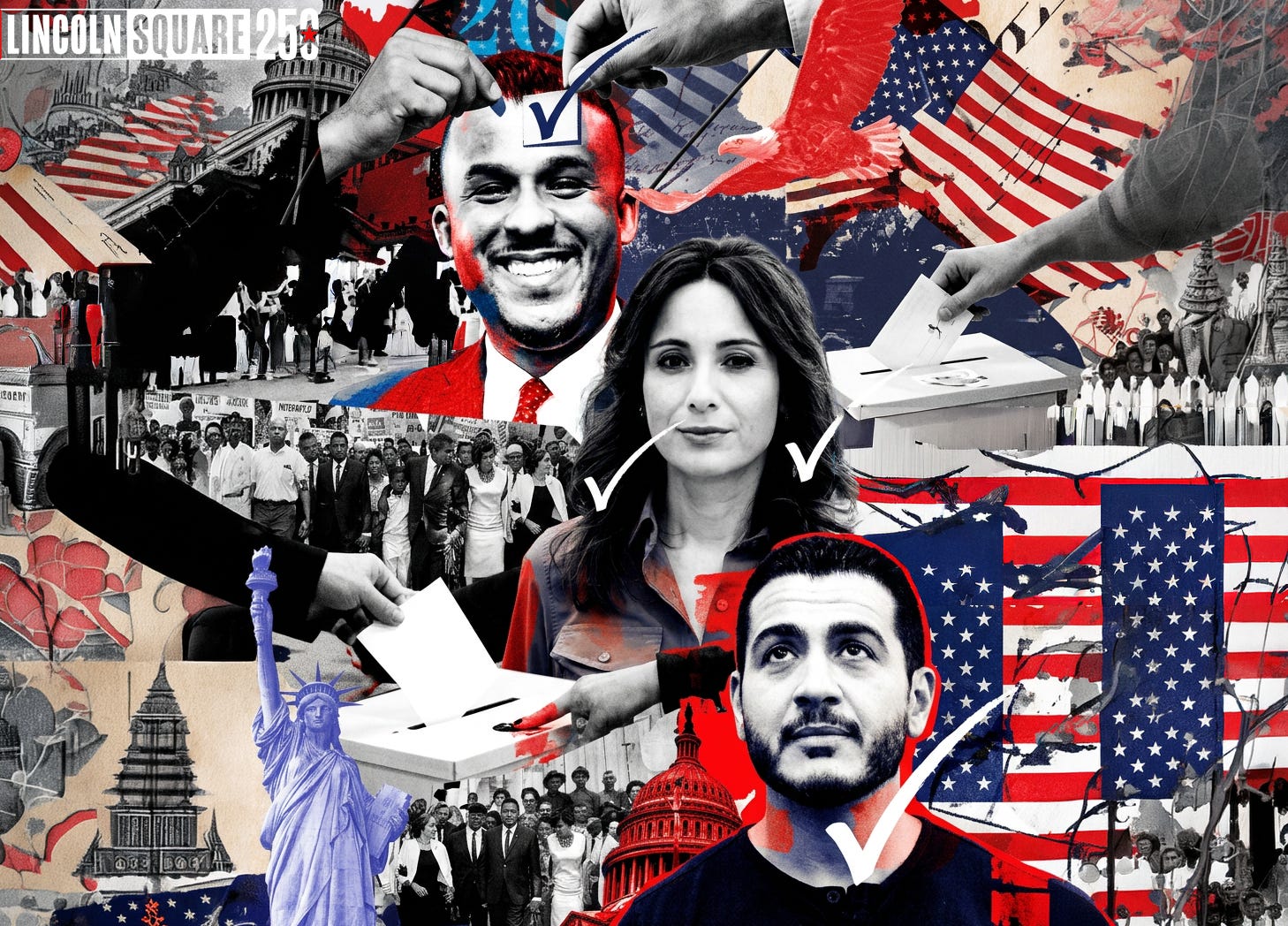
The 2026 midterm elections offered a powerful repudiation of that story. On Nov. 3, American voters delivered a remarkable collection of historic firsts, expanding the representation of people whom the Trump administration has systematically attempted to silence, exclude, or erase from the rooms where decisions are made.
Scott Colom was just announced as the first Black Senator to be elected in Mississippi since Reconstruction 140 years ago. In Georgia, former Atlanta Mayor Keisha Lance Bottoms became the first Black woman elected governor in American history. In New Mexico, Deb Haaland became the first Native American woman elected governor, bringing the history and continuing presence of Indigenous people into the highest executive office of a state.
In Texas, Gina Hinojosa became the state’s first Latina governor. In California, Xavier Becerra became its first Latino governor in 150 years. Ohio elected Amy Acton as its first woman governor, while Minnesota elected Amy Klobuchar as its first. Florida elected Byron Donalds as its first Black governor, Wisconsin elected David Crowley as its first Black governor, and Aaron D. Ford becomes the first Black governor of Nevada. Allison Montgomery becomes the first transgender state lawmaker in Alabama. In Colorado, Melat Kiros is the first Gen Z woman elected to Congress, and a new generation of inspiring leaders in their 30s and 40s will be sworn into Congress this January, propelled by a historic turnout and overwhelming support from young voters.
The Senate also broke historic barriers. In addition to Mississippi, Michigan elected Abdul El-Sayed, who will become the first Muslim United States senator after overcoming vicious Islamophobic attacks on the campaign trail. Minnesota elected Peggy Flanagan, the first Native American woman to serve in the Senate. New Hampshire voters chose Chris Pappas, the first openly gay man elected to that chamber.
Black representatives like Shomari Figures and Don Davis were reelected despite having their congressional districts redrawn in an attempt to redistrict them out of their seats. Black voters across the South turned out to make their voices heard, angered by the Supreme Court’s gutting of the Voting Rights Act and the partisan attempts to reduce the influence of their votes in Congress. And Latino voters in Texas made their disapproval with the state of the economy and cruel immigration enforcement clear, upending partisan efforts to eliminate several Latino Members of Congress.
The U.S. Congress is beginning to look like America. It’s an America where I could see myself represented. These were people who look like me. I came to the United States as a college student from Kenya, arriving at a college in Pennsylvania with a few possessions, not even any winter clothes. I became a lawyer, an American citizen, and now lead one of the country’s largest charitable foundations. This election showed us all how representation matters, and the results came as a source of hope and inclusion.
The midterm results demonstrate that America’s democratic story is bigger than Rubio’s Eurocentric narrative. Representation is a measure of a democracy’s capacity to recognize its people-- all its people. Its institutions and leadership should reflect the different histories, identities, and experiences.
Four False Claims Republicans Are Spouting About Their Crushing Defeat

Edwin Eisendrath is the former CEO of the Chicago Sun-Times and Chicago Alderman who hosts It's The Democracy Stupid on Lincoln Square and a weekly radio show on WCPT820AM/ Heartland Signal. Subscribe to his Substack.
The achievement of the midterms is that Americans from different racial, religious, cultural and generational backgrounds are taking their seats at the table. They are not asking permission to participate in the American experiment. They are rightfully exercising the citizenship that belongs to them. That includes the right to participate, to be heard, to exercise influence, and to have all experiences and histories recognized as part of that collective story. It was a celebration of an American tradition that welcomes people of all backgrounds, a tradition where Americans show generosity toward one another.
We can celebrate Athens without pretending that this nation belongs exclusively to Europeans. We can honor the Founders without forgetting the enslaved people whose labor helped build the republic, the Indigenous nations whose lands became its territory, the immigrants who powered its industries, and the generations who fought to make its constitutional promises real. Democracy’s greatest achievement is not the harkening back to preserve a supposedly superior civilization. It is the capacity to collectively grow from a diversity of contributions.
That is the deeper meaning of the 2026 midterms. The American story is not diminished when more people claim ownership of it. It is strengthened. The next chapter will not be written by those who insist that greatness only belongs to a European inheritance, but by those who understand that democracy grows whenever new voices are welcomed to the table.
Rubio speaks of civilization as a European legacy to be defended. Langston Hughes reminds us that democracy is a promise to be fulfilled, a continuing struggle for inclusion, dignity, and recognition.
Hughes ended with a vision that remains as powerful today as when he wrote it:
Tomorrow,
I’ll be at the table
When company comes.
Nobody’ll dare
Say to me,
“Eat in the kitchen,”
Then.
The future belongs to those who refuse exclusion and insist on belonging. America’s greatness has never come from a single lineage. It has come from generation after generation of people who stood up and said, as Langston Hughes did:
“I, too, am America.”
Binaifer Nowrojee is President of the Open Society Foundations, the largest philanthropy advancing human rights, equity, and justice.
What Scott Colom’s Historic Win Means

Kristoffer Ealy is a political scientist, political analyst, and professor in Southern California. He teaches American Government and political behavior, with a focus on political psychology, voting behavior, and political socialization. Subscribe to his Substack,
the beauty of america is its diversity regardless of what some would otherwise have us believe. langston hughes’ poem, Let America Be America rings true to the america that is. this election truly reflects what inclusion looks like. thank you for shining a light on the diversity that is.
If Rubio's theory is correct, then why did the US surpass Europe in many economic and some social measures? Is it not the diversity and sanctuary offered for those looking for a better life throughout the years and the patriotism it created?