


Kristoffer Ealy is a political scientist, political analyst, and professor in Southern California. He teaches American Government and political behavior, with a focus on political psychology, voting behavior, and political socialization. Subscribe to his Substack, The Thinking Class with Professor Ealy.
There is a concept in fiction storytelling called villain decay. And I need you to stay with me here because this is not a detour — this is the entire map. Villain decay is what happens when a bad guy gets so familiar that the audience stops feeling the danger.
The villain has not gotten weaker. The audience has simply gotten used to him. They have seen enough fights, enough losses, enough dramatic exits, enough “you have not seen the last of me” speeches from a man actively being dragged away by security, that somewhere in their nervous system the threat gets downgraded from existential to annoying. He goes from “this man could destroy the world” to “oh great, this fool again.” And when storytellers feel the audience settling in — when the villain has become less nightmare and more recurring billing charge — they escalate. They introduce something worse. Something colder. Something louder. Something that makes the previous villain look, in hindsight, like a strongly worded letter with a typo in the subject line.
Marvel understood this. Loki showed up in the first Avengers film as a genuine menace — calculating, theatrical, willing to level a city to satisfy his ego. He was also, eventually, a man who kept losing to a guy in a robot suit and a rage monster. By the time audiences had watched Loki fail enough times, he had been quietly reclassified from God of Mischief to complicated family member nobody wants to sit next to at Thanksgiving. So Marvel introduced Thanos — a being whose ambition was so cosmological it made Loki look like a man arguing about a parking spot. Thanos did not want to conquer the world. He wanted to erase half of it. And he had the stones to do it literally.
DC ran the same play. Lex Luthor has been Superman’s villain for close to a century — brilliant, calculating, motivated by a coherent if deeply unhinged ideology. Audiences knew Luthor. They could anticipate his moves. He was dangerous but legible. Then in December 1992, Doomsday came crashing out of the earth with no plan, no ideology, no interest in negotiation, and no ability to be reasoned with. He tore through the Justice League like they were a mild inconvenience and beat the Man of Steel to death in the streets of Metropolis. Not because he was smarter. Because he was incapable of stopping. When it was over, Superman was dead and Doomsday was also dead, which was cold comfort to everyone who had just watched the most powerful being on Earth get punched into the afterlife by something that operated entirely on instinct and destruction.
I am telling you all of this because American farmers need a mirror. In this story, you are not Superman. You are the audience. And you watched the villain decay in real time, got comfortable, and voted for the upgrade. You looked at the guy who wrecked the town in the first movie and decided the real problem was all the people pointing at the wreckage. Then you demanded a sequel. Now the sequel is here, the barn is missing, the soybean market is gone, and somehow you are still arguing with the movie reviewers.
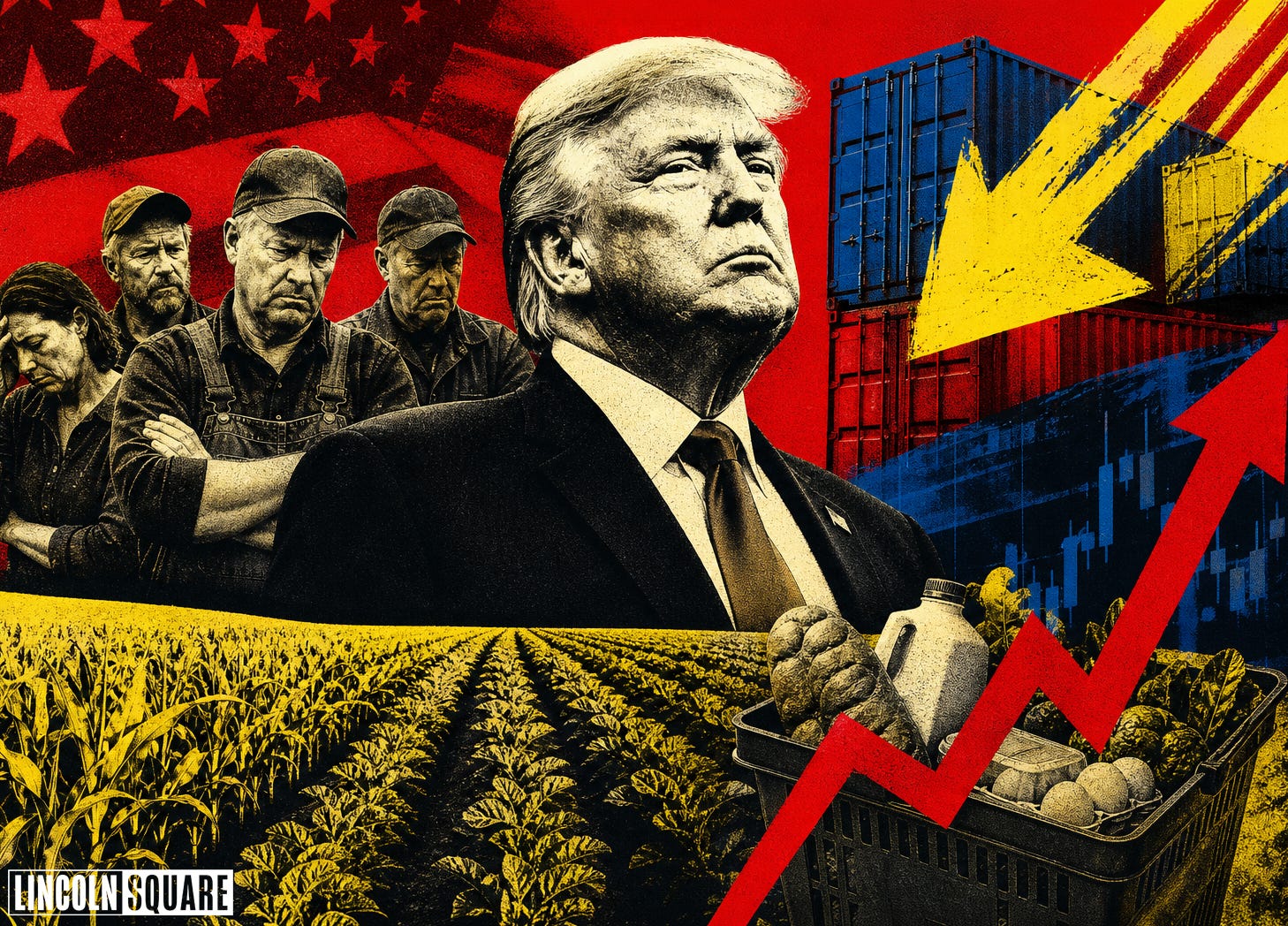
Donald Trump’s first term was Loki. Chaotic, damaging, exhausting, and survivable — but barely. Farmers took a beating in the 2018 trade war with China. The soybean market took a hit. The administration panicked and handed out $28 billion in bailout payments — financed, with beautiful irony, by the tariff revenue that was supposed to be punishing China. China barely flinched, pivoted toward Brazil, and filed the whole experience under “useful information.” But survivable does not mean harmless. Trump still appointed three Supreme Court justices. The effects of his presidency continued long after he left office. The villain never actually disappeared. He was like Lex Luthor between Superman II and Superman IV — absent enough that people stopped thinking about him, but not gone. Just off-screen, waiting for the franchise to make another terrible decision.
