


On the same night former President Barack Obama was headlining a Detroit rally for the Michigan Democratic ticket featuring U.S. Senate nominee Abdul El-Sayed and gubernatorial nominee Jocelyn Benson, the line was out the door for another election event at Walled Lake Northern High School about an hour away.
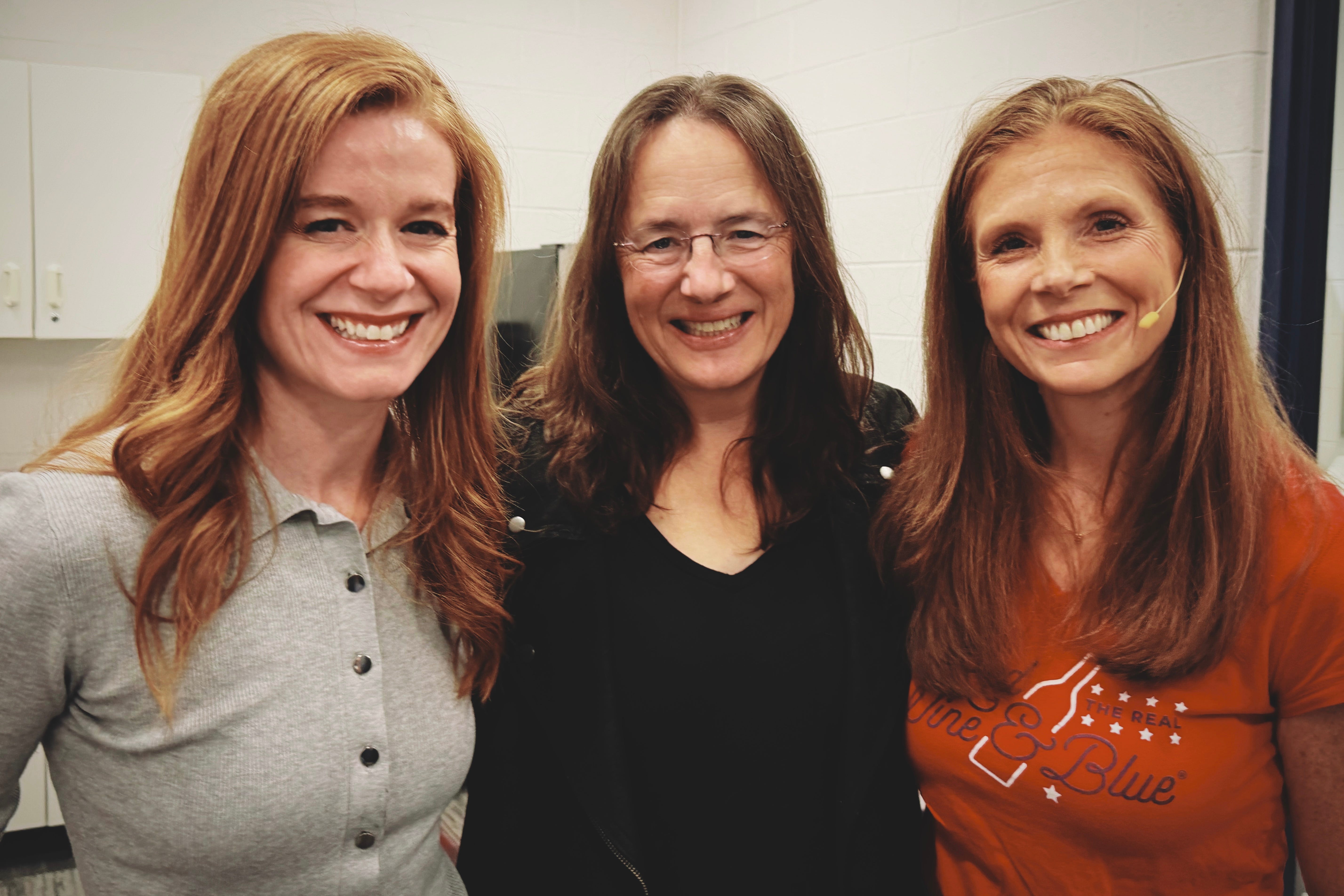
More than 800 people — including buses of voters from Kalamazoo and Grand Rapids — turned out for an evening with historian and bestselling author Heather Cox Richardson, Red Wine & Blue Founder Katie Paris, and Michigan state Sen. Mallory McMorrow, who ran for U.S. Senate this year. Organizers said the Michigan rally might have been the largest event in the group’s history. Attendees pledged to contact over 8,000 people before Election Day.
The atmosphere was festive, with the lobby featuring plenty of voter information, signs like “Good Moms Make Good Trouble,” and Red Wine & Blue swag, as well as a cardboard cutout of Obama attendees could pose with (so they didn’t have FOMO). Before the event started, photos of past RWB events and pro-democracy protests played on screen as Lady Gaga’s “Born This Way” thumped in the background.
Paris kicked off the program by stressing how important the Nov. 3 election is, especially in Michigan.
“The whole U.S. Senate could come down to y’all,” she said.


Before Richardson, Paris, and McMorrow took to the stage, Lincoln Square CEO and Executive Editor Susan J. Demas interviewed them about Michigan’s tight Senate race between Democratic Dr. Abdul El-Sayed and GOP former Congressman Mike Rogers; President Donald Trump’s foreign policy and corruption; parallels to the 1850s, 1890s, and 1930s; the importance of women voters; and much more:
Susan J. Demas: We are a little over a week away from the election. So why are you both in Michigan?
Katie Paris: We are excited to be here in Michigan on the day that early voting starts. We are celebrating democracy, the first time that Michiganders can vote early in person. [Editor’s Note: Michiganders voted in 2022 for Proposal 2, a constitutional amendment expanding voting rights that required in-person early voting and was in place for the 2024 election.]
And our intention tonight is to make sure that not only all almost 1,000 people here make sure to cast their votes in the next 10 days, but that they get tens of thousands of their friends to do that, too. We believe in the power of friend-to-friend organizing at Red Wine & Blue. And we see Heather Cox Richardson and Mallory McMorrow as our friends. So there’s no better people to come do this with.
Demas: Professor, you have a very competitive Senate seat in Maine [between Democrat Troy Jackson and GOP Sen. Susan Collins.] We have one here in Michigan. How are you feeling as we’re going into the midterms?
Heather Cox Richardson: Well, I predict the past, not the future. So I’m not going to take a stand on that. But I want to echo what Katie said. I’m here for the first day of voting. And I’m here for my friends. I mean, this is how we’re doing this. And one of the things that I have found traveling around the country makes it a wonderful thing to be doing is that the American people are taking back their agency and they are reclaiming their democracy. And Michigan is such an important state. Watching the enthusiasm here is just something I didn’t want to miss out on.
Demas: Professor, I know you just spoke with Abdul El-Sayed a few days ago. What was your biggest takeaway? What did you learn the most from him?
Richardson: Well, I find him fascinating. You know, one of the things that the interviews I’ve been doing have been because there is this dramatic change in American politics right now. And I think it’s more than generational change. I think it’s one of those ones that will be marked in the history books the way the 1850s or the 1890s were, for example.
And what I took from not so much the interview I did with him, but from the way he talks more generally, is that there is this really interesting — and this may be way more than weeds than you may want — but there’s this really interesting thing happening around the country where we are watching people in the Democratic Party or associated with the anti-Trumpers rethinking what American political ideology should be. And there’s this really interesting moment where people are going back to the greats, to Lincoln especially, at the same time that they’re applying those principles to the new conditions of modern America.
And El-Sayed is doing that in spades. So it’s just fascinating to watch him talk about immigration and religion and data centers with the language of Abraham Lincoln. I think it’s fascinating. It makes you rethink the entire way people come up with ideology, which I had always thought sort of came from an understanding of political positions and rethinking them. I’m watching it growing organically, and I did not expect to see that.
Demas: Sen.McMorrow, you ran against Abdul El-Sayed. You’ve been there every step of the way trying to support him and the rest of the ticket. How are you feeling at this moment?
McMorrow: You know, I feel good. The biggest takeaway — and I did three canvas kickoffs in West Michigan this morning — I was out in Southwest Michigan last night with supporters of mine who had reached out after the primary to say they were disappointed. But their immediate followup question is: “Will you come and do a fundraiser with us for Abdul?”
And I think exactly to Heather’s point, there is a realigning on corruption versus the rest of us. It is not along a left-right political ideology. It is who is going to tackle these really big systemic issues for us. So I feel like that gives us a tremendous opportunity. But it’s Michigan. I also want to make sure people don’t get burned out. Or people don’t read the polls and get complacent and recognize we have 10 days of work left to do to talk to everybody we know to make sure they have a voting plan and to go out and vote.
Demas: Professor, I was really struck by something you wrote recently, that “everything feels out of whack in the United States.” And you were also talking about how Republicans are peddling “fear porn” right now during this election. Can you talk with us about how Americans can stay grounded amid all of this chaos? And what is your hope about what 2027 might look like if we see some change this election?
Richardson: So small questions. [Laughs]
Demas: [Laughs] Yes, very small.
Richardson: So to be clear, the term “fear porn” …
Demas: … Came from [Fox News host] Jesse Watters, actually.
Richardson: And it was reported by Media Matters. So they’re really a go-to place for that kind of language. So what I meant when I said the country feels out of whack is, as you know, I’m trying to take a snapshot of every day in American history.
If you look at the behavior of the president right now, he’s not OK. And you don’t know what’s going to happen next. And that is, for all that a president is a political and a governmental leader, he’s also a symbolic leader. And you don’t expect to see your president, you know, talking about some senator’s ass. [Editor’s Note: On the campaign trail, President Trump has made repeated comments about the backside of Ohio GOP U.S. Sen. Jon Husted, as reported by USA Today and other outlets.]
I’m sorry, but whatever. There’s that. There’s the economy being as out of control as it seems to be. There’s the fact that we don’t know what’s going to happen with the war in the Middle East. And then there is the extraordinary fact that it appears for the first time in our history that the president has openly sold out to a foreign country.
Demas: Are you speaking specifically about Russia?
Richardson: Russia, yes. And you and I are speaking on the day after the news broke [in the New York Times] about Russian investments in Alaska, liquid natural gas. And I think that just makes people terrified to pick up their phone. You know, what are we going to see next?
And one of the things that I think is so important in this moment is for those of us who care about democracy to hold the guardrails and say, “Listen, many of the institutions are under stress. Certainly the things that are happening to us are bonkers, but there are things we can hold on to.”
We can hold on to voting. We can hold on to our state legislatures, the delegations we send to Congress. We can hold on to our neighbors and to the principles that are outlined in the Declaration of Independence. We have a right to be treated equally before the law. We have a right to equal access to resources. We have a right to have a say in our government.
And if we can hold on to that, I think what we are seeing is, again, what we saw in the 1850s or the 1890s, or the 1930s, the American people, as a whole, waking up, in part because they’re punched by things like diesel prices, and saying, “We’re all in this together against the corruption, against the backroom dealing, against the things that are so badly hurting us.”
And if we do that, we can go into 2027 with the Democrats in control of at least the House of Representatives and possibly the Senate and continue to build that pressure in a way that looks very much like 1975, 1976, where they managed to rein in a president [Richard Nixon] that was out of control. And then once Jimmy Carter was elected [president] in ‘76, most people forget it. But there was actually a lot of extraordinary legislation that passed in ‘77 and ‘78.
Demas: A lot of anti-corruption legislation.
Richardson: And also a lot of social welfare legislation. We get [no-fault] divorce in a lot of states. There’s a lot of stuff that happened. Most people are forgotten now, but that’s what I hope to see going forward. And then we have a presidential election [in 2028], then we have another midterm [in 2030]. And by then, if we all keep our hands down and keep working, we should have a different kind of country.
Demas: Katie, you have helped build a grassroots organization for hundreds of thousands of women. Back in the 2018 midterms, that was a pink wave election. We elected [U.S. Reps.] Ilhan Omar and AOC and [Michigan Gov.] Gretchen Whitmer and a lot of women who have made a difference in this country. What we saw after the 2024 election loss was Democrats seem to be very focused on winning back men, finding their Joe Rogan. Do you think women are being taken for granted by the party?
Paris: I think that women are used to being taken for granted, period, in all walks of life. But you know who talks a lot to men? Women. And you know who actually tends to listen to the women that they trust in their life? It is men and women.
And so … I see women stepping up in ways that are more courageous than ever because they know the stakes are that high. And they understand exactly what is going on here in terms of the distractions, the chaos. We know that they’re trying to burn us out by design.
And we also know that there’s more of us than them. And we know that community is ultimately the antidote to extremism and to all this mess. So we are keeping our heads down, reading Heather Cox Richardson every morning. And then talking to our friends, our family, our neighbors — everyone we know, everyone we meet — to make sure everyone votes in this election.
Because if that happens, we will win.
After our interview, Richardson, Paris, and McMorrow took to the stage and spoke to the crowd about the midterms, early voting, organizing, the Michigan U.S. Senate race, and more.
During the event, Paris referenced our interview and asked Richardson to expound on one of the topics:
Paris: Before this, we were talking backstage to a reporter. And she asked us: “Did we think since the 2024 election there’s been a lot of focus on the men’s vote? And did we think that that meant that women were being taken for granted, maybe underestimated when it comes to politics and influencing elections?”
And, you know, just looking now at the audience here today, [there’s] a lot of women. And a few very good men. What do you have to say to that question to whether or not women are underestimated, women are taken for granted in terms of our role in the political press?
Richardson: So I love this question because I think this is the story that many people have missed, and I would say most of the media has missed. For women of a certain age, we are the first generation of women who had access to reliable contraception, which comes into America in 1965 [with the Supreme Court’s Griswold decision]. That’s really when we get prescriptions for the Pill and IUDs. And has, at least for most of our lifetimes, meant we’ve had reliable access to reproductive health care. That meant that we had the opportunity to join the economy, to get involved in our communities in ways that our mothers did not.
But it also meant that we benefited from Title IX, which goes into place in 1972. And most people think that’s about sports. What that said was that women had to have equal access to educational opportunities that were available to men. And you know what that meant? That meant women went to professional schools, which until then had caps of between one and five percent on how many women could go into those professions, into those professional schools.
So what I think we are seeing now is those women who then went into the workforce in a way that they had not been able to in previous generations and then benefited from the extraordinary strides we’ve had in healthcare since World War II. So we are the first generation of women who have 20 to 30 years [left] after our kids have left home or after our careers have gotten to where we want them to be. And we have skills and we have friends and we have connections and we know what we’re doing and often we have money. And now we have 30 to 40 years to decide what we’re going to do with that, in a way, second life.
And it turns out that what we want to do is save democracy. And I think the fact they haven’t figured it out is our superpower. Because they, you know, I always laugh when I come to these things because, like, you will read, oh my God, this guy on the radical right, he’s got 30,000 followers. And every time I see that I think, “Have y’all looked at Katie Paris’ numbers?”
Paris: Have you looked at Heather Cox Richardson’s numbers?
Richardson: And that’s us, right? So I think it’s our superpower, and I think we should take it out for a spin.
I’m so glad they are putting their heads together, even if just for a photo.
Great job ladies! 👏🏼👏🏼👏🏼