


Don Moynihan is the J. Ira and Nicki Harris Family Professor of Public Policy at the University of Michigan Ford School of Public Policy. Subscribe to his Substack, Can We Still Govern?

Michael Lewis is the most engaging writer about government alive, and he has written a new book about DOGE, Blockers. Elon Musk used the term “blockers” to describe government employees who tried to slow down the changes DOGE was imposing, and directed DOGE foot soldiers to fire them.
The book is important and timely for a few reasons. It comes just as a wave of DOGE revisionism is occurring. DOGErs are written op-eds saying that their approach needs to become the model for government. They are getting rich off the connections they made while undermining the American government. Elon Musk has been invited back into government, to tell the DOD which weapons it should buy (his).
Lewis also helps to provide the raw materials for an answer to a question that I don’t think enough people who want change in government are grappling honestly with: why did DOGE fail?
As in his earlier book, The Fifth Risk, Lewis reminds us that the federal government is full of heroic public servants. He also reminds us that, at a time when there is broad agreement that government has to operate more quickly, sometimes blocking is a good thing. Even when Lewis is simply giving us the inside perspective on what we already knew, that perspective is invaluable, because it asks us to identify with some awful ordeals and dilemmas federal employees went through while trying to protect the public and uphold their oath to the Constitution.
In an excerpt from the book in The Guardian, Lewis described one such blocker, Kathleen Walters at the IRS, and the impossible choices she was faced with. Despite having the letter of the law on her side, Walters left the agency because she refused to participate in illegal sharing of IRS immigrant data led by DOGEr Gavin Kliger. I haven’t read the full book, but this example, which I will excerpt generously, is terrific.
DOGErs Were a Specific Type of Guy
Gavin Kliger turned up at IRS on February 13 demanding agency credentials and access to data. Kliger was at the forefront of DOGE’s crippling of multiple agencies.
He wrote the email telling USAID employees to stop coming into work.
The 25 year old was told his private stock portfolios limited him from working at CFPB, the consumer watchdog, and he needed to divest. He refused but led an attempt to fire 90% of staff. One member of the CFPB Reduction in Force team swore that: “He kept the team up for 36 hours straight to ensure that the notices would go out yesterday…Gavin was screaming at people he did not believe were working fast enough…calling them incompetent.”
He oversaw the cutting of climate grants by USDA.
He was assigned to American General Media, the parent company of Voice of America, shortly before almost all employees on leave.
Kliger was a Berkeley grad whose online posts veered toward anti-immigrant white nationalism. He reposted self-proclaimed Nazi Nick Fuentes, and misogynist Andrew Tate. According to Forbes, he called for military executions of criminal immigrants, and the pardon of Derek Chauvin, the police officer who killed George Floyd. Despite benefiting from an education at perhaps the best public university in the United States, he called for cutting all public funding to universities. He also criticized foreign aid, saying, “Wonder what the kickbacks on this latest grift look like.” Keep that last one in mind.
We can simplify DOGE into basically a) Musk and his inner circle, and b) the foot soldiers. Musk and his inner circle represent the owner class of Silicon Valley and its hangers-on, already enmeshed into a network the foot soldiers desperately wanted to get into. When he joined DOGE, Kliger was on the outer edges of that network, an employee at an AI start-up funded by Andreessen-Horowitz.
Lewis claims that the DOGE foot soldiers like Kliger had a certain type: white, male, middle class, desperate to have Elon’s attention. Many had been rejected from elite institutions and had a chip on their shoulder. They enjoyed their sense of power over experienced government employees who knew much more than they did.
Some combination of those personality traits, ideologies and desire for Elon’s approval led them to do illegal and morally reprehensible things. The Washington Post reports that Kliger and Luke Farritor overrode orders to keep USAID’s life-saving aid flowing. They literally flipped the switches in a kill chain.
Several times, USAID managers prepared packages of these payments and got the agency’s interim leaders to sign off on them with support from the White House. But each time, using their new gatekeeping powers and clearly acting on orders from Musk or one of his lieutenants, Farritor and Kliger would veto the payments — a process that required them to manually check boxes in the payment system one at a time, the same tedious way you probably pay your bills online.
DOGErs Vs. Experienced Civil Servants
IRS officials had some sense of Kliger when he arrived. He was dismissive of and rude to IRS staff, insisting he did not need to go through basic mandated training before accessing data. When he finally relented, you can imagine how uncomfortable it was for the Black IRS staffer who briefed him on privacy issues. Kliger refused to shake her hand, or pay attention during the presentation. From Lewis:
Phyllis, who loved working for Kathleen and saw falling on hand grenades as part of her job, never told her how this one had felt. She knew Gavin had expressed enthusiasm for white nationalists, and he likely knew that she knew. She tried to break the ice by walking in with her hand extended; Gavin stared at it and declined to shake it, though he had shaken the hands of the white men who had offered them. “He was kind of cool towards me,” said Phyllis. Before she could even start the briefing, he said, You know, I’ve heard these rules before at other agencies. Yes, she said, but these rules are different, because no other agency is governed by this privacy law, and this law can get you thrown in jail very quickly. As she walked him through the basics – how you can’t use your personal phone for business, how if you happen to so much as glimpse a form 1040 with someone’s name on it you must avert your eyes – Gavin played on his phone. “He’s multitasking right in front of me, typing and texting,” said Phyllis. “It was, here’s a routine that I must endure.”
One point here is that Black women have gone to federal work in disproportionate numbers, with a primary explanation being that they are selecting into a workforce where hiring and ongoing personnel processes offer strong protection against discrimination. While they represented about 12% of the federal workforce, they represented about one-third of federal employment losses according to one analysis. (I’d like to see more data, but the Trump administration has stopped collected federal employee data on race). Some of this may reflect the focus on eliminating DEI initiatives, but the backdrop of these cuts being driven by a group of predominantly white men, some of who held racist views, is inescapable.
Using Federal Employees to Do their Dirty Work
DOGE made false claims about employee performance in order to fire them, but did not want to put their names to these emails. So they would coerce civil servants into doing so. If the civil servants refused, they were fired. A judge would later find these mass firings of probationary employees were likely unlawful, but did not give them their jobs back.
To get rid of IRS’s 6,700 probationary employees, DOGE told the acting Commissioner, Doug O’Donnell, to fire them via email for unspecified performance reasons. He refused, and was removed from office, to be replaced by Melanie Krause, a career civil servant considered to be more pliable. Kliger then asked the head of IRS human resources, Traci DiMartini, to do the firing.
The Doge people played this trick often. They’d use or try to use civil servants as a kind of ventriloquist dummy so that they, the Doge workers, could keep their names off official documents. But Traci took one look at the email, saw it was plainly a lie, and refused to have anything to do with it. The price of that single act of resistance was her job. Gavin didn’t have the authority to fire Traci, but his new acting commissioner did. “He asked Melanie to fire Traci, and Melanie did it,” said Kathleen.
The DOGE officials knew enough to know that they lacked the power to make these firings, or at least that they did not want to be dragged into lawsuits. And so they put a gun to the head of other public servants to do their dirty work for them. There were no performance reviews, no staffing plans. Just purges at the behest of people who did not understand or care about the damage they were doing.
Again, this was not a one off. As I wrote last year:
HR officials at the National Nuclear Security Administration resigned after they became frustrated at being forced to tell employees, falsely, that they were being fired for performance reasons. The absurdity of the situation was underlined when a Small Business Administration hire was told they were fired for poor performance, despite not yet having worked a single day in the agency. Other employees were fired despite receiving only excellent performance evaluations. It is one thing to lie to the public about what bureaucrats do—and Musk has been doing plenty of that—but there is something deeply amoral about lying directly to individual human beings about their performance.
Trump, DOGE, and an Army of Lobbyists: Why Doing Your Taxes Just Got Harder

Don Moynihan is the J. Ira and Nicki Harris Family Professor of Public Policy at the University of Michigan Ford School of Public Policy Subscribe to his Can We Still Govern? Substack.
DOGErs Knew They Broke the Law, but Pushed Ahead
One of the first things you learn about federal government data is that the IRS data is a) highly valuable, and b) impossible to access without an act of Congress. Whether that is a good thing or not is up for debate, but the law is clear.
DOGErs were told about this law, but did not care. Kliger called a staff meeting to tell IRS veterans: “Every agency has a superpower. The IRS’s superpower is data.”
Everyone in the agency knew that its data was valuable. That was the reason for the strict laws that prevented it from being exploited for profit or political gain. “He said this in a way that he expected everyone to clap when he was done,” said Kathleen. “No one said a word.” The people around the table – a group that included a woman who had worked at the IRS for 54 years, or 53 years and 50 weeks longer than Gavin Kliger – looked down, or away. Kathleen felt embarrassed for Gavin Kliger. But now it was clear what the meeting was about. Gavin wanted, in his words, “to explore how we can share our data with other agencies”. Interestingly, he never once mentioned Ice or DHS. Instead, that week, he sought to share data with himself, by trying to access files detailing IRS contracts with outside consultants that also contained taxpayer information. Kathleen denied him access.
This might be a good time to tell you that after Kliger finished with DOGE he was made the Chief Data Officer at the Department of Defense. The Chief Data Officer.
Kliger was not alone in the thirst for data. Whistleblowers have said that DOGErs exposed Social Security data by uploading it to the cloud, and downloading it on a thumb drive to bring to their new job.
DOGErs and Government Lawyers Lied to Courts
Judges generally assume that when a government lawyer comes in front of them, they will receive honest and good faith answers. This basic trust, called the presumption of regularity, makes court oversight of the government operate more smoothly.
IRS lawyers had told judges that the agency had not shared data with DHS. Then the Washington Post revealed that such data sharing was happening. IRS lawyers went back to the judge and acknowledged they had lied to the court. The judge determined that their sharing of taxpayer data violated the law about 43,000 times.
DOGErs Undermined Agency Missions
DOGE was led by a white nationalist immigrant who hates (non-white) immigrants and many of his foot soldiers feel the same way. Under that worldview, you don’t really think about the second order effects of constructing a police state.
But let’s think this through a little bit. The IRS has data about undocumented immigrants because it allows undocumented immigrants to pay taxes. This matters, a lot, because the numbers are non-trivial. Undocumented immigrants pay about $66 billion a year in federal taxes. They subsidize government services that they often cannot claim, like Medicaid, Medicare, SNAP and Social Security.
If DOGE was interested in cutting the deficit, as it claimed, it would not have engaged in illegal data sharing of immigrants’ identities because doing so has the entirely predictable effect of discouraging immigrants from paying taxes. If DOGE was a white nationalist organization, it would not care about those lost revenues. It did not care about those lost revenues.
Now the Trump administration wants to add a citizenship question to tax returns (and to the Census) to drive those immigrants underground and say goodbye to billions.
If DOGE was interested in cutting the deficit, as it claimed, it would not have cut 1 in 4 IRS employees, and 1 in 3 of its revenue agents and tax examiners. If DOGE was an organization dedicated to protecting wealthy tax evaders, it would not care about those lost revenues. It did not care about those lost revenues.
We are already seeing billions in lost revenues from tax evaders, a figure which is expected to balloon out to hundreds of billions in the future.
DOGErs Destroyed Agency Leadership
For a short period of time the richest man in the world had more power over every government agency than anyone except the President. During that time, he employed a strategy of firing civil servants who told him what he was doing was illegal.
Eventually this equilibrium broke. Musk became unpopular, Cabinet officials were confirmed and some started to resent not being able to run their agencies. But during that window, career civil servants had no one who might be willing to push back except themselves. And the result was that many left government because they could not cope with the impossible choices they were asked to make, and they no longer felt able to resist.
When those people left, a lot of institutional knowledge and ethics left the building with them. IRS became a hollow shell of itself. In April of last year, I wrote about the leadership crisis at IRS:
So: the IRS is on its fifth Commissioner in three months. And no Chief Human Capital Officer. The Acting Chief Counsel was replaced with someone more DOGE-friendly after he resisted DOGE requests for data. Oh, and a few other people resigned after the privacy violations occurred. The Chief of Staff. The Chief Financial Officer. The Chief Risk Officer. The Chief Privacy Officer. The Chief Information Officer and his two deputies.
The situation is not much better now. The IRS is trying to rebuild after DOGE gutted its leadership.
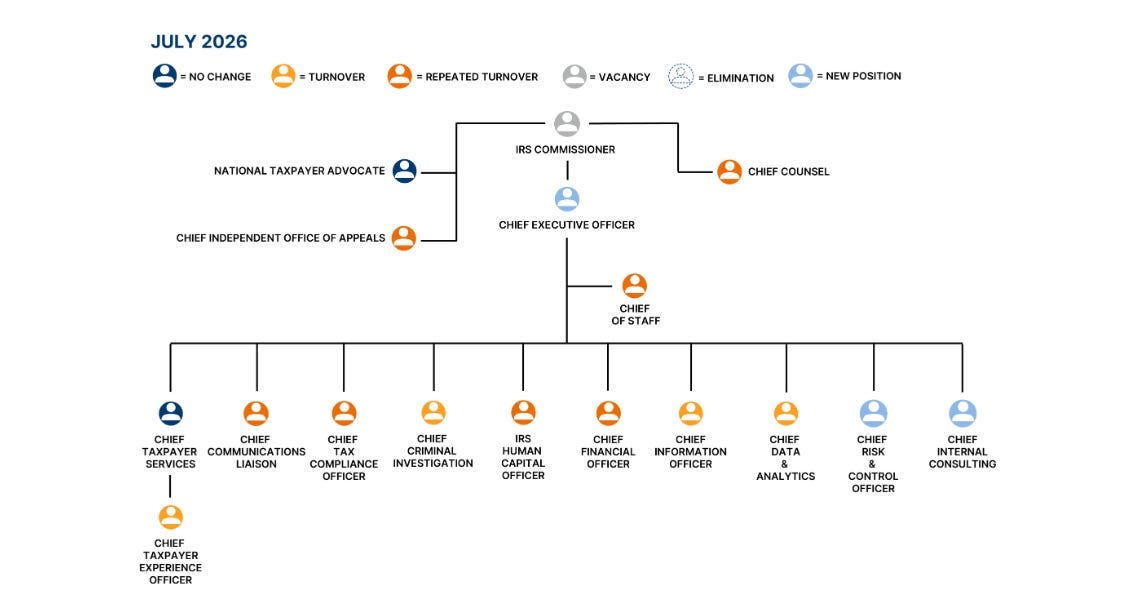
Lewis explains what it was like from the inside. Krause, the acting IRS leader, deputized lower-level leaders to manage the data sharing. But everyone could see this for what it was, and no-one wanted to be left holding the back for DOGE’s illegal actions. The breaking point was a phone call where ICE asked for the addresses of seven million immigrants without going through the standard legal processes for data sharing.
After the call, Julie, the IRS privacy lawyer, came straight to her office. Julie was usually ice-calm – someone who kept her wits about her. She hadn’t a trace of drama in her. But now Julie was not calm. Kathleen, after that call I’m not working on this thing, she said. I’m not coming in tomorrow. I might not come in Monday. I might not come in ever again.
“I don’t usually deal with life or death stuff,” said Kathleen. “But this was life or death stuff. At that moment I knew I had to quit. Either that or I’m going to get fired, because I can’t facilitate something that will break the law and is going to hurt people. We all have boundaries. That was my boundary.”
That weekend, Kathleen sent Melanie a note saying she’d be resigning. “I didn’t need to tell her why,” said Kathleen. “She knew why.” She’d be leaving just weeks before her 20th anniversary with the agency. If she’d waited until mid-May, she would have been able to retire and receive benefits for the rest of her life. But she didn’t want to retire. Federal law made it hard for a retired civil servant to return, and if the day ever came when the IRS was rebuilt, she wanted to be able to return.
DOGErs Are Cashing in
So where is Kliger now? He is one of many DOGE foot soldiers who have used their experience to move themselves closer to the heart of the VC world of Silicon Valley that set up DOGE. Immediately after leaving DOD, he and other DOGErs started fundraising for a security start-up that sees the DOD as a future customer, with funding from Andreessen-Horowitz and Sequoia Capital.1 From the Washington Post, which detailed a wave of DOGE-based start-ups:
The start-ups include a host of firms focused on cybersecurity and defense technology, as well as ventures dedicated to helping businesses across America deploy artificial intelligence tools. Among the largest is Cathedral, an AI-enabled cybersecurity firm, founded by Gavin Kliger and Luke Farritor. Valued by investors at $1.4 billion, Cathedral aims to sell to both corporate America and government agencies, including the Pentagon, according to a person familiar with the business, who spoke on the condition of anonymity because the firm has not made its operations public.
Maybe Kliger’s old boss, Musk, will put in a good word to the Pentagon in his new role advising them on what to buy. As Kliger might say: “Wonder what the kickbacks on this latest grift look like.”
Despite the massive destruction wrought by DOGE, a lot of the commentariat about government still reflexively values the disruptors and denigrates the blockers. Lewis does us a service by providing a stark example of why we need more Walters and fewer Kligers.
The federal government needs employees who believe in the rule of law, and will defend it, even when it costs them their career. But lets face it, the blockers have gotten little support. They have been stripped of the civil service protections provided precisely to help them to defend the constitution. The courts have repeatedly failed to uphold their ability to protect us.
Here is a tangible short-run action to hold DOGE accountable. Lets assume Democrats gain control of Congress in November. There is an existing DOGE subcommittee in the House. Reconfigure it with staff and members able to make it do the job it has failed to do thus far: provide real oversight of DOGE. Run hearings that puts former DOGE members under oath. Call whistleblowers the DOJ has ignored. Call the “blockers” Lewis wrote about and other witnesses to abuse. Create public salience and a record that will lay the groundwork for criminal investigations in 2029. Establish credible signals that they won’t get away with it.

How to untangle. . . . . The capacity for humans to destroy is immeasurable.
Gavin Kliger needs to be doxxed relentlessly.