


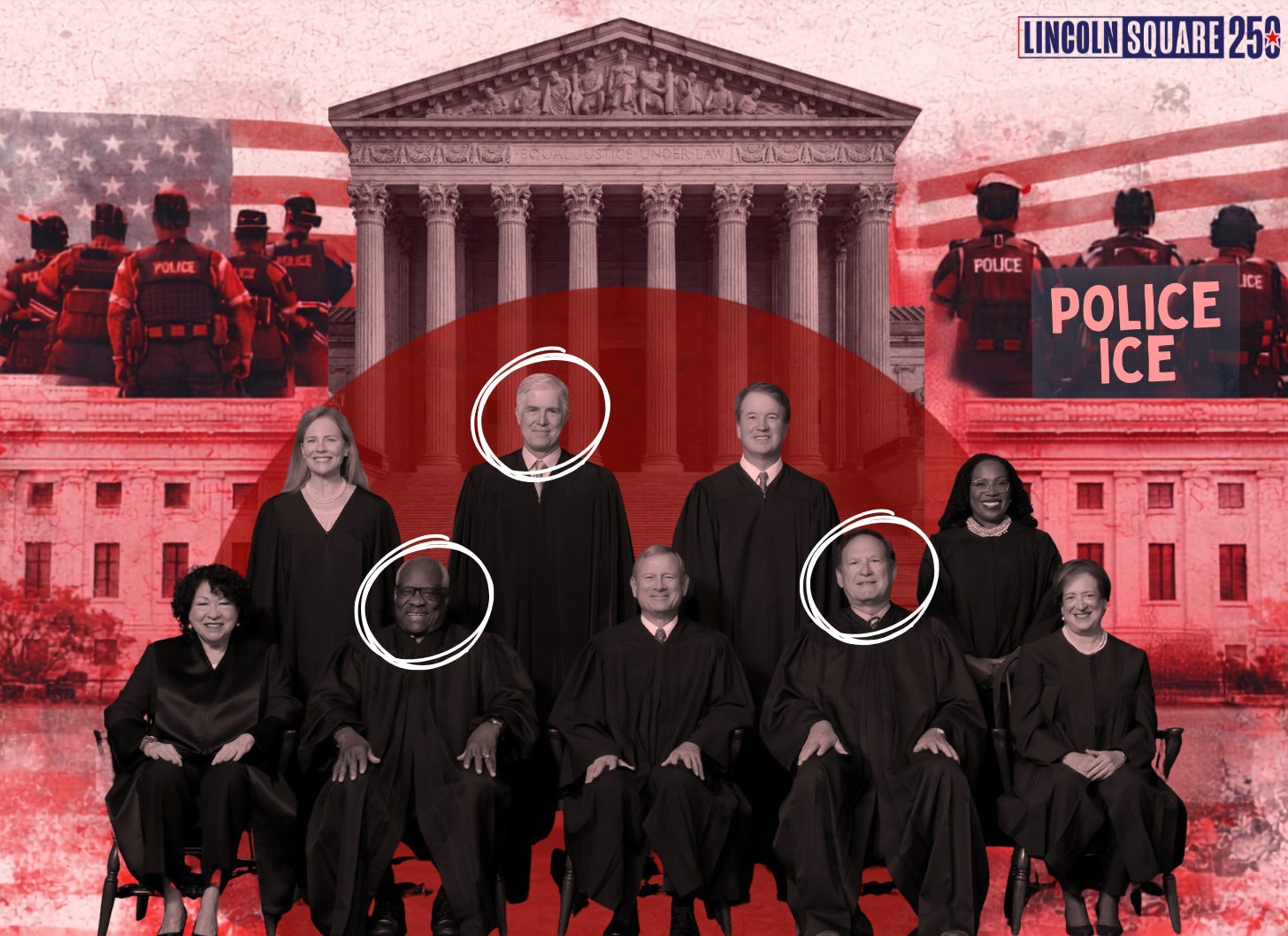
On Tuesday, the Supreme Court ruled 6-3 that babies born on American soil are, in fact, Americans. Read that sentence again. In the Year of Our Lord 2026, the highest court in the United States had to decide whether babies born here are actually Americans. Not immigration policy. Not asylum law. Not some hyper-technical fight over visa categories that requires three law degrees and a bottle of bourbon to decipher. The question was whether a baby, delivered in an American hospital by an American doctor, taking its first breath on American soil, gets to be an American citizen.
Six justices said yes. Three said no. I suppose I am expected to celebrate because the alternative was a constitutional catastrophe with no visible bottom. Fine. I’ll take the win. But if your democracy needs a 6-3 Supreme Court decision to establish that babies born in America are Americans, you are not watching a triumph. You are watching a five-alarm fire that happened to stop one house short of yours.
Birthright citizenship is not some fringe legal theory somebody dreamed up in a group chat. It is textbook constitutional law, settled by the 14th Amendment in 1868 and reaffirmed by United States v. Wong Kim Ark in 1898, when the Court held that a man born in San Francisco to Chinese parents who were legally barred from ever becoming citizens themselves was, nonetheless, an American by birth. That ruling is 128 years old. It survived two world wars. It survived Japanese American internment camps, where children born to parents locked up by their own government were still recognized as citizens, because the Constitution did not have an asterisk for convenience. It survived the entire Trump first term without anyone seriously trying to overturn it in front of the Supreme Court. And then, on his first day back in office for what I will keep referring to as his second non-consecutive term because accuracy matters, Donald Trump signed an executive order trying to unilaterally rewrite what “subject to the jurisdiction thereof” means, and instead of getting laughed out of the building, it took a sitting president attending oral arguments and 128 years of settled precedent to produce a bare-minimum majority.
Had Clarence Thomas, Samuel Alito, and Neil Gorsuch gotten their way, every maternity ward in America would have become an immigration checkpoint. Every birth certificate would have come with a paperwork audit, and not just for undocumented families, but for anyone who looked like they might require “additional verification,” which in America has never been administered with anything remotely resembling equal enthusiasm. The result would have been a bureaucratic nightmare entirely of the Court’s own making: children born here but citizens of nowhere because their parents’ home countries follow different citizenship rules, hospitals forced into the immigration business, and states cobbling together fifty different interpretations of who counts as an American depending on which side of a state line a delivery room happened to sit. And because Trump’s executive order only applied prospectively, the legal theory underneath it came with no logical stopping point. Once you accept that the government can decide babies born here are not citizens today, you have already accepted the premise that it can decide someone born here yesterday is not a citizen tomorrow. That is not judicial restraint. That is not constitutional originalism. That is three Supreme Court justices looking at 128 years of settled law and saying, “You know what this country really needs? A citizenship department run like the DMV.”
So here is the math. Chief Justice John Roberts wrote the majority opinion, joined by Justices Sonia Sotomayor, Elena Kagan, Amy Coney Barrett, and Ketanji Brown Jackson. Brett Kavanaugh concurred in the judgment on statutory grounds rather than constitutional ones, which is its own brand of judicial “I’ll explain myself later.”
Then there were the three: Thomas, Alito, and Gorsuch. Three Supreme Court justices who looked at a baby born on American soil and thought, “Well … let’s workshop this.” Not three guys yelling into Facebook comment sections. Not three conspiracy podcasters with microphones and merch. Three people with lifetime appointments, black robes, and enough constitutional authority to alter the legal status of hundreds of millions of people, all apparently convinced that a 128-year-old constitutional settlement deserved to be tossed into the wood chipper because the current occupant of the White House showed up with an executive order and a wish list. If your judicial philosophy can be shaken loose by a president who has been back in office for five minutes, you do not have an interpretive method. You have the constitutional backbone of a wet paper straw.
Clarence Thomas’s dissent is one of the great ironies in modern constitutional law. Born in 1948 in Pin Point, Georgia, a Gullah-Geechee community founded by formerly enslaved people, and raised by his grandfather in a home that lacked indoor plumbing for part of his childhood, Thomas has built an entire public identity around the American bootstraps story. Yet that story runs directly through the constitutional settlement he just tried to narrow. The Fourteenth Amendment is not some academic abstraction in Clarence Thomas’s life. It is the reason his family’s freedom, citizenship, and legal standing exist as settled constitutional fact rather than perpetual debate.
