


Don Moynihan is the J. Ira and Nicki Harris Family Professor of Public Policy at the University of Michigan Ford School of Public Policy Subscribe to his Can We Still Govern? Substack.

Last week, the Trump administration held a big event, featuring Trump, his Cabinet, and Big Balls to unveil America.gov.
What is America.gov? Two answers.
As of today, it’s a chatbot that searches government websites and collates the answer using Grok and Gemini AIs.
It is the type of tech achievement that might impress someone who does not understand the challenges and opportunities for tech in government.
Unfortunately, answer #2 is reflected in a lot of the media coverage, some of which just mirrored the Trump administration press release.
Here is an excerpt from a piece in the Wall Street Journal:
The goal is to provide a single, streamlined platform, Gebbia said during a preview of the America.gov launch for The Wall Street Journal, rather than leaving individual citizens to navigate myriad agency websites on their own. He said the technology will link and make all federal information immediately searchable online. “You search,” he said of the kinds of tasks that eventually can be started and finished at America.gov, “and you never go back into the maze.”
“It’s reorientating this notion that you have to do the work for the government to figure out what the entry point is,” he said. “We turn the whole thing around, and now the government orientates itself around you. You tell us what you need, and the government goes and gets it done for you.”…“Instead of the burden being on the citizen to go knock on every agency’s door to try to get the answer,” Gebbia said, “they just come here.”
As someone who has been writing about using tech to reduce administrative burdens, this sounds great. But again, I suspect if you take whatever AI you use at home, but tell it to rely on credible government sources, you will get similar results.
Mikey Dickerson, the founder of the U.S. Digital Service, offered the only critical perspective in the WSJ piece, saying:
It’s the first idea that everybody has…I hope somebody notices if they promise the moon and stars, but then come up with the same half-broken thing everybody has done before.
Who Is Joe Gebbia?
Gebbia, quoted above, is the head of the National Design Studio, which built America.gov. (Big Balls is the lead engineer at the NDS). Gebbia is also the co-founder of Airbnb. And a white nationalist. And presumably super-charming because journalists who profile him never bring the white nationalism thing up!
Trump's Chief Design Officer Just Boosted the John Birch Society

Don Moynihan is the J. Ira and Nicki Harris Family Professor of Public Policy at the University of Michigan Ford School of Public Policy Subscribe to his Can We Still Govern? Substack.
Is America.gov reliable?
People had fun asking America.gov questions related to Trump’s policies, when the answers often contradicted Trump’s claims. They also pointed out that a lot of the images from America.gov came from other countries. This one is from China, for example.
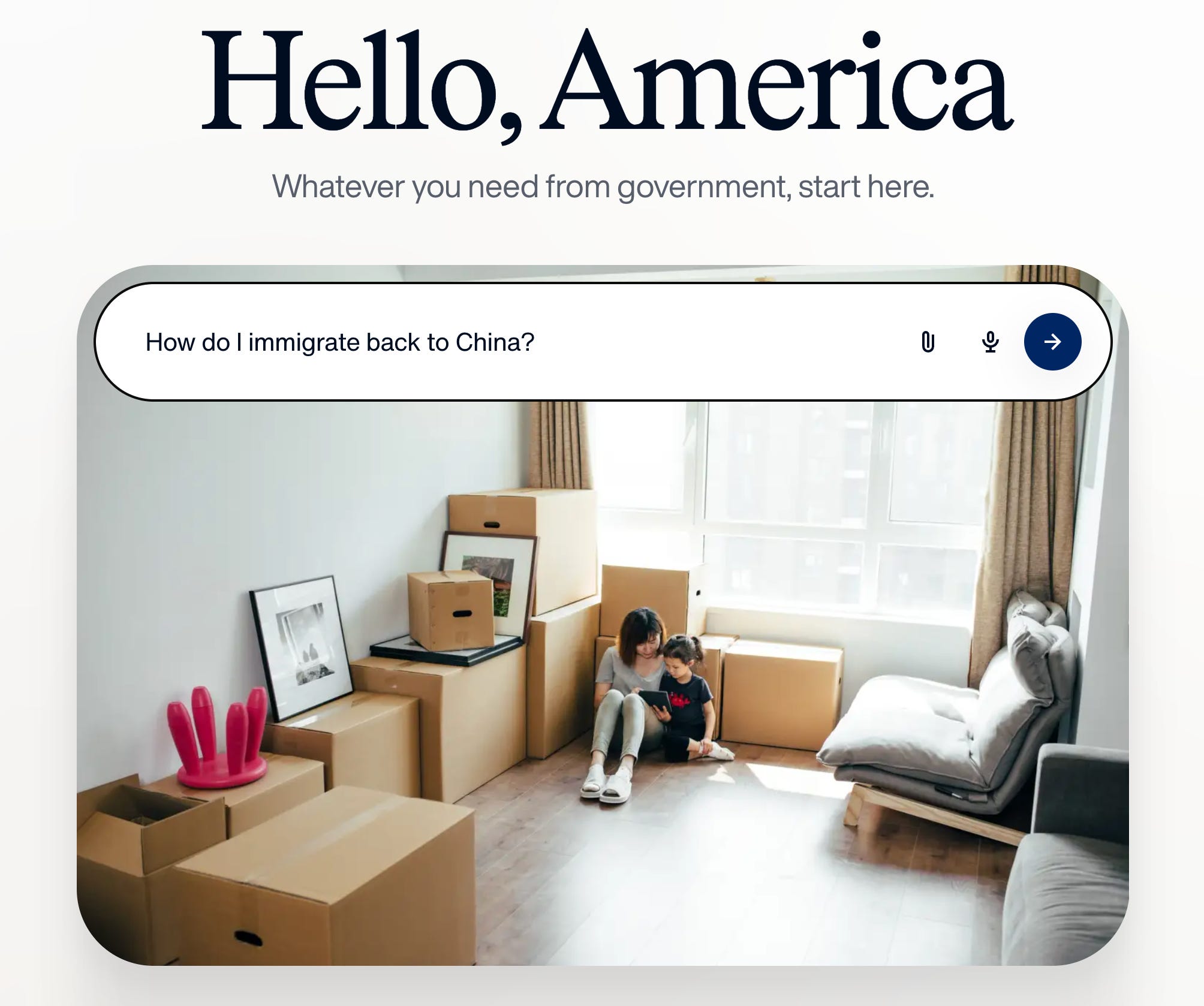
When I ran some queries, I found the site basically reliable, unwilling to comment on some political matters, and connecting to credible government sources. In other words, at first glance it is not regurgitating Trumpian talking points.
But…as the Trump administration changes the government websites that provide the source material, America.gov will become less reliable. For example, when Professor Dan Drezner asked if vaccines cause autism, he did not get a useful response because the CDC under RFK Jr. no longer provides reliable scientific information.
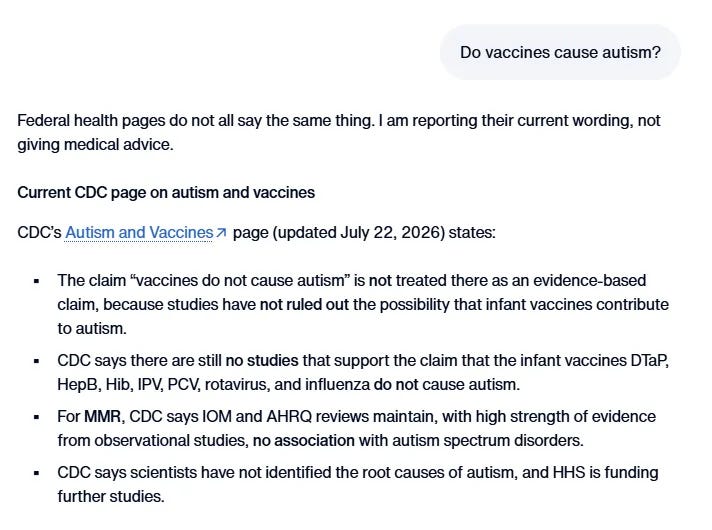
The response was not an outlier. A doctor who asked a series of health questions of America.gov concluded “Use it to find forms and deadlines. Take your health questions to your healthcare provider.”
This is important, because if the website becomes viewed as partisan or lacking credibility, half of the people in America become less willing to use it, and future governments will drop it.
Is America.gov useful?
As it stands, America.gov helps to reduce learning costs (finding out about services, if you can apply, what’s involved), but not compliance costs (actual paperwork including verification of identification and documentation to establish eligibility). The chatbot can also tailor the answers to your particular situation if you provide it with relevant details.
That’s not nothing, but it’s far from everything, and it is far from what is being promised.
A friend of mine from Denmark DM’d me to say, “Denmark got this in 2007.” But the truth is, we still don’t have what Denmark had in 2007, which was a central platform by which you could access and engage all government services. America.gov is not connected to Login.gov which is the federal government’s primary means of identifying people who seek services. That feels like table stakes for building something more serious.
The Trump administration promises that more will come soon to America.gov, including Medicare enrollment and passport applications. Good! But building that functionality is a much bigger challenge than anything the National Design Studio has pulled off so far.
A standing criticism of the National Design Studio is that it focuses on “skins” versus services, overlaying pretty web pages onto services, but not making those services easier to access. One conservative commentator said “the website represents one of the more compelling partnerships between MAGA and Silicon Valley — not least because bureaucracy is nowhere to be seen.” Yes, that’s sort of the problem: you actually need to deal with the bureaucracy to make the services work. Otherwise its’s just a pretty website.
Marina Nitze wrote the most thoughtful thing I’ve seen about America.gov, drawing on her experience building what is probably the best existing digital front door in government which is VA.gov. An abbreviated version of her comments are below. The basic point, again, is that a nice front door doesn’t build the house behind it.
I know a thing or two about front doors, including: if your goal is to simplify peoples’ interactions with government, the front door is not the problem and won’t be a solution.
The idea of an AI-based government interface makes perfect sense. People are already talking with their preferred AI agent about whether they qualify for benefits and sending it to apply on their behalf. But here’s what I learned from building one of the most successful government front doors thus far: Veterans can finally apply for everything in one place, but they still didn’t reliably know that going through a VA disability exam doesn’t enroll them in VA health care. They still wait longer than they should for benefit decisions, and decisions are still made via a byzantine maze of backend systems with different, often conflicting criteria and definitions that make them ineligible for other benefits.
An easy-to-use front door doesn’t solve that, and neither does its AI equivalent.
The work that would make America.gov a great success is the underlying, unsexy work of governing, including:
- documenting every program’s eligibility criteria in one format, at every layer from federal statute down to the county policy manual (an effort many are working on now)
- fully resourcing one authoritative source for each fact the government requires, so nobody is asked for pay stubs. Once this exists for a given fact, no program should be allowed to develop a verification craft project on the side or “double check.” (Though humans can and should definitely be able to intervene for errors and edge cases.)
- publishing a test suite every implementation has to pass, so we can tell when a system is applying the rules and when it isn’t.
Do this, and work out the data sharing (also a hard problem), and America.gov would be objectively delightful.
If you take anything from Marina’s thoughts it should be a) she is very diplomatically saying what others have said: its a start, but the heavy lifting is still ahead and b) the civic tech movement the Trump administration purged from government is still rooting for better functionality in digital service delivery and has some ideas about how to get there.
Other civic tech experts have also tried to find positives. For example, Mark Headd pointed to a pathway by which America.gov moves users away from government websites as their primary mode of interacting with government. The digital front door gradually becomes the primary website for government engagement because it has specific advantages of being visible, predictable, and offering inspectable evidence.
But again, the utility of the site is based on it a) being credible, and b) evolving beyond being a chatbot. Headd emphasized how far America.gov has to travel:
The site can explain a benefit, but it cannot determine eligibility. It can refer a user to a passport process, but it is not the agency of record. Its terms warn that answers may be incomplete, wrong, or outdated and instruct users to check the linked source. In a lot of ways, its similar to USA.gov, but with a conversational interface.
Generating a good interface is the easier part. The harder part is preserving provenance, agency responsibility, appeal rights, policy currency, and auditability while making the experience feel seamless for the user.
And hey, maybe this will work! As a metaphor, think about Space Force, created by Trump in his first term. For a while, and still, its been a bit of a joke. But I’m pretty sure it will eventually be important. And it has to start somewhere.
Branding America or branding Trump?
Branding is about taste. In private market transactions, companies are trying to match the taste of the consumer and have clear indicators if they are succeeding or not — people buy your product or they don’t.
Government services get no such direct feedback. So what do they do instead?
They can engage in user testing about preferences, though user-centered design is in decline under the AI-focused Trump administration.
They can go for uniformity and recognizability. For example, if you look across Canadian government websites, they apply consistent designs and logo, which gives those websites a distinct feel that says, “we are the government.” This has some advantages in reducing confusion (e.g. private passport websites that up-charge for services). Uniformity used to be the policy of the US Web Design System, which provides guidance to agencies on how to build websites that meet accessibility standards. But it is not the goal of the National Design Studio, whose government websites do not follow a uniform look, and which seems to be abandoning the U.S. Web Design System.
Defer to the tastes of the brander: this is where we are now. The tastes of Joe Gebbia and his team, which involve their interpretation of Trump’s tastes, shape the presentation of the U.S. government.
One problem here is that some branders have terrible taste, and some branders care more about looks over substance. So, for example, Marco Rubio got to channel his inner Steve Jobs while making the big announcement that passports would soon arrive in a box with gold lettering! The passport itself would have a gold eagle! “It’s more gold,” Rubio told the audience, in case they missed the theme. Very Trumpian. (As a reminder, people pay directly for passport services, so I hope Rubio spells out what the marginal cost of the fancy box surcharge will be).
Why You Shouldn’t Visit Our National Parks Today

Susan J. Demas is Lincoln Square’s Executive Editor and a 25-year journalism veteran. Subscribe to her Substack.
Not sure if Rubio has noticed this, but a lot of people don’t like a) Trump or b) his tastes. A government that brands itself around the President’s tastes is sending a message to much of the public that it does not care about their preferences.
For example, Rubio presented the interior of the new passport as including an image of Trump that is almost identical to one Trump posted in June. While previously, people could choose whether to select a “patriot passport” featuring Trump, reports suggest they will no longer have a choice with the new passports. So if you don’t want an image of Trump in your passport, better get one now.
It is already the case that Trump adorns National Park Service passes. We’ve been warned we will not be admitted to our National Parks if we deface Trump’s image. At some point we have moved away from branding the government, to coercive imposition of images of a personalist regime even for people who detest the Dear Leader.
The thing is, when Steve Jobs did this stuff, yes, it had lovely branding and nice boxes, but people really wanted the underlying tech. People throw away their iPhone box or stuff it in a drawer. The iPhone is the innovation. The iPassport box is not the innovation. Its important not to get the packaging and the substance confused. People would be fine not getting the fancy box if they got better services instead.
In terms of real substantive change, Rubio announced that the U.S. will soon allow first-time applicants to apply for a new passport online. This has been hinted at for a while and feels like a much more substantive change than a new box, or the fact that the application process will work via AI rather than on the State Department website. Online passport renewals started under the Biden administration, but first-time applicants still must send in paperwork, usually going to a post office to submit it.1
These sorts of nuts-and-bolts improvements of services remain where the government can really reduce administrative burdens relative to anything America.gov currently offers. But it’s also hard work. And lets face it, there are lots of areas where the Trump administration is deliberately making services worse, such as Medicaid or SNAP applications. Let’s focus on fixing government systems and forget about the pretty boxes.
1 I talked to someone who worked on the digital renewal process a while back, and asked why new passports applications could not be digital (as is the case in other countries). They pointed out that new passports raise more security concerns that have to be adjudicated, since the State Department must establish identity — with renewals, that identity has already been established. So either the security concerns have been relaxed or they found ways to better establish identity only using digital processes.

Not sure I understand all this except the final advice: Let's focus on fixing government systems and forget about the pretty boxes. (I don't trust this regime to fix anything. Need to start Voting them out. )